 Add to Chrome
 Add to Firefox
 Add to Edge
A Unified Causal Inference Framework for the Desirability of Outcome Ranking Paradigm in Benefit-Risk Evaluation
Aug 05, 2026
We developed a unified covariate-adjusted causal inference framework for estimating the desirability of outcome ranking (DOOR) probability for benefit-risk evaluation in randomized trials and observational studies. The framework expresses the DOOR probability as a bilinear functional of the marginal ordinal outcome distributions under the two treatment strategies, estimates conditional ordinal distributions through sequential risk-set hazards, and derives the efficient influence function (EIF) of the DOOR probability. The point-estimation simulations compared G-computation, normalized inverse probability weighting (IPW), augmented IPW (AIPW), and targeted maximum likelihood estimation (TMLE), with nuisance functions estimated using generalized linear models or Super Learner (SL). TMLE-SL showed the strongest and most consistent point-estimation performance, with AIPW-SL ranking second. EIF-based inference was then evaluated for AIPW-SL and TMLE-SL, with and without cross-fitting, across settings varying in overlap, treatment-effect heterogeneity, and treatment allocation. CVTMLE-SL showed the strongest overall performance across DOOR-scale bias, recovery of the underlying ordinal distributions, standard-error accuracy, and confidence-interval coverage. We illustrate the methodology using data from the multidrug-resistant organism network of the Antibacterial Resistance Leadership Group.

Causal Inference via Conditional Kolmogorov Complexity using MDL Binning
Nov 06, 2019
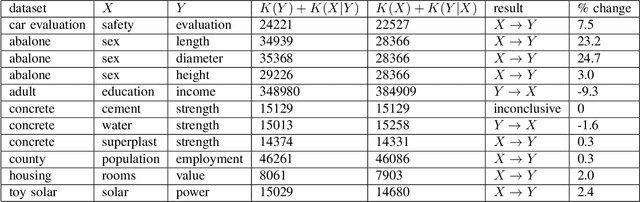
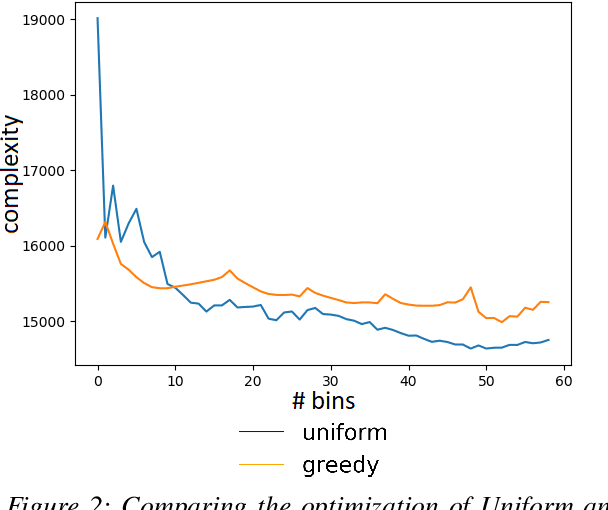
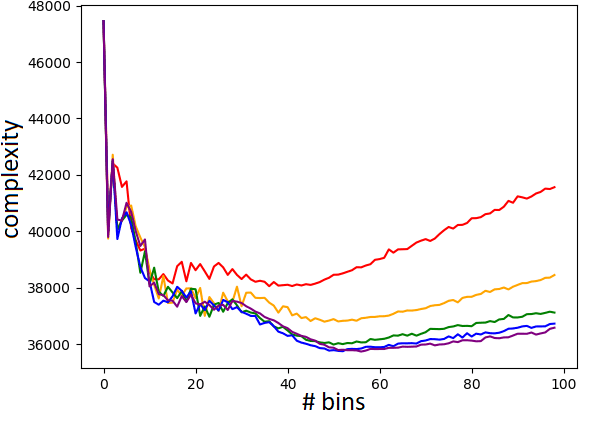
Recent developments have linked causal inference with Algorithmic Information Theory, and methods have been developed that utilize Conditional Kolmogorov Complexity to determine causation between two random variables. We present a method for inferring causal direction between continuous variables by using an MDL Binning technique for data discretization and complexity calculation. Our method captures the shape of the data and uses it to determine which variable has more information about the other. Its high predictive performance and robustness is shown on several real world use cases.