 Add to Chrome
 Add to Firefox
 Add to Edge
Generalization Guarantees on Data-Driven Tuning of Gradient Descent with Langevin Updates
Apr 13, 2026
We study learning to learn for regression problems through the lens of hyperparameter tuning. We propose the Langevin Gradient Descent Algorithm (LGD), which approximates the mean of the posterior distribution defined by the loss function and regularizer of a convex regression task. We prove the existence of an optimal hyperparameter configuration for which the LGD algorithm achieves the Bayes' optimal solution for squared loss. Subsequently, we study generalization guarantees on meta-learning optimal hyperparameters for the LGD algorithm from a given set of tasks in the data-driven setting. For a number of parameters $d$ and hyperparameter dimension $h$, we show a pseudo-dimension bound of $O(dh)$, upto logarithmic terms under mild assumptions on LGD. This matches the dimensional dependence of the bounds obtained in prior work for the elastic net, which only allows for $h=2$ hyperparameters, and extends their bounds to regression on convex loss. Finally, we show empirical evidence of the success of LGD and the meta-learning procedure for few-shot learning on linear regression using a few synthetically created datasets.

Is Pre-training Truly Better Than Meta-Learning?
Jun 24, 2023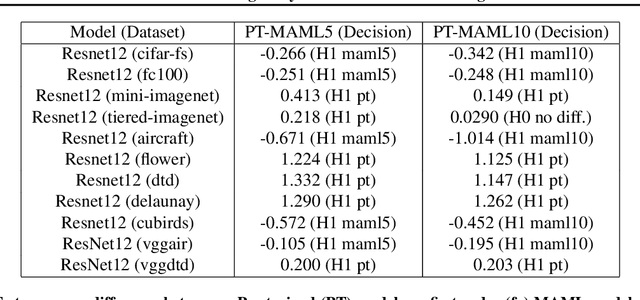
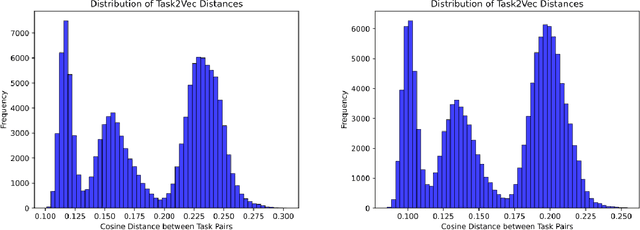
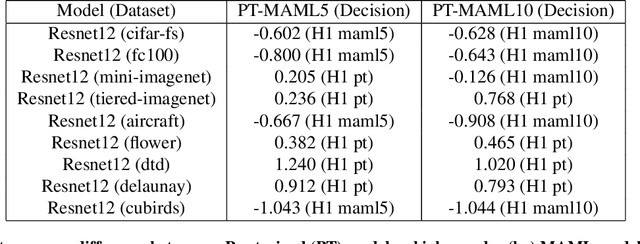
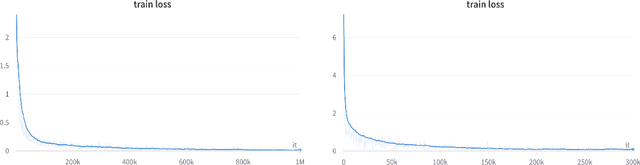
In the context of few-shot learning, it is currently believed that a fixed pre-trained (PT) model, along with fine-tuning the final layer during evaluation, outperforms standard meta-learning algorithms. We re-evaluate these claims under an in-depth empirical examination of an extensive set of formally diverse datasets and compare PT to Model Agnostic Meta-Learning (MAML). Unlike previous work, we emphasize a fair comparison by using: the same architecture, the same optimizer, and all models trained to convergence. Crucially, we use a more rigorous statistical tool -- the effect size (Cohen's d) -- to determine the practical significance of the difference between a model trained with PT vs. a MAML. We then use a previously proposed metric -- the diversity coefficient -- to compute the average formal diversity of a dataset. Using this analysis, we demonstrate the following: 1. when the formal diversity of a data set is low, PT beats MAML on average and 2. when the formal diversity is high, MAML beats PT on average. The caveat is that the magnitude of the average difference between a PT vs. MAML using the effect size is low (according to classical statistical thresholds) -- less than 0.2. Nevertheless, this observation is contrary to the currently held belief that a pre-trained model is always better than a meta-learning model. Our extensive experiments consider 21 few-shot learning benchmarks, including the large-scale few-shot learning dataset Meta-Data set. We also show no significant difference between a MAML model vs. a PT model with GPT-2 on Openwebtext. We, therefore, conclude that a pre-trained model does not always beat a meta-learned model and that the formal diversity of a dataset is a driving factor.