 Add to Chrome
 Add to Firefox
 Add to Edge
Classification of Disease from Lungs X-ray Images using VGG16, VGG19 and ResNet50 Models
Jul 29, 2026
With the increase in the number of cases related to respiratory diseases, there is an urgent need to detect them early and diagnose them accurately. Convolutional neural networks have given promising results when used for diagnosing diseases using imaging tests. In this study, we investigate the potential of applying deep learning algorithms such as VGG16, VGG19, and ResNet50 for classification of lung ailments based on X-ray images. A detailed analysis of the aforementioned models' performances was conducted to assess how well they can classify various types of lung ailments, including pneumonia, tuberculosis, lung cancer, and normal lungs. In order to do that, these deep learning models were trained on a vast amount of X-ray images. The results of our study show that while all three models provide good results, ResNet-50 performs best in comparison with other models due to its efficiency and high level of accuracy. We believe that these deep learning models can be successfully implemented in the practice of diagnosing pulmonary diseases in the future. It helps with early disease detection and improves patient outcomes.
* 15 pages, 10 figures, 3 tables, International Journal of Drug Delivery Technology (IJDDT)

Motion-Aware Reinforcement Learning For Object Localization
Jun 19, 2026We present MARLNet (Motion-Aware Reinforcement Learning Network), a PPO-based bounding-box refinement agent that incorporates a constant-velocity motion prior into the observation state and an action smoothness penalty into the reward function. The agent operates on 268-dimensional observations encoding the current proposal, a kinematic prediction, the previous action, and a 256-dimensional EfficientNet-B0 crop feature, and learns a five-dimensional policy controlling coordinate adjustments and a binary termination trigger. Evaluated on Pascal VOC 2012 and VisDrone 2019, MARLNet trains stably across all regularization strengths tested and achieves consistent gains in detection success rate at $\text{IoU} \geq 0.5$: up to $+0.011$ on VOC ($λ_\text{phys}{=}0.10$), where the motion prior prevents the overshooting that causes plain PPO to regress on this metric, and $+0.007$ on VisDrone ($λ_\text{phys}{=}0.70$), where unconstrained PPO achieves a larger gain ($+0.025$) owing to the weaker base detector. Through reward design ablations and training dynamics analysis, we identify a reward interference in which combining a constant-velocity deviation penalty with an absolute IoU term causes trigger collapse, and show that replacing it with the action smoothness penalty resolves this failure. We further characterize a representational ceiling facing crop-feature refinement agents that share a backbone with their base detector, confirmed through a global-plus-local observation ablation. Project page: https://prithviraj97.github.io/marl-net
Medical Image Analysis for Detection, Treatment and Planning of Disease using Artificial Intelligence Approaches
May 18, 2024
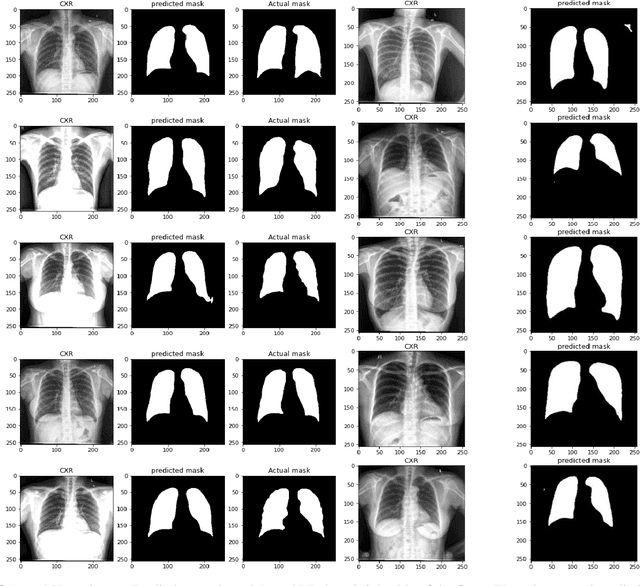
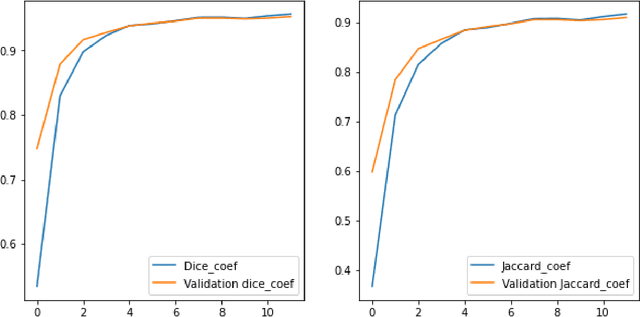
X-ray is one of the prevalent image modalities for the detection and diagnosis of the human body. X-ray provides an actual anatomical structure of an organ present with disease or absence of disease. Segmentation of disease in chest X-ray images is essential for the diagnosis and treatment. In this paper, a framework for the segmentation of X-ray images using artificial intelligence techniques has been discussed. Here data has been pre-processed and cleaned followed by segmentation using SegNet and Residual Net approaches to X-ray images. Finally, segmentation has been evaluated using well known metrics like Loss, Dice Coefficient, Jaccard Coefficient, Precision, Recall, Binary Accuracy, and Validation Accuracy. The experimental results reveal that the proposed approach performs better in all respect of well-known parameters with 16 batch size and 50 epochs. The value of validation accuracy, precision, and recall of SegNet and Residual Unet models are 0.9815, 0.9699, 0.9574, and 0.9901, 0.9864, 0.9750 respectively.
* 10 pages, 3 figures