 Add to Chrome
 Add to Firefox
 Add to Edge
Scaling Vision Language Models for Pharmaceutical Long Form Video Reasoning on Industrial GenAI Platform
Jan 08, 2026
Vision Language Models (VLMs) have shown strong performance on multimodal reasoning tasks, yet most evaluations focus on short videos and assume unconstrained computational resources. In industrial settings such as pharmaceutical content understanding, practitioners must process long-form videos under strict GPU, latency, and cost constraints, where many existing approaches fail to scale. In this work, we present an industrial GenAI framework that processes over 200,000 PDFs, 25,326 videos across eight formats (e.g., MP4, M4V, etc.), and 888 multilingual audio files in more than 20 languages. Our study makes three contributions: (i) an industrial large-scale architecture for multimodal reasoning in pharmaceutical domains; (ii) empirical analysis of over 40 VLMs on two leading benchmarks (Video-MME and MMBench) and proprietary dataset of 25,326 videos across 14 disease areas; and (iii) four findings relevant to long-form video reasoning: the role of multimodality, attention mechanism trade-offs, temporal reasoning limits, and challenges of video splitting under GPU constraints. Results show 3-8 times efficiency gains with SDPA attention on commodity GPUs, multimodality improving up to 8/12 task domains (especially length-dependent tasks), and clear bottlenecks in temporal alignment and keyframe detection across open- and closed-source VLMs. Rather than proposing a new "A+B" model, this paper characterizes practical limits, trade-offs, and failure patterns of current VLMs under realistic deployment constraints, and provide actionable guidance for both researchers and practitioners designing scalable multimodal systems for long-form video understanding in industrial domains.

Dimension vs. Precision: A Comparative Analysis of Autoencoders and Quantization for Efficient Vector Retrieval on BEIR SciFact
Nov 18, 2025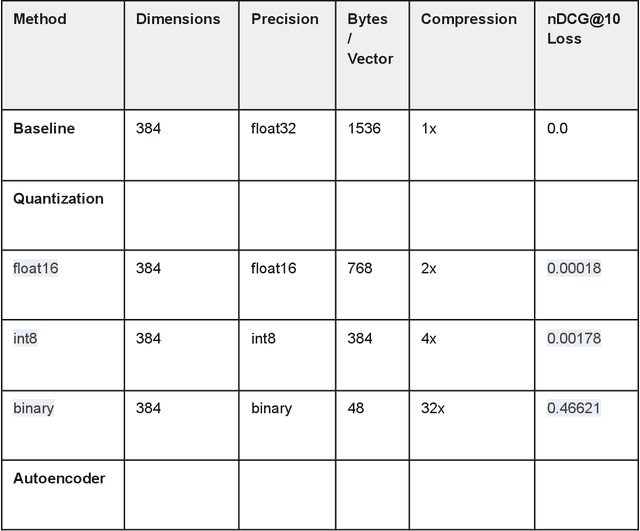
Dense retrieval models have become a standard for state-of-the-art information retrieval. However, their high-dimensional, high-precision (float32) vector embeddings create significant storage and memory challenges for real-world deployment. To address this, we conduct a rigorous empirical study on the BEIR SciFact benchmark, evaluating the trade-offs between two primary compression strategies: (1) Dimensionality Reduction via deep Autoencoders (AE), reducing original 384-dim vectors to latent spaces from 384 down to 12, and (2) Precision Reduction via Quantization (float16, int8, and binary). We systematically compare each method by measuring the "performance loss" (or gain) relative to a float32 baseline across a full suite of retrieval metrics (NDCG, MAP, MRR, Recall, Precision) at various k cutoffs. Our results show that int8 scalar quantization provides the most effective "sweet spot," achieving a 4x compression with a negligible [~1-2%] drop in nDCG@10. In contrast, Autoencoders show a graceful degradation but suffer a more significant performance loss at equivalent 4x compression ratios (AE-96). binary quantization was found to be unsuitable for this task due to catastrophic performance drops. This work provides a practical guide for deploying efficient, high-performance retrieval systems.