 Add to Chrome
 Add to Firefox
 Add to Edge
Sparse Memory Finetuning as a Low-Forgetting Alternative to LoRA and Full Finetuning
May 04, 2026
Adapting a pretrained language model to a new task often hurts the general capabilities it already had, a problem known as catastrophic forgetting. Sparse Memory Finetuning (SMF) tries to avoid this by adding key-value memory layers to the model and, on each training step, updating only the small set of memory rows that the current batch reads most heavily. We re-implement SMF on Qwen-2.5-0.5B-Instruct and compare it with LoRA and full finetuning on MedMCQA, a 4-choice medical exam task, using WikiText perplexity and TriviaQA accuracy as forgetting probes. SMF improves MedMCQA by 2.5 percentage points while keeping both forgetting probes within roughly 1 point of the base model, whereas LoRA and full finetuning achieve larger gains but with clear drift on both. We also compare two row-selection rules (KL-divergence and TF-IDF), which balance the two forgetting metrics differently.

Improving Sparse Memory Finetuning
Apr 06, 2026Large Language Models (LLMs) are typically static after training, yet real-world applications require continual adaptation to new knowledge without degrading existing capabilities. Standard approaches to updating models, like full finetuning or parameter-efficient methods (e.g., LoRA), face a fundamental trade-off: catastrophic forgetting. They modify shared dense representations, causing interference across tasks. Sparse Memory Finetuning (SMF) offers a promising alternative by localizing updates to a small subset of parameters in explicit memory layers. In this work, we present an open-source pipeline to retrofit existing pretrained models (Qwen-2.5-0.5B) with sparse memory modules, enabling effective continual learning on consumer hardware. We extend prior work by introducing a theoretically grounded slot-selection mechanism based on Kullback-Leibler (KL) divergence, which prioritizes memory updates for informationally "surprising" tokens relative to a background distribution. Our experiments demonstrate that our retrofitted models can acquire new factual knowledge with minimal forgetting of held-out capabilities, validating the sparse update hypothesis in a practical setting.
DualDiffusion: A Speculative Decoding Strategy for Masked Diffusion Models
Apr 06, 2026Masked Diffusion Models (MDMs) offer a promising alternative to autoregressive language models by enabling parallel token generation and bidirectional context modeling. However, their inference speed is significantly limited by the inability to cache key-value pairs due to bidirectional attention, requiring $O(N^2)$ computations at each generation step. While recent methods like FastDLLM and DkvCache improve inference speed through attention approximations and caching strategies, they achieve speedups at the cost of generation quality. We propose DualDiffusion, a speculative decoding framework for MDMs that combines fast drafter models (using efficient approximations) with slower, more accurate verifier models. By running multiple steps of a lightweight drafter followed by a single verification step, DualDiffusion achieves a superior Pareto frontier between generation steps and accuracy compared to existing approaches. We evaluate our method on MMLU and GSM8K, demonstrating that DualDiffusion maintains high accuracy while reducing the number of generation steps required, effectively pushing the quality-efficiency trade-off curve for masked diffusion language models.
IOLBENCH: Benchmarking LLMs on Linguistic Reasoning
Jan 08, 2025
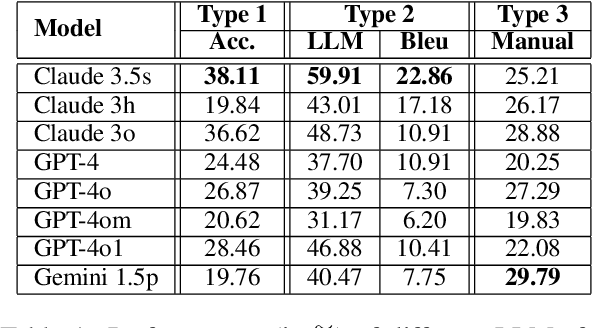
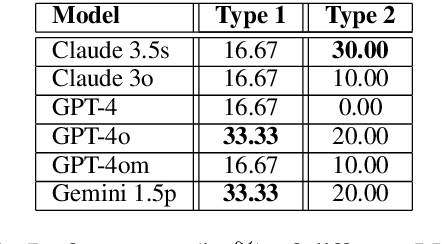
Despite the remarkable advancements and widespread applications of deep neural networks, their ability to perform reasoning tasks remains limited, particularly in domains requiring structured, abstract thought. In this paper, we investigate the linguistic reasoning capabilities of state-of-the-art large language models (LLMs) by introducing IOLBENCH, a novel benchmark derived from International Linguistics Olympiad (IOL) problems. This dataset encompasses diverse problems testing syntax, morphology, phonology, and semantics, all carefully designed to be self-contained and independent of external knowledge. These tasks challenge models to engage in metacognitive linguistic reasoning, requiring the deduction of linguistic rules and patterns from minimal examples. Through extensive benchmarking of leading LLMs, we find that even the most advanced models struggle to handle the intricacies of linguistic complexity, particularly in areas demanding compositional generalization and rule abstraction. Our analysis highlights both the strengths and persistent limitations of current models in linguistic problem-solving, offering valuable insights into their reasoning capabilities. By introducing IOLBENCH, we aim to foster further research into developing models capable of human-like reasoning, with broader implications for the fields of computational linguistics and artificial intelligence.