 Add to Chrome
 Add to Firefox
 Add to Edge
A Deep Learning Framework for Heat Demand Forecasting using Time-Frequency Representations of Decomposed Features
Mar 01, 2026
District Heating Systems are essential infrastructure for delivering heat to consumers across a geographic region sustainably, yet efficient management relies on optimizing diverse energy sources, such as wood, gas, electricity, and solar, in response to fluctuating demand. Aligning supply with demand is critical not only for ensuring reliable heat distribution but also for minimizing carbon emissions and extending infrastructure lifespan through lower operating temperatures. However, accurate multi-step forecasting to support these goals remains challenging due to complex, non-linear usage patterns and external dependencies. In this work, we propose a novel deep learning framework for day-ahead heat demand prediction that leverages time-frequency representations of historical data. By applying Continuous Wavelet Transform to decomposed demand and external meteorological factors, our approach enables Convolutional Neural Networks to learn hierarchical temporal features that are often inaccessible to standard time domain models. We systematically evaluate this method against statistical baselines, state-of-the-art Transformers, and emerging foundation models using multi-year data from three distinct Danish districts, a Danish city, and a German city. The results show a significant advancement, reducing the Mean Absolute Error by 36% to 43% compared to the strongest baselines, achieving forecasting accuracy of up to 95% across annual test datasets. Qualitative and statistical analyses further confirm the accuracy and robustness by reliably tracking volatile demand peaks where others fail. This work contributes both a high-performance forecasting architecture and critical insights into optimal feature composition, offering a validated solution for modern energy applications.

Heat Demand Forecasting with Multi-Resolutional Representation of Heterogeneous Temporal Ensemble
Oct 24, 2022One of the primal challenges faced by utility companies is ensuring efficient supply with minimal greenhouse gas emissions. The advent of smart meters and smart grids provide an unprecedented advantage in realizing an optimised supply of thermal energies through proactive techniques such as load forecasting. In this paper, we propose a forecasting framework for heat demand based on neural networks where the time series are encoded as scalograms equipped with the capacity of embedding exogenous variables such as weather, and holiday/non-holiday. Subsequently, CNNs are utilized to predict the heat load multi-step ahead. Finally, the proposed framework is compared with other state-of-the-art methods, such as SARIMAX and LSTM. The quantitative results from retrospective experiments show that the proposed framework consistently outperforms the state-of-the-art baseline method with real-world data acquired from Denmark. A minimal mean error of 7.54% for MAPE and 417kW for RMSE is achieved with the proposed framework in comparison to all other methods.
Prediction of Household-level Heat-Consumption using PSO enhanced SVR Model
Dec 03, 2021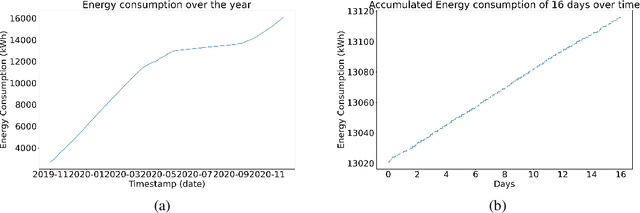
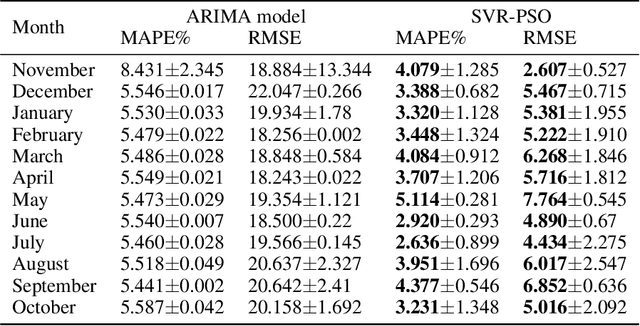
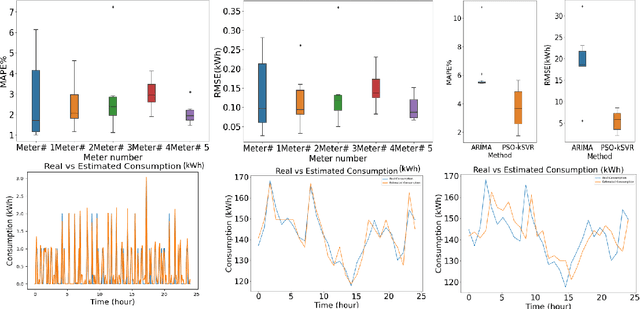
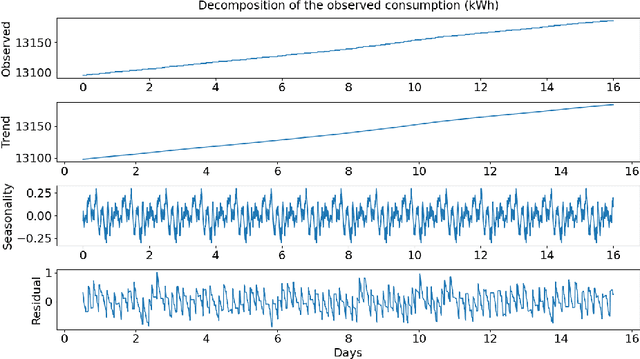
In combating climate change, an effective demand-based energy supply operation of the district energy system (DES) for heating or cooling is indispensable. As a consequence, an accurate forecast of heat consumption on the consumer side poses an important first step towards an optimal energy supply. However, due to the non-linearity and non-stationarity of heat consumption data, the prediction of the thermal energy demand of DES remains challenging. In this work, we propose a forecasting framework for thermal energy consumption within a district heating system (DHS) based on kernel Support Vector Regression (kSVR) using real-world smart meter data. Particle Swarm Optimization (PSO) is employed to find the optimal hyper-parameter for the kSVR model which leads to the superiority of the proposed methods when compared to a state-of-the-art ARIMA model. The average MAPE is reduced to 2.07% and 2.64% for the individual meter-specific forecasting and for forecasting of societal consumption, respectively.