 Add to Chrome
 Add to Firefox
 Add to Edge
Exploring Student Perception on Gen AI Adoption in Higher Education: A Descriptive Study
Mar 29, 2026
The rapid proliferation of Generative Artificial Intelligence (GenAI) is reshaping pedagogical practices and assessment models in higher education. While institutional and educator perspectives on GenAI integration are increasingly documented, the student perspective remains comparatively underexplored. This study examines how students perceive, use, and evaluate GenAI within their academic practices, focusing on usage patterns, perceived benefits, and expectations for institutional support. Data were collected through a questionnaire administered to 436 postgraduate Computer Science students at the University of Hertfordshire and analysed using descriptive methods. The findings reveal a Confidence-Competence Paradox: although more than 60% of students report high familiarity with tools such as ChatGPT, daily academic use remains limited and confidence in effective application is only moderate. Students primarily employ GenAI for cognitive scaffolding tasks, including concept clarification and brainstorming, rather than fully automated content generation. At the same time, respondents express concerns regarding data privacy, reliability of AI-generated information, and the potential erosion of critical thinking skills. The results also indicate strong student support for integrating AI literacy into curricula and programme Knowledge, Skills, and Behaviours (KSBs). Overall, the study suggests that universities should move beyond a policing approach to GenAI and adopt a pedagogical framework that emphasises AI literacy, ethical guidance, and equitable access to AI tools.

TinBiNN: Tiny Binarized Neural Network Overlay in about 5,000 4-LUTs and 5mW
Mar 05, 2019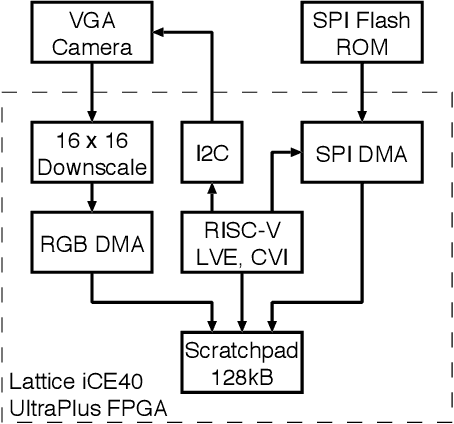
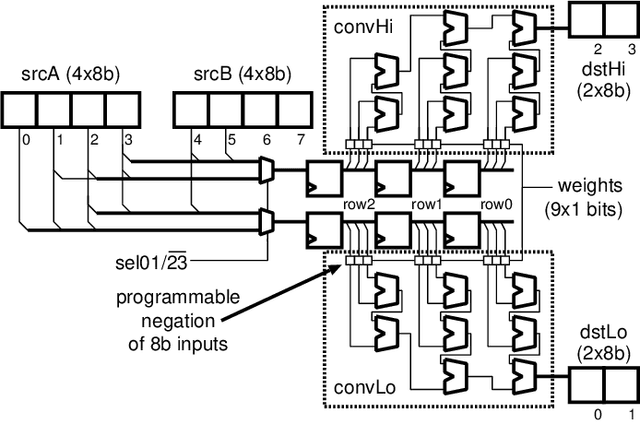

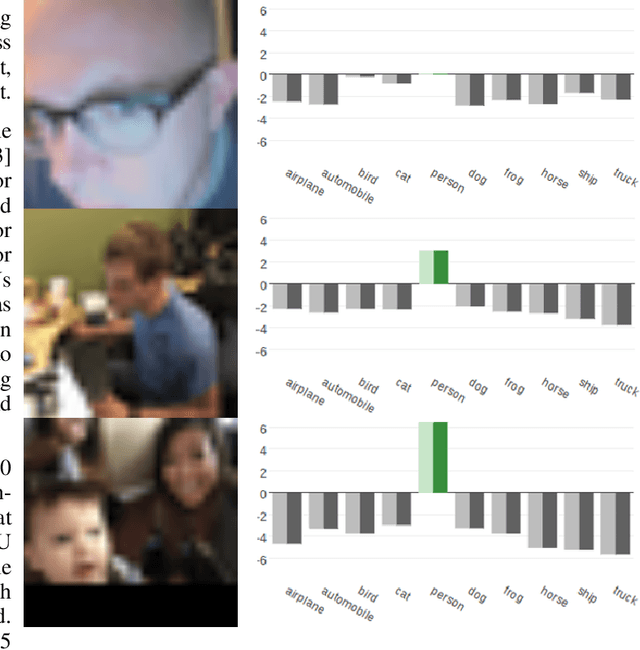
Reduced-precision arithmetic improves the size, cost, power and performance of neural networks in digital logic. In convolutional neural networks, the use of 1b weights can achieve state-of-the-art error rates while eliminating multiplication, reducing storage and improving power efficiency. The BinaryConnect binary-weighted system, for example, achieves 9.9% error using floating-point activations on the CIFAR-10 dataset. In this paper, we introduce TinBiNN, a lightweight vector processor overlay for accelerating inference computations with 1b weights and 8b activations. The overlay is very small -- it uses about 5,000 4-input LUTs and fits into a low cost iCE40 UltraPlus FPGA from Lattice Semiconductor. To show this can be useful, we build two embedded 'person detector' systems by shrinking the original BinaryConnect network. The first is a 10-category classifier with a 89% smaller network that runs in 1,315ms and achieves 13.6% error. The other is a 1-category classifier that is even smaller, runs in 195ms, and has only 0.4% error. In both classifiers, the error can be attributed entirely to training and not reduced precision.