 Add to Chrome
 Add to Firefox
 Add to Edge
Periodic Event-Triggered Explicit Reference Governor for Constrained Attitude Control on SO(3)
Apr 05, 2026
This letter addresses the constrained attitude control problem for rigid bodies directly on the special orthogonal group SO(3), avoiding singularities associated with parameterizations such as Euler angles. We propose a novel Periodic Event-Triggered Explicit Reference Governor (PET-ERG) that enforces input saturation and geometric pointing constraints without relying on online optimization. A key feature is a periodic event-triggered supervisory update: the auxiliary reference is updated only at sampled instants when a robust safety condition is met, thereby avoiding continuous-time reference updates and enabling a rigorous stability analysis of the cascade system on the manifold. Through this structured approach, we rigorously establish the asymptotic stability and exponential convergence of the closed-loop system for almost all initial configurations. Numerical simulations validate the effectiveness of the proposed control architecture and demonstrate constraint satisfaction and convergence properties.

Optimization-Free Constrained Control with Guaranteed Recursive Feasibility: A CBF-Based Reference Governor Approach
Apr 05, 2026This letter presents a constrained control framework that integrates Explicit Reference Governors (ERG) with Control Barrier Functions (CBF) to ensure recursive feasibility without online optimization. We formulate the reference update as a virtual control input for an augmented system, governed by a smooth barrier function constructed from the softmin aggregation of Dynamic Safety Margins (DSMs). Unlike standard CBF formulations, the proposed method guarantees the feasibility of safety constraints by design, exploiting the forward invariance properties of the underlying Lyapunov level sets. This allows for the derivation of an explicit, closed-form reference update law that strictly enforces safety while minimizing deviation from a nominal reference trajectory. Theoretical results confirm asymptotic convergence, and numerical simulations demonstrate that the proposed method achieves performance comparable to traditional ERG frameworks.
Ground and Flight Locomotion for Two-Wheeled Drones via Model Predictive Path Integral Control
Mar 20, 2025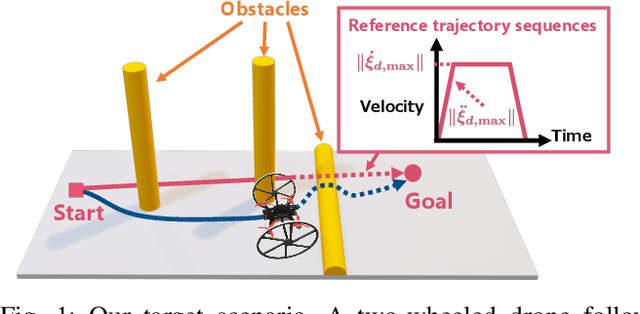
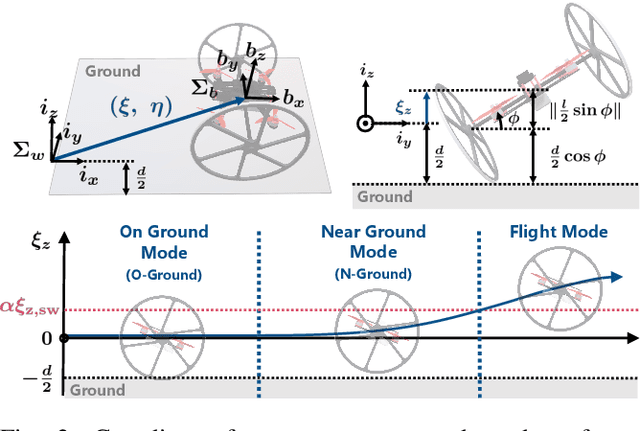
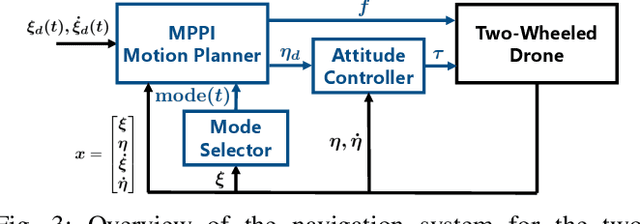
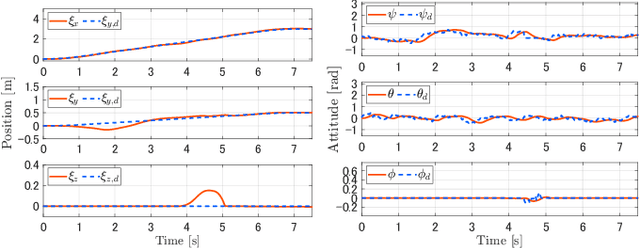
This paper presents a novel approach to motion planning for two-wheeled drones that can drive on the ground and fly in the air. Conventional methods for two-wheeled drone motion planning typically rely on gradient-based optimization and assume that obstacle shapes can be approximated by a differentiable form. To overcome this limitation, we propose a motion planning method based on Model Predictive Path Integral (MPPI) control, enabling navigation through arbitrarily shaped obstacles by switching between driving and flight modes. To handle the instability and rapid solution changes caused by mode switching, our proposed method switches the control space and utilizes the auxiliary controller for MPPI. Our simulation results demonstrate that the proposed method enables navigation in unstructured environments and achieves effective obstacle avoidance through mode switching.