 Add to Chrome
 Add to Firefox
 Add to Edge
PL-Guard: Probabilistic Logic Reasoning for LLM Guardrails
Aug 16, 2026
Large language model guardrails can be viewed as policy-consistency problems: a system must determine which policy-relevant facts hold in a prompt-response pair and what those facts imply under a given policy. Common approaches, including policy prompting and LLM-as-a-judge pipelines, often overlap the tasks of semantic grounding and policy reasoning: the model both interprets the prompt-response pair and reasons about whether a policy has been violated. This can lead to unsafe compliance with harmful prompts, or refusals to assist benign ones. To separate grounding and reasoning roles, we propose PL-Guard, a neurosymbolic guardrail architecture. Using a symbolic policy interface consisting of predicates and ProbLog rules, a local LLM grounds prompt-response pairs into predicate probabilities using renormalized True/False token scores, while ProbLog performs explicit probabilistic rule inference over the symbolic policy. On the XSTest benchmark, an offline Qwen-based evaluator finds that PL-Guard with a hand-curated policy reduces unsafe compliance from 22.0% for the base model to 0.5%, and below the 6.0% rate of an LLM-as-a-judge baseline. This comes at the cost of higher over-refusal than the LLM-as-a-judge baseline, 14.4% versus 5.2%. These results suggest that separating neural grounding from probabilistic symbolic reasoning can expose the safety-helpfulness tradeoff while making the guardrail's intermediate reasoning steps explicit and auditable.

Think Smart, Act SMARL! Analyzing Probabilistic Logic Driven Safety in Multi-Agent Reinforcement Learning
Nov 07, 2024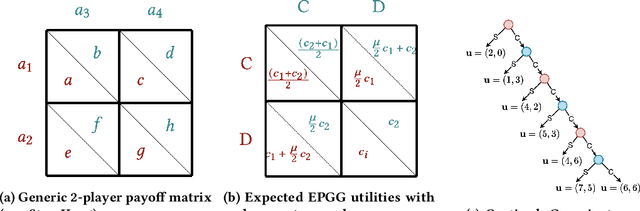
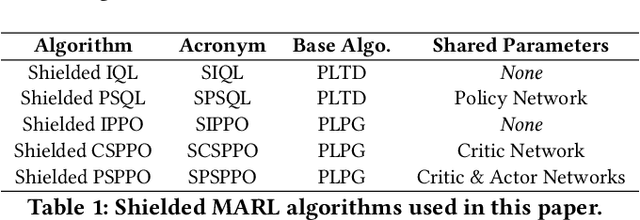
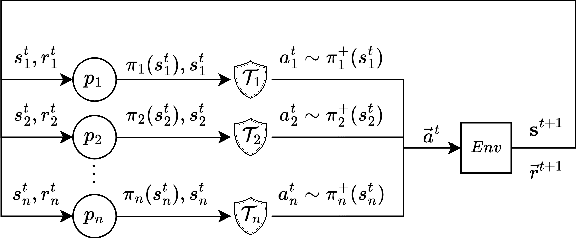
An important challenge for enabling the deployment of reinforcement learning (RL) algorithms in the real world is safety. This has resulted in the recent research field of Safe RL, which aims to learn optimal policies that are safe. One successful approach in that direction is probabilistic logic shields (PLS), a model-based Safe RL technique that uses formal specifications based on probabilistic logic programming, constraining an agent's policy to comply with those specifications in a probabilistic sense. However, safety is inherently a multi-agent concept, since real-world environments often involve multiple agents interacting simultaneously, leading to a complex system which is hard to control. Moreover, safe multi-agent RL (Safe MARL) is still underexplored. In order to address this gap, in this paper we ($i$) introduce Shielded MARL (SMARL) by extending PLS to MARL -- in particular, we introduce Probabilistic Logic Temporal Difference Learning (PLTD) to enable shielded independent Q-learning (SIQL), and introduce shielded independent PPO (SIPPO) using probabilistic logic policy gradients; ($ii$) show its positive effect and use as an equilibrium selection mechanism in various game-theoretic environments including two-player simultaneous games, extensive-form games, stochastic games, and some grid-world extensions in terms of safety, cooperation, and alignment with normative behaviors; and ($iii$) look into the asymmetric case where only one agent is shielded, and show that the shielded agent has a significant influence on the unshielded one, providing further evidence of SMARL's ability to enhance safety and cooperation in diverse multi-agent environments.