 Add to Chrome
 Add to Firefox
 Add to Edge
Investigating the impact of stereo processing -- a study for extending the Open Dataset of Audio Quality (ODAQ)
Dec 16, 2025
In this paper, we present an initial study for extending Open Dataset of Audio Quality (ODAQ) towards the impact of stereo processing. Monaural artifacts from ODAQ were adapted in combinations with left-right (LR) and mid-side (MS) stereo processing, across stimuli including solo instruments, typical wide stereo mixes and and hard-panned mixes. Listening tests in different presentation context -- with and without direct comparison of MS and LR conditions -- were conducted to collect subjective data beyond monaural artifacts while also scrutinizing the listening test methodology. The ODAQ dataset is extended with new material along with subjective scores from 16 expert listeners. The listening test results show substantial influences of the stimuli's spatial characteristics as well as the presentation context. Notably, several significant disparities between LR and MS only occur when presented in direct comparison. The findings suggest that listeners primarily assess timbral impairments when spatial characteristics are consistent and focus on stereo image only when timbral quality is similar. The rating of an additional mono anchor was overall consistent across different stereo characteristics, averaging at 65 on the MUSHRA scale, further corroborating that listeners prioritize timbral over spatial impressions.

Exploring Perceptual Audio Quality Measurement on Stereo Processing Using the Open Dataset of Audio Quality
Dec 11, 2025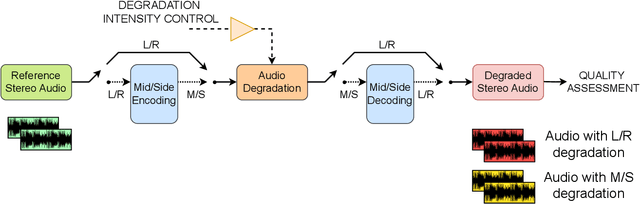
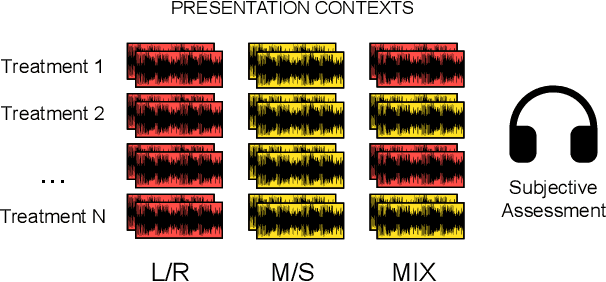
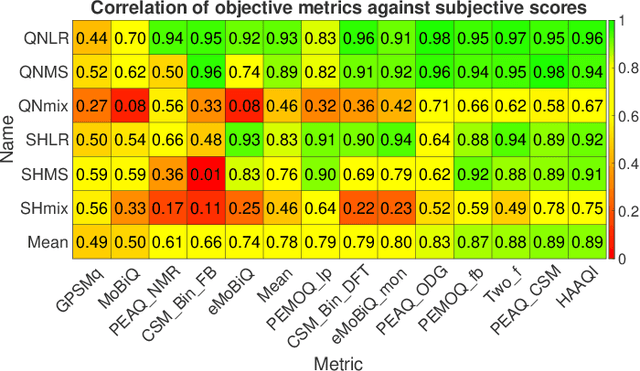
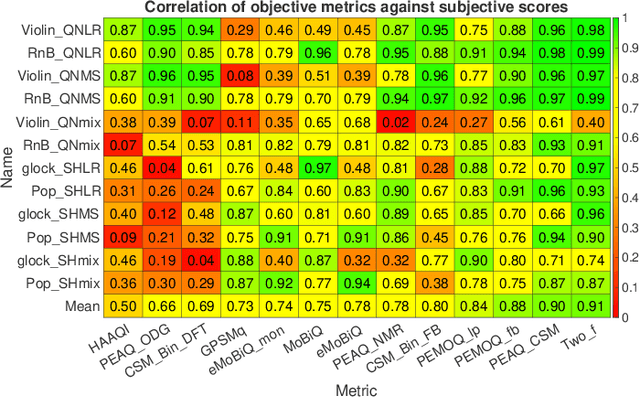
ODAQ (Open Dataset of Audio Quality) provides a comprehensive framework for exploring both monaural and binaural audio quality degradations across a range of distortion classes and signals, accompanied by subjective quality ratings. A recent update of ODAQ, focusing on the impact of stereo processing methods such as Mid/Side (MS) and Left/Right (LR), provides test signals and subjective ratings for the in-depth investigation of state-of-the-art objective audio quality metrics. Our evaluation results suggest that, while timbre-focused metrics often yield robust results under simpler conditions, their prediction performance tends to suffer under the conditions with a more complex presentation context. Our findings underscore the importance of modeling the interplay of bottom-up psychoacoustic processes and top-down contextual factors, guiding future research toward models that more effectively integrate both timbral and spatial dimensions of perceived audio quality.
Expanding and Analyzing ODAQ -- the Open Dataset of Audio Quality
Apr 01, 2025
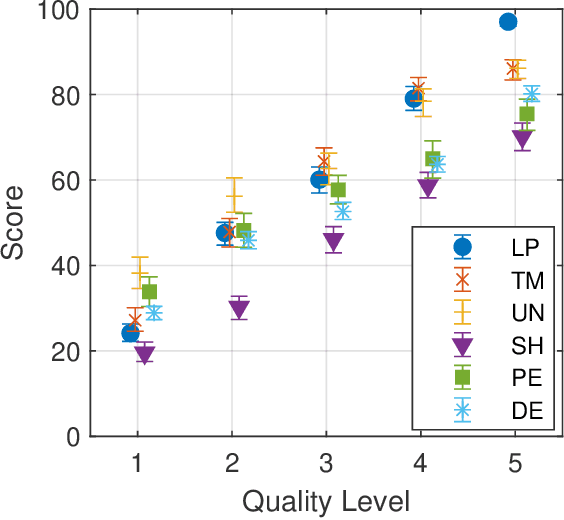
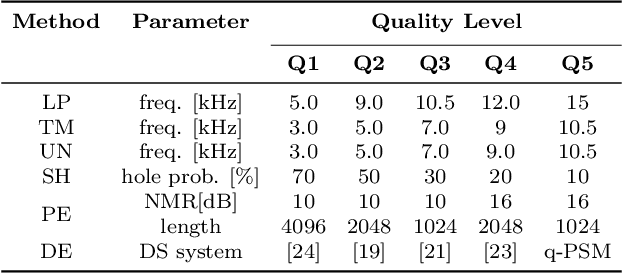
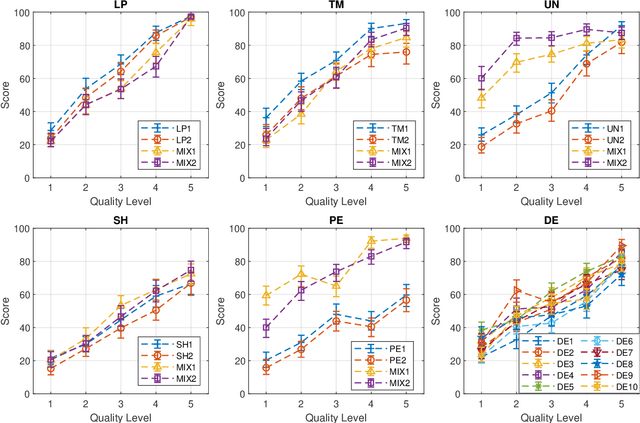
The Open Dataset of Audio Quality (ODAQ) was recently introduced to address the scarcity of openly available audio datasets with corresponding subjective quality scores. The dataset, released under permissive licenses, comprises audio material processed using six different signal processing methods operating at five quality levels, along with corresponding subjective test results. To expand the dataset, we provided listener training to university students to conduct further subjective tests and obtained results consistent with previous expert listeners. We also showed how different training approaches affect the use of absolute scales and anchors. The expanded dataset now comprises results from three international laboratories providing a total of 42 listeners and 10080 subjective scores. This paper provides the details of the expansion and an in-depth analysis. As part of this analysis, we initiate the use of ODAQ as a benchmark to evaluate objective audio quality metrics in their ability to predict subjective scores
ODAQ: Open Dataset of Audio Quality
Dec 30, 2023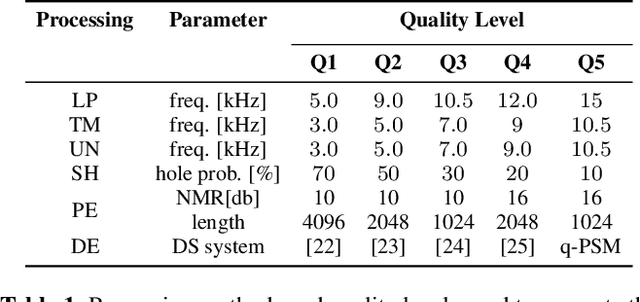
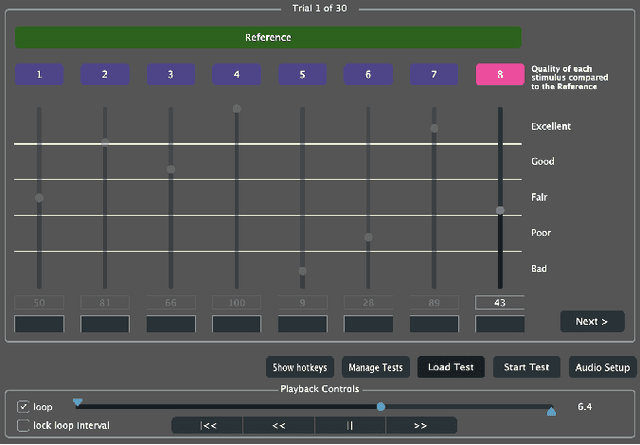
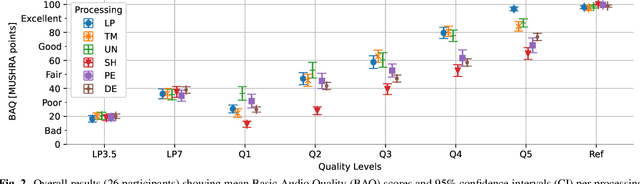
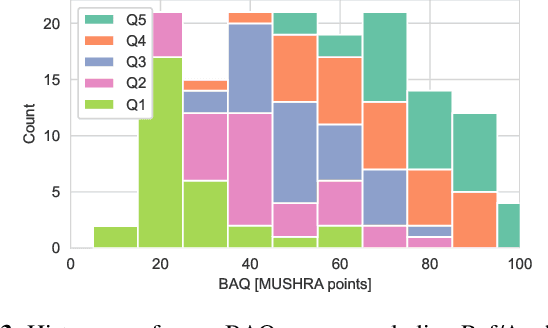
Research into the prediction and analysis of perceived audio quality is hampered by the scarcity of openly available datasets of audio signals accompanied by corresponding subjective quality scores. To address this problem, we present the Open Dataset of Audio Quality (ODAQ), a new dataset containing the results of a MUSHRA listening test conducted with expert listeners from 2 international laboratories. ODAQ contains 240 audio samples and corresponding quality scores. Each audio sample is rated by 26 listeners. The audio samples are stereo audio signals sampled at 44.1 or 48 kHz and are processed by a total of 6 method classes, each operating at different quality levels. The processing method classes are designed to generate quality degradations possibly encountered during audio coding and source separation, and the quality levels for each method class span the entire quality range. The diversity of the processing methods, the large span of quality levels, the high sampling frequency, and the pool of international listeners make ODAQ particularly suited for further research into subjective and objective audio quality. The dataset is released with permissive licenses, and the software used to conduct the listening test is also made publicly available.