 Add to Chrome
 Add to Firefox
 Add to Edge
FOXGLOVE: Understanding Goal-Oriented and Anchored Writing Feedback from Experts and LLMs on Argumentative Essays
Jun 04, 2026
While large language models (LLMs) are increasingly used to generate writing feedback, there remains no systematic comparison of LLM and expert feedback on the dimensions that writing research identifies as central to revision: goal-orientation, anchoring to specific sentences, and prioritization. We introduce FOXGLOVE, a dataset of 696 feedback comments written by trained writing instructors on 69 twelfth-grade argumentative essays, paired with 1,644 comments generated from four frontier LLMs under a shared protocol, totaling 2,340 comments. We provide expert quality ratings on a subset of both instructor and LLM comments. We find that instructors and LLMs distribute feedback similarly across goals and essay positions, yet instructors and models diverge on the specific sentences on which to provide feedback. Additionally, we find that models tend to write more complex feedback and use fewer questions than instructors. LLM feedback also receives higher ratings on most dimensions of quality, as rated by instructors, but much of this advantage appears to be attributable to lengthier comments. FOXGLOVE enables systematic comparison of where human and LLM feedback align, diverge, and differ.

Creative Reading: Scaffolding Reading for Transformation
Jun 03, 2026Reading augmentation systems increasingly help readers process text at scale. While these tools address real constraints of time and cognitive load, they often implicitly frame reading as information transmission, or "reading to discard," delegating interpretation and effort to the machine. Yet this delegation changes the outcome of reading. For example, in scholarly reading, deciding what a research text implies and why it matters is central to the work of scholarly production. We propose creative reading as an alternative goal: reading augmentation that supports readers in creating both readings and themselves as readers. By putting literary and narrative theories into conversation with scholarly sensemaking and creativity support, we present a provocation-oriented design space for valuing the process of reading as a way of preserving a plurality of readings and transforming readers over time.
A Design Space for Intelligent and Interactive Writing Assistants
Mar 26, 2024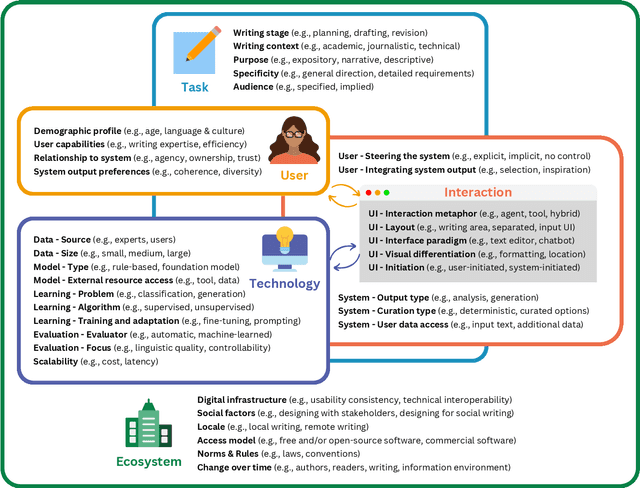
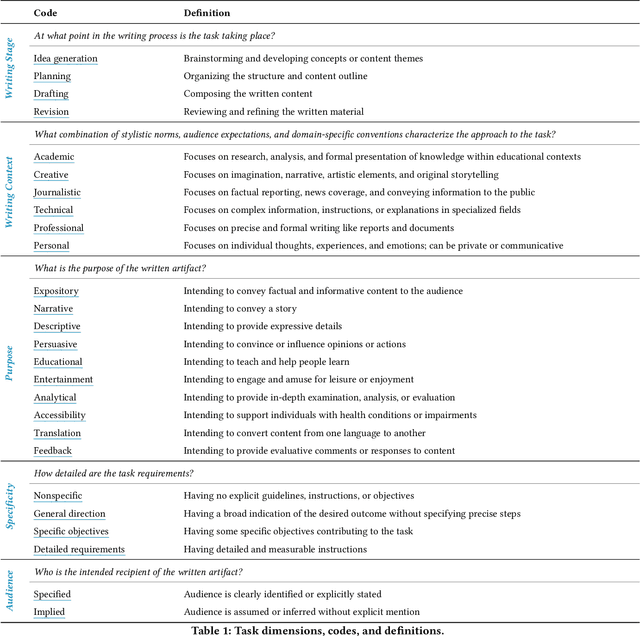
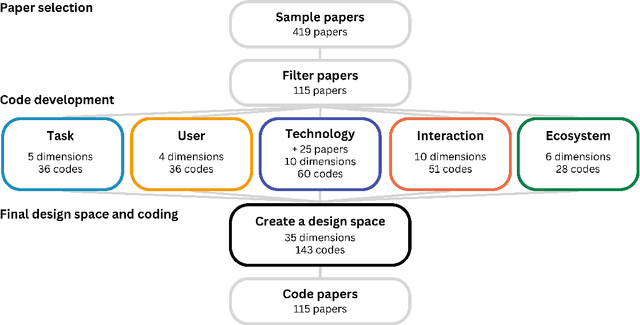

In our era of rapid technological advancement, the research landscape for writing assistants has become increasingly fragmented across various research communities. We seek to address this challenge by proposing a design space as a structured way to examine and explore the multidimensional space of intelligent and interactive writing assistants. Through a large community collaboration, we explore five aspects of writing assistants: task, user, technology, interaction, and ecosystem. Within each aspect, we define dimensions (i.e., fundamental components of an aspect) and codes (i.e., potential options for each dimension) by systematically reviewing 115 papers. Our design space aims to offer researchers and designers a practical tool to navigate, comprehend, and compare the various possibilities of writing assistants, and aid in the envisioning and design of new writing assistants.