 Add to Chrome
 Add to Firefox
 Add to Edge
Multi-FRuGaL: Multimodal Flexible Redundancy-aware Decomposed Gated Learning for Cancer Diagnosis and Prognosis
Jun 05, 2026
Modern medicine relies on heterogeneous data sources spanning radiology, pathology, text reports, and structured clinical information. However, real-world patient data are frequently incomplete, with missing or sparsely acquired modalities, limiting the effectiveness of standard multimodal fusion approaches. To this end, we propose the Multimodal Flexible Redundancy-aware decomposed GAted Learning (Multi-FRuGaL) framework, a decomposition-aware, adaptive gated intermediate-fusion framework that performs modality-level representation learning under missing data. Multi-FRuGaL integrates per-modality encoders with a signal decomposition layer, an input-conditioned gating network, and an information-aware fusion objective to separate redundant from modality-specific complementary signals, selectively upweighting informative modalities and suppressing redundant or noisy inputs, and remaining well-defined even when multiple modalities are absent. We evaluate Multi-FRuGaL on two multimodal head and neck cancer cohorts: the HANCOCK challenge dataset (N = 763) comprising five modalities and two prognostic endpoints (5-year survival and 2-year recurrence), and the HECKTOR challenge dataset (N = 588) comprising three modalities for human papillomavirus (HPV) status classification. Multi-FRuGaL consistently achieves higher mean performance than the evaluated baselines across multiple tasks, improving AUC from 0.601 to 0.8496 for survival, from 0.672 to 0.8102 for recurrence, and achieving 0.975 AUC for HPV prediction on HECKTOR. For survival analysis, it further achieves a concordance index of 0.6814 for overall survival, 0.7421 for recurrence-free survival, and 0.7143 for progression-free survival on HANCOCK, and 0.7203 for recurrence-free survival on HECKTOR. Qualitative analyses further show that Multi-FRuGaL learns discriminative and robust multimodal representations, even under severe missing-modality conditions.

Classifying Histopathologic Glioblastoma Sub-regions with EfficientNet
Nov 12, 2025Glioblastoma (GBM) is the most common aggressive, fast-growing brain tumor, with a grim prognosis. Despite clinical diagnostic advancements, there have not been any substantial improvements to patient prognosis. Histopathological assessment of excised tumors is the first line of clinical diagnostic routine. We hypothesize that automated, robust, and accurate identification of distinct histological sub-regions within GBM could contribute to morphologically understanding this disease at scale. In this study, we designed a four-step deep learning approach to classify six (6) histopathological regions and quantitatively evaluated it on the BraTS-Path 2024 challenge dataset, which includes digitized Hematoxylin \& Eosin (H\&E) stained GBM tissue sections annotated for six distinct regions. We used the challenge's publicly available training dataset to develop and evaluate the effectiveness of several variants of EfficientNet architectures (i.e., B0, B1, B2, B3, B4). EfficientNet-B1 and EfficientNet-B4 achieved the best performance, achieving an F1 score of 0.98 in a 5-fold cross-validation configuration using the BraTS-Path training set. The quantitative performance evaluation of our proposed approach with EfficientNet-B1 on the BraTS-Path hold-out validation data and the final hidden testing data yielded F1 scores of 0.546 and 0.517, respectively, for the associated 6-class classification task. The difference in the performance on training, validation, and testing data highlights the challenge of developing models that generalize well to new data, which is crucial for clinical applications. The source code of the proposed approach can be found at the GitHub repository of Indiana University Division of Computational Pathology: https://github.com/IUCompPath/brats-path-2024-enet.
Biochemical Prostate Cancer Recurrence Prediction: Thinking Fast & Slow
Sep 03, 2024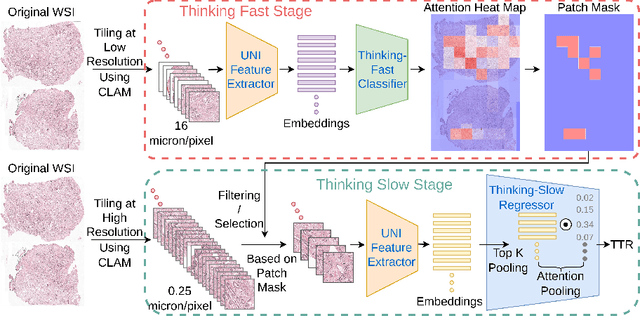
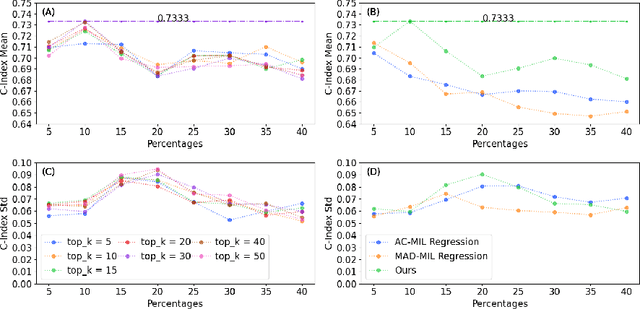
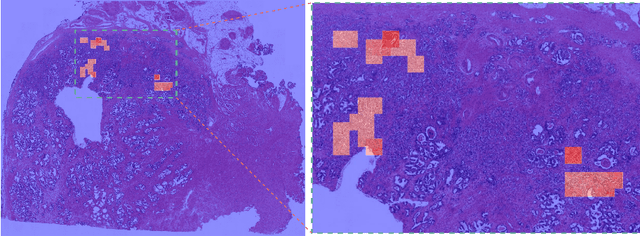
Time to biochemical recurrence in prostate cancer is essential for prognostic monitoring of the progression of patients after prostatectomy, which assesses the efficacy of the surgery. In this work, we proposed to leverage multiple instance learning through a two-stage ``thinking fast \& slow'' strategy for the time to recurrence (TTR) prediction. The first (``thinking fast'') stage finds the most relevant WSI area for biochemical recurrence and the second (``thinking slow'') stage leverages higher resolution patches to predict TTR. Our approach reveals a mean C-index ($Ci$) of 0.733 ($\theta=0.059$) on our internal validation and $Ci=0.603$ on the LEOPARD challenge validation set. Post hoc attention visualization shows that the most attentive area contributes to the TTR prediction.