 Add to Chrome
 Add to Firefox
 Add to Edge
Ordered-to-disordered transfer learning with graph neural networks for formation-energy and HOMO-LUMO gap prediction in high-entropy perovskite oxides
Jul 31, 2026
High-entropy perovskite oxides (HEPOs) represent a chemically complex class of materials with promising functional properties, yet their vast compositional space and, chemical/structural disorder pose significant challenge for accurate property prediction. Graph neural networks (GNNs) enable rapid exploration of materials space but are often limited by the availability of representative training data. Here, we investigate ordered-to-disordered transfer learning using GNNs for formation-energy and HOMO-LUMO gap prediction in HEPOs by transferring knowledge learned from chemically ordered perovskites. Four representative GNN models, including CGCNN, GATGNN, ALIGNN and M3GNet are evaluated to understand the role of structural representations, spanning pairwise two-body and angular three-body interactions in transfer performance. We find strong property-dependent transfer behavior: formation-energy prediction transfers effectively to disordered HEPOs, whereas HOMO-LUMO gap prediction shows limited transferability due to its sensitivity to local chemical environments. Incorporating a small HEPO-specific training dataset substantially improves HOMO-LUMO gap prediction. Representation-level analysis using UMAP further highlights the importance of encoding three-body geometric information such as in ALIGNN for capturing complex structure-property relationships and improving transferability.

Importance of feature engineering and database selection in a machine learning model: A case study on carbon crystal structures
Jan 30, 2021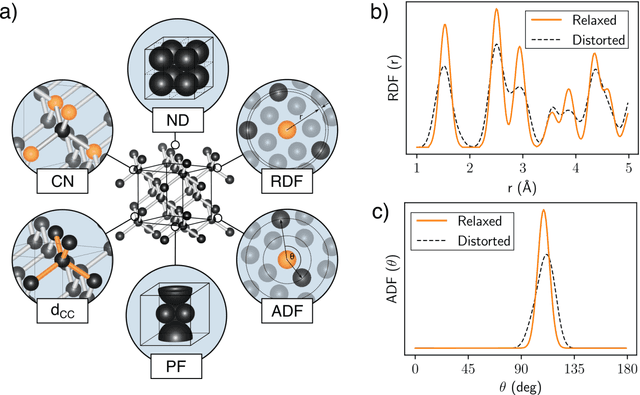
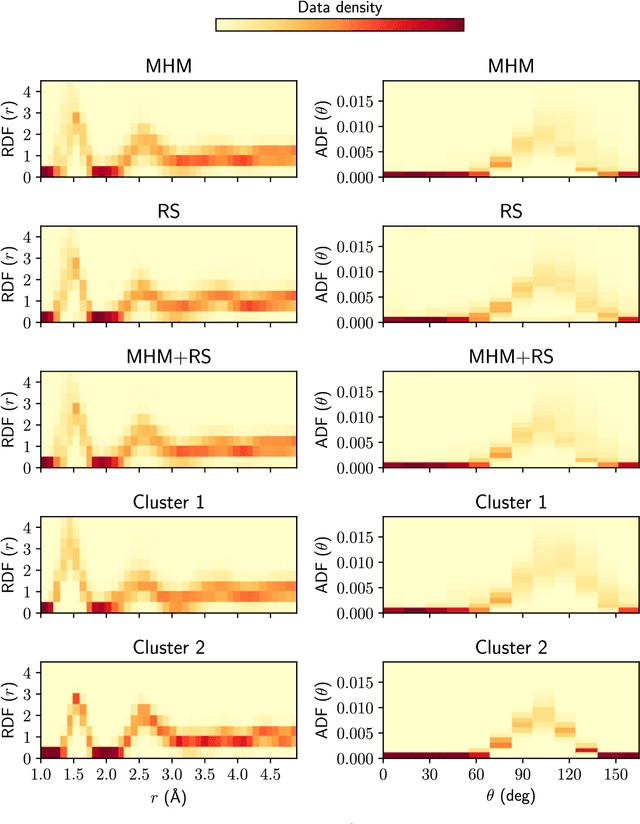
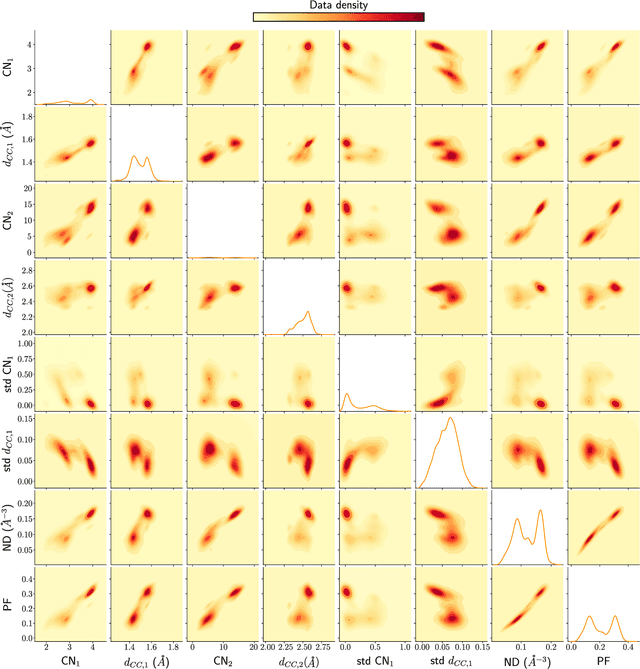
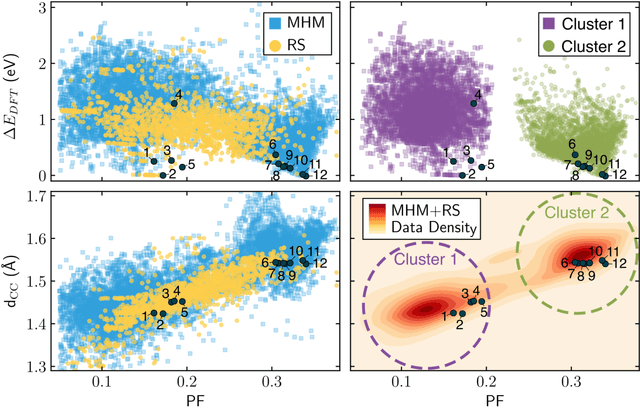
Drive towards improved performance of machine learning models has led to the creation of complex features representing a database of condensed matter systems. The complex features, however, do not offer an intuitive explanation on which physical attributes do improve the performance. The effect of the database on the performance of the trained model is often neglected. In this work we seek to understand in depth the effect that the choice of features and the properties of the database have on a machine learning application. In our experiments, we consider the complex phase space of carbon as a test case, for which we use a set of simple, human understandable and cheaply computable features for the aim of predicting the total energy of the crystal structure. Our study shows that (i) the performance of the machine learning model varies depending on the set of features and the database, (ii) is not transferable to every structure in the phase space and (iii) depends on how well structures are represented in the database.