 Add to Chrome
 Add to Firefox
 Add to Edge
Decoding Fake Narratives in Spreading Hateful Stories: A Dual-Head RoBERTa Model with Multi-Task Learning
Dec 18, 2025
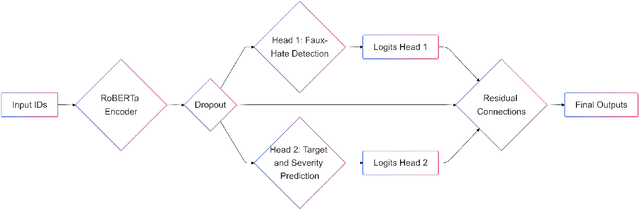
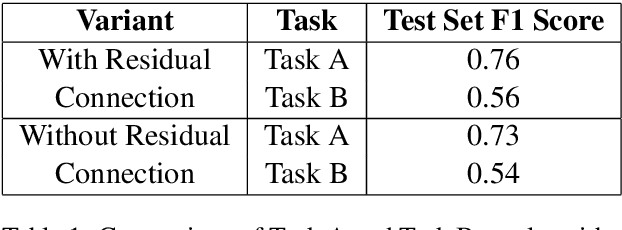
Social media platforms, while enabling global connectivity, have become hubs for the rapid spread of harmful content, including hate speech and fake narratives \cite{davidson2017automated, shu2017fake}. The Faux-Hate shared task focuses on detecting a specific phenomenon: the generation of hate speech driven by fake narratives, termed Faux-Hate. Participants are challenged to identify such instances in code-mixed Hindi-English social media text. This paper describes our system developed for the shared task, addressing two primary sub-tasks: (a) Binary Faux-Hate detection, involving fake and hate speech classification, and (b) Target and Severity prediction, categorizing the intended target and severity of hateful content. Our approach combines advanced natural language processing techniques with domain-specific pretraining to enhance performance across both tasks. The system achieved competitive results, demonstrating the efficacy of leveraging multi-task learning for this complex problem.
* Accepted Paper, Anthology ID: 2024.icon-fauxhate.3, 4 pages, 1 figure, 1 table

Fine-tuning Pre-trained Named Entity Recognition Models For Indian Languages
May 08, 2024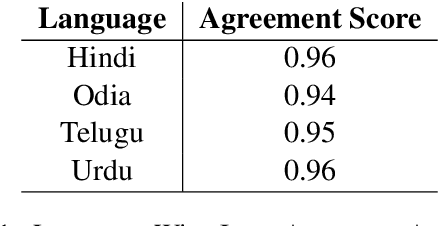
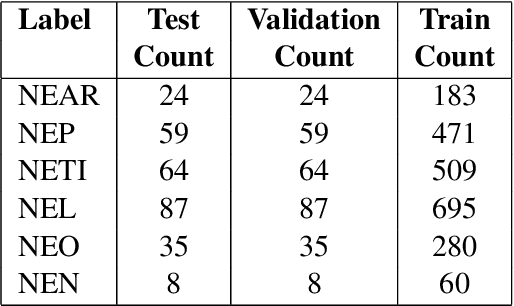
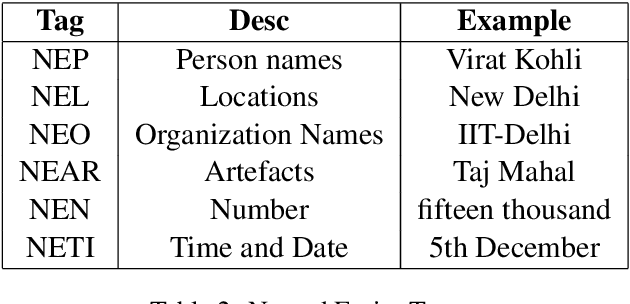
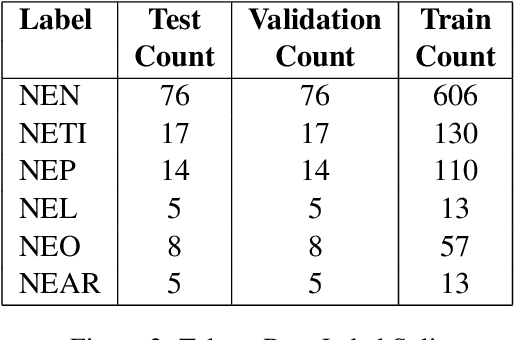
Named Entity Recognition (NER) is a useful component in Natural Language Processing (NLP) applications. It is used in various tasks such as Machine Translation, Summarization, Information Retrieval, and Question-Answering systems. The research on NER is centered around English and some other major languages, whereas limited attention has been given to Indian languages. We analyze the challenges and propose techniques that can be tailored for Multilingual Named Entity Recognition for Indian Languages. We present a human annotated named entity corpora of 40K sentences for 4 Indian languages from two of the major Indian language families. Additionally,we present a multilingual model fine-tuned on our dataset, which achieves an F1 score of 0.80 on our dataset on average. We achieve comparable performance on completely unseen benchmark datasets for Indian languages which affirms the usability of our model.