 Add to Chrome
 Add to Firefox
 Add to Edge
Parameter Efficient Fine-tuning for Domain-specific Gastrointestinal Disease Recognition
Apr 12, 2026
Despite recent advancements in the field of medical image analysis with the use of pretrained foundation models, the issue of distribution shifts between cross-source images largely remains adamant. To circumvent that issue, investigators generally train a separate model for each source. However, this method becomes expensive when we fully fine-tune pretrained large models for a single dataset, as we must store multiple copies of those models. Thus, in this work, we propose using a low-rank adaptation (LoRA) module for fine-tuning downstream classification tasks. LoRAs learn lightweight task-specific low-rank matrices that perturb pretrained weights to optimize those downstream tasks. For gastrointestinal tract diseases, they exhibit significantly better results than end-to-end finetuning with improved parameter efficiency. Code is available at: github.com/sanjay931/peft-gi-recognition.

Feature Selection and Regularization in Multi-Class Classification: An Empirical Study of One-vs-Rest Logistic Regression with Gradient Descent Optimization and L1 Sparsity Constraints
Oct 16, 2025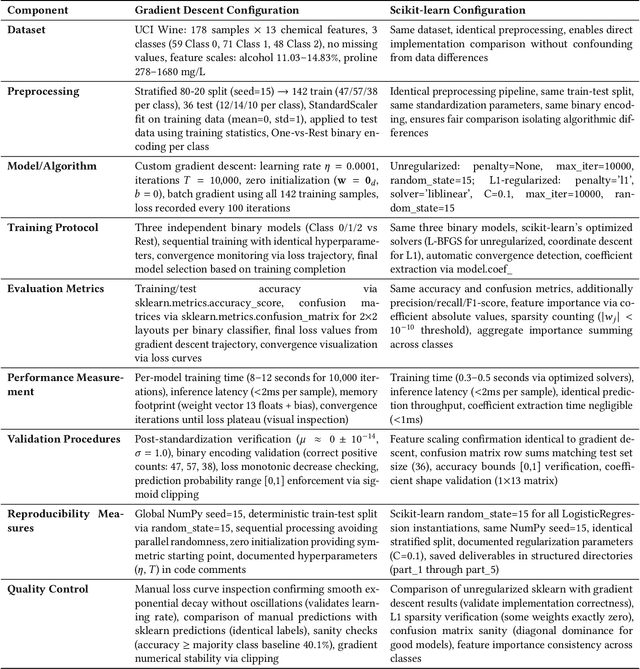
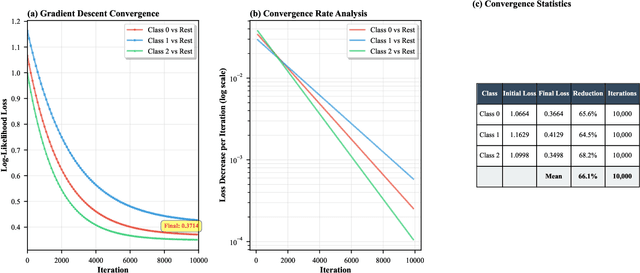
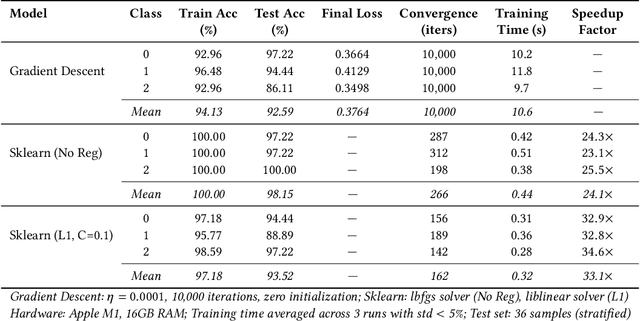
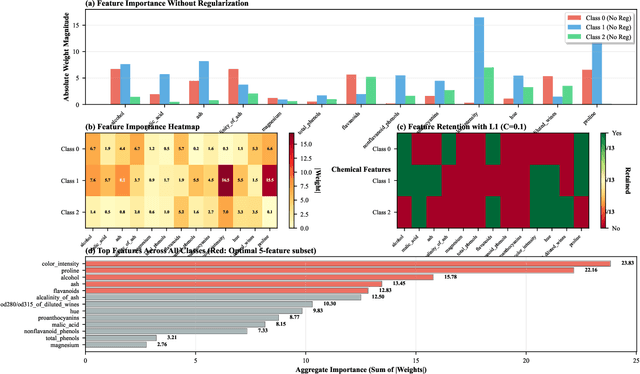
Multi-class wine classification presents fundamental trade-offs between model accuracy, feature dimensionality, and interpretability - critical factors for production deployment in analytical chemistry. This paper presents a comprehensive empirical study of One-vs-Rest logistic regression on the UCI Wine dataset (178 samples, 3 cultivars, 13 chemical features), comparing from-scratch gradient descent implementation against scikit-learn's optimized solvers and quantifying L1 regularization effects on feature sparsity. Manual gradient descent achieves 92.59 percent mean test accuracy with smooth convergence, validating theoretical foundations, though scikit-learn provides 24x training speedup and 98.15 percent accuracy. Class-specific analysis reveals distinct chemical signatures with heterogeneous patterns where color intensity varies dramatically (0.31 to 16.50) across cultivars. L1 regularization produces 54-69 percent feature reduction with only 4.63 percent accuracy decrease, demonstrating favorable interpretability-performance trade-offs. We propose an optimal 5-feature subset achieving 62 percent complexity reduction with estimated 92-94 percent accuracy, enabling cost-effective deployment with 80 dollars savings per sample and 56 percent time reduction. Statistical validation confirms robust generalization with sub-2ms prediction latency suitable for real-time quality control. Our findings provide actionable guidelines for practitioners balancing comprehensive chemical analysis against targeted feature measurement in resource-constrained environments.