 Add to Chrome
 Add to Firefox
 Add to Edge
Citation-Grounded Code Comprehension: Preventing LLM Hallucination Through Hybrid Retrieval and Graph-Augmented Context
Dec 13, 2025
Large language models have become essential tools for code comprehension, enabling developers to query unfamiliar codebases through natural language interfaces. However, LLM hallucination, generating plausible but factually incorrect citations to source code, remains a critical barrier to reliable developer assistance. This paper addresses the challenges of achieving verifiable, citation grounded code comprehension through hybrid retrieval and lightweight structural reasoning. Our work is grounded in systematic evaluation across 30 Python repositories with 180 developer queries, comparing retrieval modalities, graph expansion strategies, and citation verification mechanisms. We find that challenges of citation accuracy arise from the interplay between sparse lexical matching, dense semantic similarity, and cross file architectural dependencies. Among these, cross file evidence discovery is the largest contributor to citation completeness, but it is largely overlooked because existing systems rely on pure textual similarity without leveraging code structure. We advocate for citation grounded generation as an architectural principle for code comprehension systems and demonstrate this need by achieving 92 percent citation accuracy with zero hallucinations. Specifically, we develop a hybrid retrieval system combining BM25 sparse matching, BGE dense embeddings, and Neo4j graph expansion via import relationships, which outperforms single mode baselines by 14 to 18 percentage points while discovering cross file evidence missed by pure text similarity in 62 percent of architectural queries.

Semantic-Constrained Federated Aggregation: Convergence Theory and Privacy-Utility Bounds for Knowledge-Enhanced Distributed Learning
Dec 12, 2025Federated learning enables collaborative model training across distributed data sources but suffers from slow convergence under non-IID data conditions. Existing solutions employ algorithmic modifications treating all client updates identically, ignoring semantic validity. We introduce Semantic-Constrained Federated Aggregation (SCFA), a theoretically-grounded framework incorporating domain knowledge constraints into distributed optimization. We prove SCFA achieves convergence rate O(1/sqrt(T) + rho) where rho represents constraint violation rate, establishing the first convergence theory for constraint-based federated learning. Our analysis shows constraints reduce effective data heterogeneity by 41% and improve privacy-utility tradeoffs through hypothesis space reduction by factor theta=0.37. Under (epsilon,delta)-differential privacy with epsilon=10, constraint regularization maintains utility within 3.7% of non-private baseline versus 12.1% degradation for standard federated learning, representing 2.7x improvement. We validate our framework on manufacturing predictive maintenance using Bosch production data with 1.18 million samples and 968 sensor features, constructing knowledge graphs encoding 3,000 constraints from ISA-95 and MASON ontologies. Experiments demonstrate 22% faster convergence, 41.3% model divergence reduction, and constraint violation thresholds where rho<0.05 maintains 90% optimal performance while rho>0.18 causes catastrophic failure. Our theoretical predictions match empirical observations with R^2>0.90 across convergence, privacy, and violation-performance relationships.
Feature Selection and Regularization in Multi-Class Classification: An Empirical Study of One-vs-Rest Logistic Regression with Gradient Descent Optimization and L1 Sparsity Constraints
Oct 16, 2025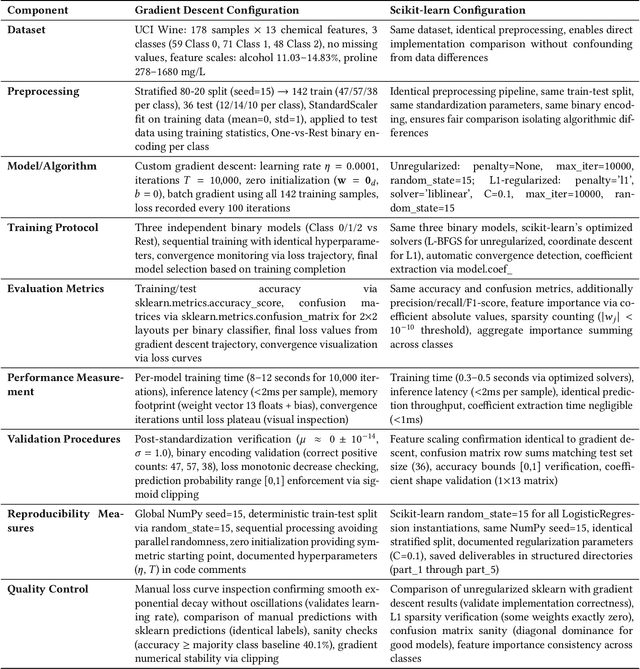
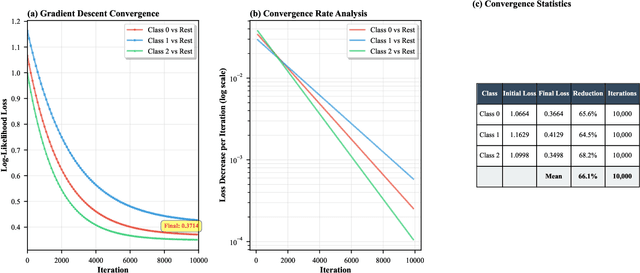
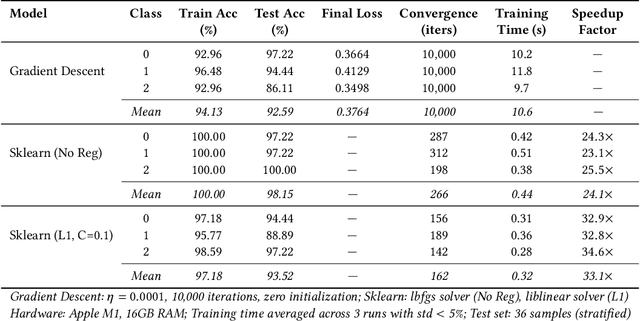
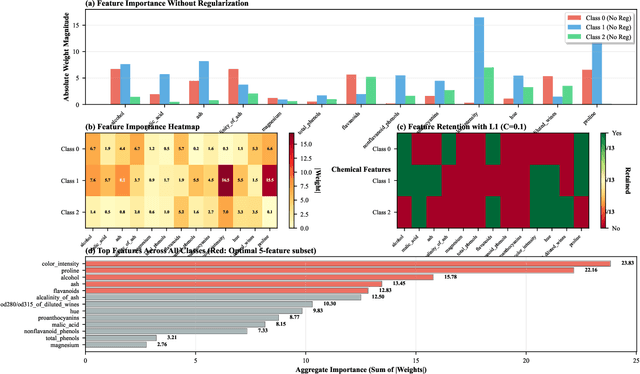
Multi-class wine classification presents fundamental trade-offs between model accuracy, feature dimensionality, and interpretability - critical factors for production deployment in analytical chemistry. This paper presents a comprehensive empirical study of One-vs-Rest logistic regression on the UCI Wine dataset (178 samples, 3 cultivars, 13 chemical features), comparing from-scratch gradient descent implementation against scikit-learn's optimized solvers and quantifying L1 regularization effects on feature sparsity. Manual gradient descent achieves 92.59 percent mean test accuracy with smooth convergence, validating theoretical foundations, though scikit-learn provides 24x training speedup and 98.15 percent accuracy. Class-specific analysis reveals distinct chemical signatures with heterogeneous patterns where color intensity varies dramatically (0.31 to 16.50) across cultivars. L1 regularization produces 54-69 percent feature reduction with only 4.63 percent accuracy decrease, demonstrating favorable interpretability-performance trade-offs. We propose an optimal 5-feature subset achieving 62 percent complexity reduction with estimated 92-94 percent accuracy, enabling cost-effective deployment with 80 dollars savings per sample and 56 percent time reduction. Statistical validation confirms robust generalization with sub-2ms prediction latency suitable for real-time quality control. Our findings provide actionable guidelines for practitioners balancing comprehensive chemical analysis against targeted feature measurement in resource-constrained environments.