 Add to Chrome
 Add to Firefox
 Add to Edge
Transformer-Hypernetwork-Controlled Deep-Unfolded Phase-Aware Channel Estimation Refinement for Phase-Drift-Robust Backscatter Links
Jun 30, 2026
This paper proposes a transformer-hypernetwork-controlled deep-unfolded phase-aware channel estimation refinement (THUNDER) for phase-drifting backscatter links. Residual carrier-phase drift across the pilot block renders the backscattered observation phase-nonstationary, and a closed-form phase-aware channel estimation (PACE) compensates only the first-order phase component, leaving a deterministic high signal-to-noise ratio (SNR) error floor. THUNDER suppresses this floor by initializing from PACE and refining the estimate through unfolded Gauss-Newton steps on the exact phase-exponential model. A transformer extracts pilot-wide phase context, and a hypernetwork generates bounded controls and pilot-reliability weights. Evaluations show an 8.9 dB normalized mean square error gain over the strongest learning-based channel estimation baseline.

Ultra-low-power Monostatic Backscatter Platform with Phase-Aware Channel Estimation and System-Level Validation
Jan 05, 2026This paper presents a novel channel-estimation (CE) method that mitigates residual phase drifts in backscatter links and a full hardware and signal-processing pipeline for a single-antenna monostatic system. The platform comprises a semi-passive tag, a software-defined radio (SDR) reader, and a 2x1 planar Yagi-Uda array (7 dBi with higher than 30 dB isolation) operating at 2.4 ~ 2.5 GHz. The developed backscatter fading model accounts for round-trip propagation and temporal correlation, and employs an analytically derived resource-optimal pilot allocation strategy. At the receiver, optimized least square (LS) and linear minimum mean square error (LMMSE) CE with pilot-aided carrier frequency offset (CFO) compensation feed a zero-forcing (ZF) equalizer to suppress ISI. The prototype delivers 500 kbps at 1 m with power of 158 uW (SDR baseband) and 10 uW (RF switch), yielding 320 pJ/bit. OOK and BPSK modulations achieve measured EVMs of 2.97 % and 4.02 %, respectively. Performance is validated by BER measurements and successful reconstruction of a full-color image in an over-the-air experiment. The results demonstrate an ultra-low-power, multimedia-capable backscatter IoT link and provide practical hardware-software co-design guidance for scalable deployments.
Janus Metasurface Breaking Polarization Symmetry: Surface-Modulated Electromagnetic Wave Radiation with Coexistent Linear and Circular Polarization
Dec 17, 2025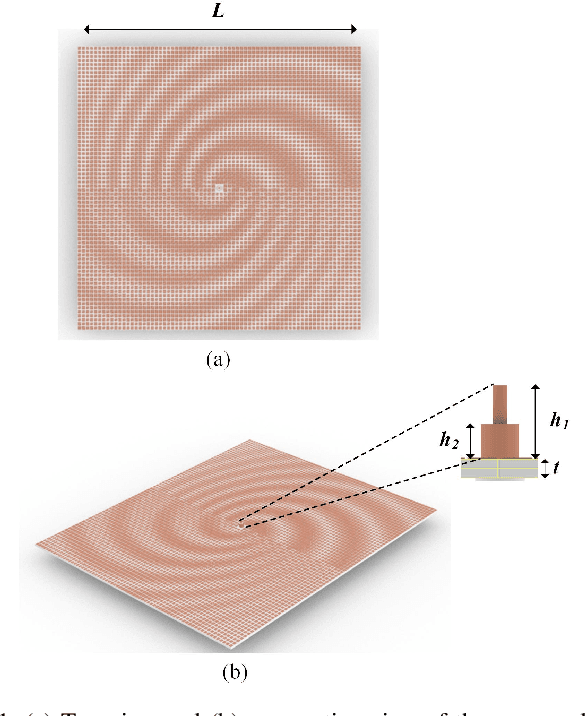

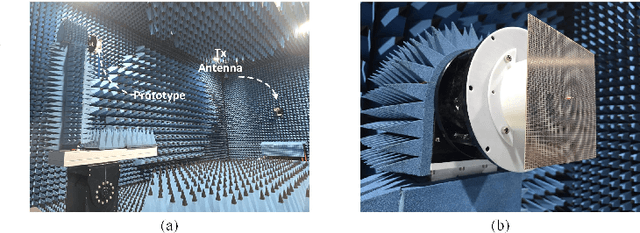
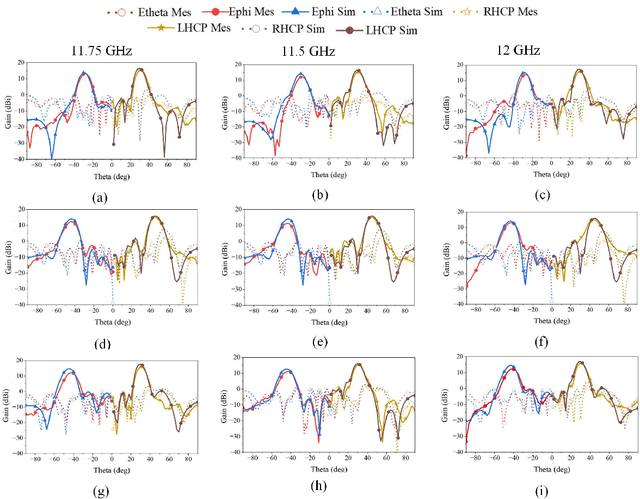
In this work, a Janus metasurface based tensor impedance holographic antenna (JHA) is proposed that simultaneously radiates linearly polarized (LP) and circularly polarized (CP) beams from a single aperture excited by a single feed. The proposed design introduces modified tensor impedance equations to significantly reduce cross-polarization at higher radiation angles. It demonstrates broadband operation bandwidth of 0.5 GHz while maintaining high circular polarization purity. The design methodology is verified using aperture field integration theory, ensuring that the impedance distribution produces the desired far-field radiation patterns. Prototypes of three variations of the holographic antenna are fabricated, validating its performance. The radiation characteristics of the proposed antenna make it an attractive choice for advanced broadband communication applications.