 Add to Chrome
 Add to Firefox
 Add to Edge
Graph-Instructed Neural Networks for parametric problems with varying boundary conditions
Mar 09, 2026
This work addresses the accurate and efficient simulation of physical phenomena governed by parametric Partial Differential Equations (PDEs) characterized by varying boundary conditions, where parametric instances modify not only the physics of the problem but also the imposition of boundary constraints on the computational domain. In such scenarios, classical Galerkin projection-based reduced order techniques encounter a fundamental bottleneck. Parametric boundaries typically necessitate a re-formulation of the discrete problem for each new configuration, and often, these approaches are unsuitable for real-time applications. To overcome these limitations, we propose a novel methodology based on Graph-Instructed Neural Networks (GINNs). The GINN framework effectively learns the mapping between the parametric description of the computational domain and the corresponding PDE solution. Our results demonstrate that the proposed GINN-based models, can efficiently represent highly complex parametric PDEs, serving as a robust and scalable asset for several applied-oriented settings when compared with fully connected architectures.

Edge-Wise Graph-Instructed Neural Networks
Sep 12, 2024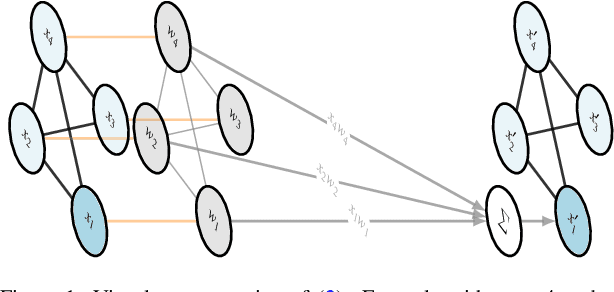
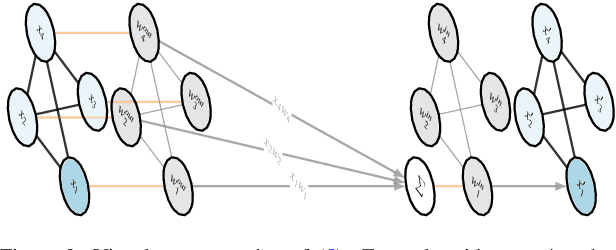
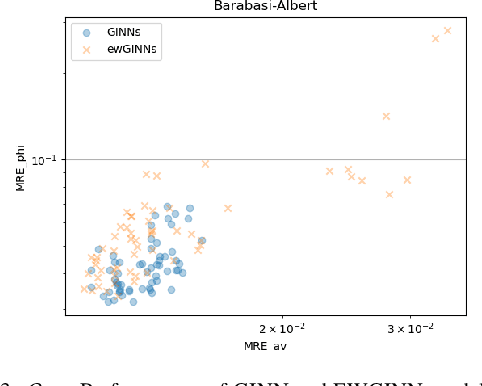
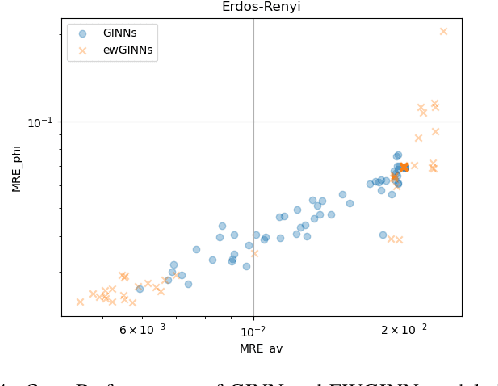
The problem of multi-task regression over graph nodes has been recently approached through Graph-Instructed Neural Network (GINN), which is a promising architecture belonging to the subset of message-passing graph neural networks. In this work, we discuss the limitations of the Graph-Instructed (GI) layer, and we formalize a novel edge-wise GI (EWGI) layer. We discuss the advantages of the EWGI layer and we provide numerical evidence that EWGINNs perform better than GINNs over graph-structured input data with chaotic connectivity, like the ones inferred from the Erdos-R\'enyi graph.
Graph-Informed Neural Networks for Sparse Grid-Based Discontinuity Detectors
Jan 25, 2024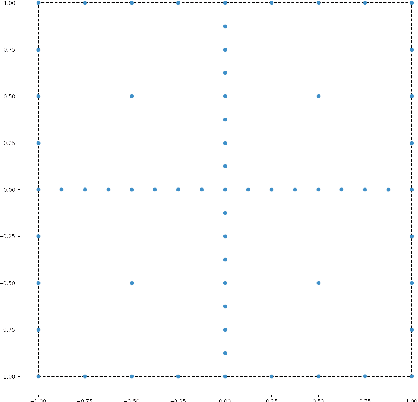
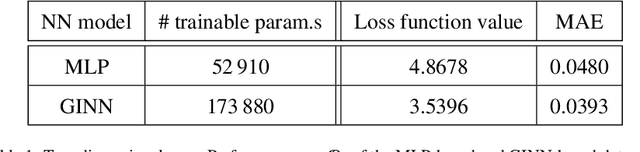
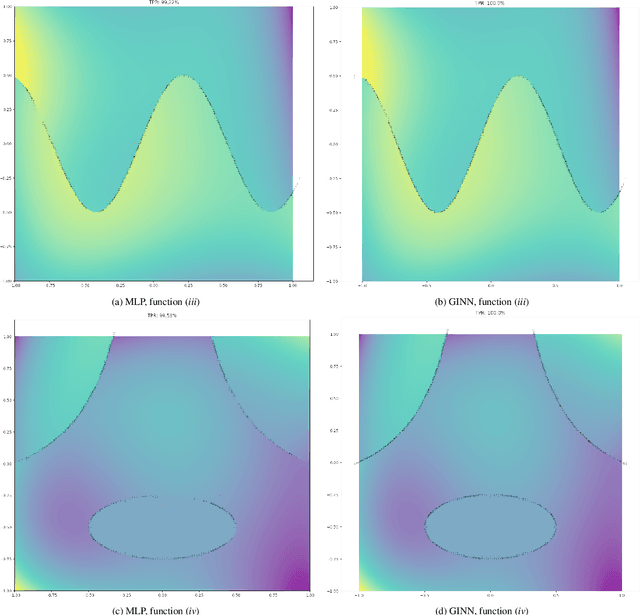
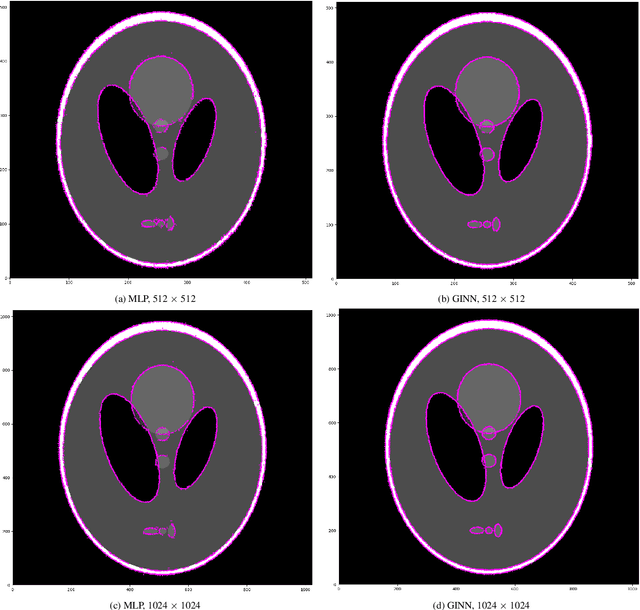
In this paper, we present a novel approach for detecting the discontinuity interfaces of a discontinuous function. This approach leverages Graph-Informed Neural Networks (GINNs) and sparse grids to address discontinuity detection also in domains of dimension larger than 3. GINNs, trained to identify troubled points on sparse grids, exploit graph structures built on the grids to achieve efficient and accurate discontinuity detection performances. We also introduce a recursive algorithm for general sparse grid-based detectors, characterized by convergence properties and easy applicability. Numerical experiments on functions with dimensions n = 2 and n = 4 demonstrate the efficiency and robust generalization of GINNs in detecting discontinuity interfaces. Notably, the trained GINNs offer portability and versatility, allowing integration into various algorithms and sharing among users.