 Add to Chrome
 Add to Firefox
 Add to Edge
LuxEmo: Expressive Text-to-Speech Corpus for Luxembourgish
Jun 30, 2026
State-of-the-art speech datasets predominantly focus on widely spoken languages, often overlooking low-resource languages such as Luxembourgish, which remain underrepresented in speech technology research. In this work, we introduce LuxEmo, a 21-hour conversational expressive speech corpus for Luxembourgish with 4 emotion categories. LuxEmo is derived from Radio Télévision Luxembourg (RTL) youth broadcasts, using automated detection followed by human validation. We propose a semi-automatic curation workflow combining voice activity detection, denoising, language identification, LuxASR-based segmentation, automatic emotion prediction, lexical cues, and targeted human review. Additionally, we benchmark five expressive TTS systems covering German-based cross-lingual transfer, multilingual Luxembourgish support, Luxembourgish adaptation, and non-parametric prosody transfer. Performance is evaluated using both objective metrics and human evaluation.

Self-supervised learning with diffusion-based multichannel speech enhancement for speaker verification under noisy conditions
Jul 05, 2023The paper introduces Diff-Filter, a multichannel speech enhancement approach based on the diffusion probabilistic model, for improving speaker verification performance under noisy and reverberant conditions. It also presents a new two-step training procedure that takes the benefit of self-supervised learning. In the first stage, the Diff-Filter is trained by conducting timedomain speech filtering using a scoring-based diffusion model. In the second stage, the Diff-Filter is jointly optimized with a pre-trained ECAPA-TDNN speaker verification model under a self-supervised learning framework. We present a novel loss based on equal error rate. This loss is used to conduct selfsupervised learning on a dataset that is not labelled in terms of speakers. The proposed approach is evaluated on MultiSV, a multichannel speaker verification dataset, and shows significant improvements in performance under noisy multichannel conditions.
How to Leverage DNN-based speech enhancement for multi-channel speaker verification?
Oct 17, 2022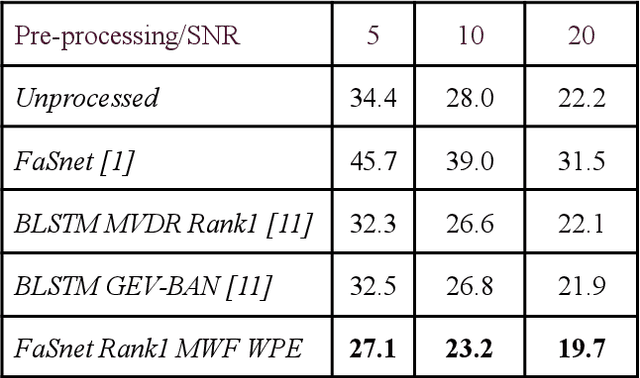
Speaker verification (SV) suffers from unsatisfactory performance in far-field scenarios due to environmental noise andthe adverse impact of room reverberation. This work presents a benchmark of multichannel speech enhancement for far-fieldspeaker verification. One approach is a deep neural network-based, and the other is a combination of deep neural network andsignal processing. We integrated a DNN architecture with signal processing techniques to carry out various experiments. Ourapproach is compared to the existing state-of-the-art approaches. We examine the importance of enrollment in pre-processing,which has been largely overlooked in previous studies. Experimental evaluation shows that pre-processing can improve the SVperformance as long as the enrollment files are processed similarly to the test data and that test and enrollment occur within similarSNR ranges. Considerable improvement is obtained on the generated and all the noise conditions of the VOiCES dataset.