 Add to Chrome
 Add to Firefox
 Add to Edge
A Multiscale Network with Supervised Contrastive Learning for Real-Time Facial Emotion Recognition
May 31, 2026
Real-time emotion recognition from facial expressions is a challenging task, particularly in video-based scenarios where multiple emotional states may occur over time. The difficulty increases further due to the fact that each emotional state is associated with facial expressions that vary significantly across individuals. The change of facial expressions portraying emotional state is not discrete, but rather continuous, which is very challenging to represent through computational aids. A system with the ability to detect variations in facial expressions can have a significant impact on determining the emotional state of an individual. Such a system can be very beneficial for psychologists during counseling by providing additional insights into the emotional state of a subject. In this paper, a deep learning-based system is presented to detect emotional changes in real-time video of a person by modeling the change in facial expressions. The current study is conducted on a standard dataset for training of the deep learning system and the system has provided very satisfactory outcomes in this respect.

Transfer Learning Assisted XgBoost For Adaptable Cyberattack Detection In Battery Packs
Apr 14, 2025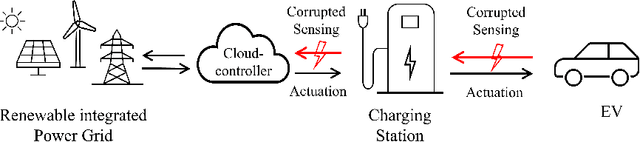
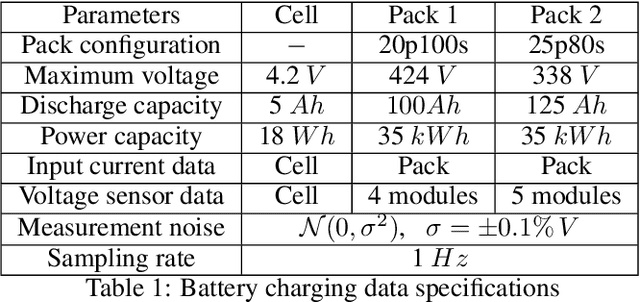
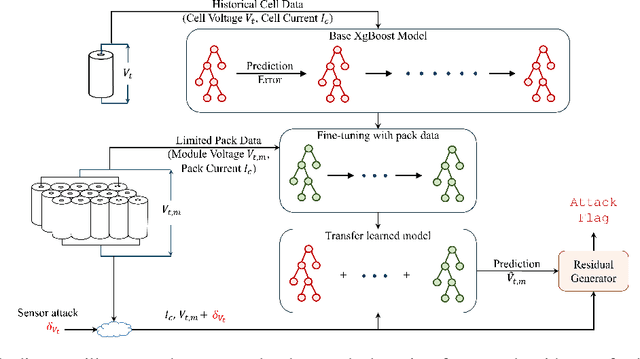
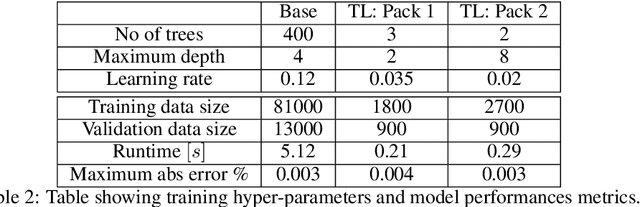
Optimal charging of electric vehicle (EVs) depends heavily on reliable sensor measurements from the battery pack to the cloud-controller of the smart charging station. However, an adversary could corrupt the voltage sensor data during transmission, potentially causing local to wide-scale disruptions. Therefore, it is essential to detect sensor cyberattacks in real-time to ensure secure EV charging, and the developed algorithms must be readily adaptable to variations, including pack configurations. To tackle these challenges, we propose adaptable fine-tuning of an XgBoost-based cell-level model using limited pack-level data to use for voltage prediction and residual generation. We used battery cell and pack data from high-fidelity charging experiments in PyBaMM and `liionpack' package to train and test the detection algorithm. The algorithm's performance has been evaluated for two large-format battery packs under sensor swapping and replay attacks. The simulation results also highlight the adaptability and efficacy of our proposed detection algorithm.