 Add to Chrome
 Add to Firefox
 Add to Edge
What Drives Students' Use of AI Chatbots? Technology Acceptance in Conversational AI
Feb 24, 2026
Conversational AI tools have been rapidly adopted by students and are becoming part of their learning routines. To understand what drives this adoption, we draw on the Technology Acceptance Model (TAM) and examine how perceived usefulness and perceived ease of use relate to students' behavioral intention to use conversational AI that generates responses for learning tasks. We extend TAM by incorporating trust, perceived enjoyment, and subjective norms as additional factors that capture social and affective influences and uncertainty around AI outputs. Using partial least squares structural equation modeling, we find perceived usefulness remains the strongest predictor of students' intention to use conversational AI. However, perceived ease of use does not exert a significant direct effect on behavioral intention once other factors are considered, operating instead indirectly through perceived usefulness. Trust and subjective norms significantly influence perceptions of usefulness, while perceived enjoyment exerts both a direct and indirect effect on usage intentions. These findings suggest that adoption decisions for conversational AI systems are influenced less by effort-related considerations and more by confidence in system outputs, affective engagement, and social context. Future research is needed to further examine how these acceptance relationships generalize across different conversational systems and usage contexts.

Understanding Human-AI Trust in Education
Jun 12, 2025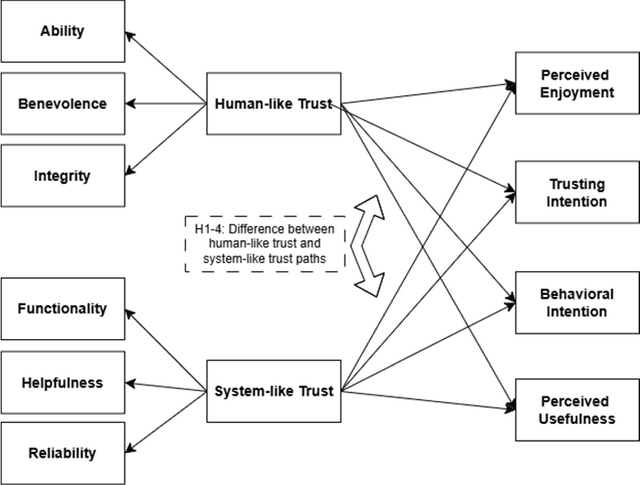
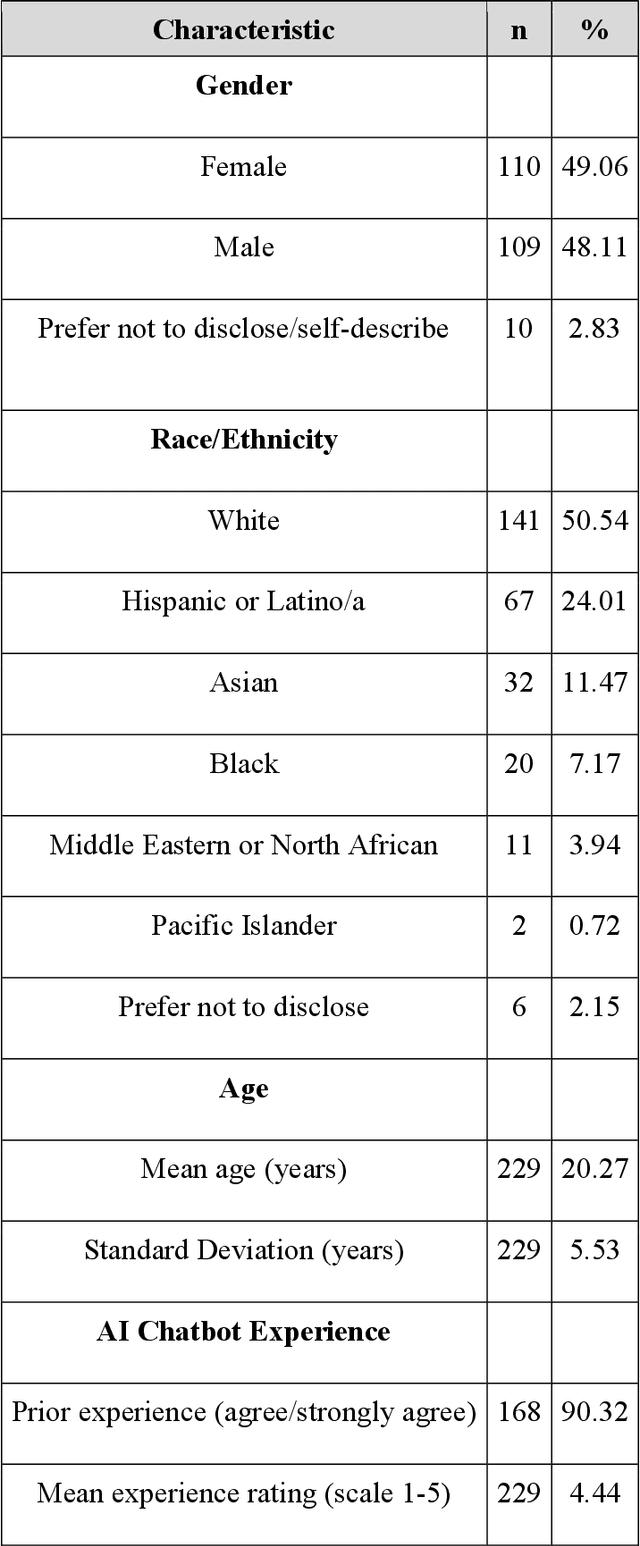
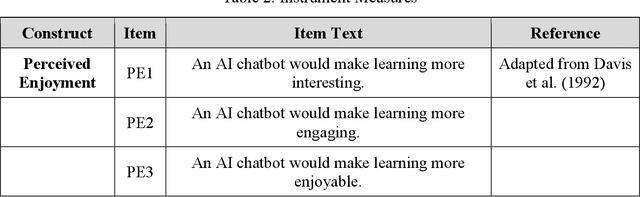
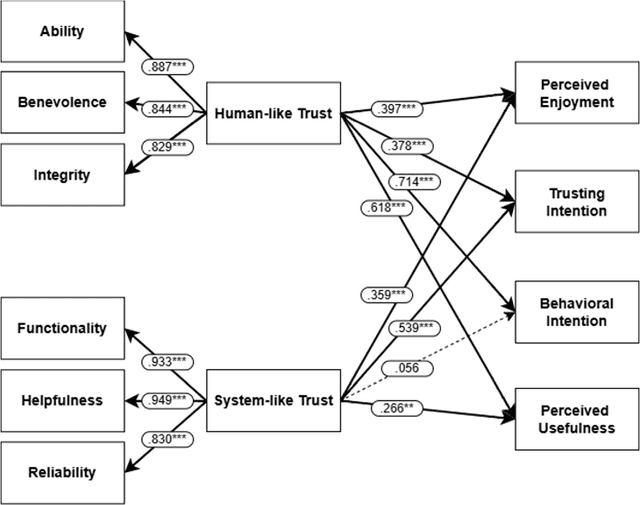
As AI chatbots become increasingly integrated in education, students are turning to these systems for guidance, feedback, and information. However, the anthropomorphic characteristics of these chatbots create ambiguity regarding whether students develop trust toward them as they would a human peer or instructor, based in interpersonal trust, or as they would any other piece of technology, based in technology trust. This ambiguity presents theoretical challenges, as interpersonal trust models may inappropriately ascribe human intentionality and morality to AI, while technology trust models were developed for non-social technologies, leaving their applicability to anthropomorphic systems unclear. To address this gap, we investigate how human-like and system-like trusting beliefs comparatively influence students' perceived enjoyment, trusting intention, behavioral intention to use, and perceived usefulness of an AI chatbot - factors associated with students' engagement and learning outcomes. Through partial least squares structural equation modeling, we found that human-like and system-like trust significantly influenced student perceptions, with varied effects. Human-like trust more strongly predicted trusting intention, while system-like trust better predicted behavioral intention and perceived usefulness. Both had similar effects on perceived enjoyment. Given the partial explanatory power of each type of trust, we propose that students develop a distinct form of trust with AI chatbots (human-AI trust) that differs from human-human and human-technology models of trust. Our findings highlight the need for new theoretical frameworks specific to human-AI trust and offer practical insights for fostering appropriately calibrated trust, which is critical for the effective adoption and pedagogical impact of AI in education.
Student Perspectives on the Benefits and Risks of AI in Education
May 04, 2025The use of chatbots equipped with artificial intelligence (AI) in educational settings has increased in recent years, showing potential to support teaching and learning. However, the adoption of these technologies has raised concerns about their impact on academic integrity, students' ability to problem-solve independently, and potential underlying biases. To better understand students' perspectives and experiences with these tools, a survey was conducted at a large public university in the United States. Through thematic analysis, 262 undergraduate students' responses regarding their perceived benefits and risks of AI chatbots in education were identified and categorized into themes. The results discuss several benefits identified by the students, with feedback and study support, instruction capabilities, and access to information being the most cited. Their primary concerns included risks to academic integrity, accuracy of information, loss of critical thinking skills, the potential development of overreliance, and ethical considerations such as data privacy, system bias, environmental impact, and preservation of human elements in education. While student perceptions align with previously discussed benefits and risks of AI in education, they show heightened concerns about distinguishing between human and AI generated work - particularly in cases where authentic work is flagged as AI-generated. To address students' concerns, institutions can establish clear policies regarding AI use and develop curriculum around AI literacy. With these in place, practitioners can effectively develop and implement educational systems that leverage AI's potential in areas such as immediate feedback and personalized learning support. This approach can enhance the quality of students' educational experiences while preserving the integrity of the learning process with AI.
In-vehicle alertness monitoring for older adults
Aug 17, 2022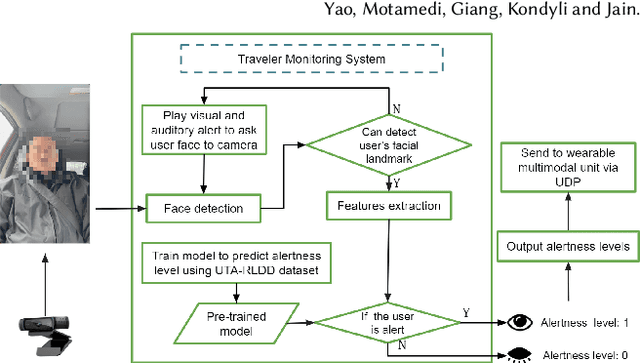
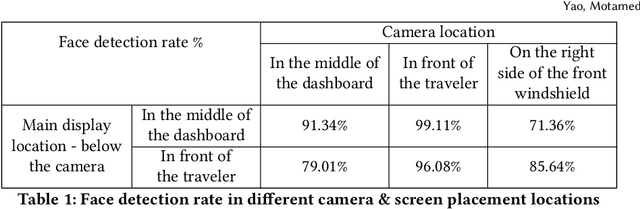
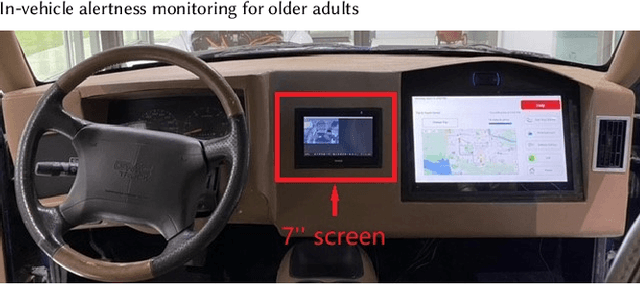

Alertness monitoring in the context of driving improves safety and saves lives. Computer vision based alertness monitoring is an active area of research. However, the algorithms and datasets that exist for alertness monitoring are primarily aimed at younger adults (18-50 years old). We present a system for in-vehicle alertness monitoring for older adults. Through a design study, we ascertained the variables and parameters that are suitable for older adults traveling independently in Level 5 vehicles. We implemented a prototype traveler monitoring system and evaluated the alertness detection algorithm on ten older adults (70 years and older). We report on the system design and implementation at a level of detail that is suitable for the beginning researcher or practitioner. Our study suggests that dataset development is the foremost challenge for developing alertness monitoring systems targeted at older adults. This study is the first of its kind for a hitherto under-studied population and has implications for future work on algorithm development and system design through participatory methods.