 Add to Chrome
 Add to Firefox
 Add to Edge
Faster Thermal Profiling of a Lunar Rover with Machine Learning Adapted Finite Difference Model
May 26, 2026
Autonomous space systems operating in extreme thermal environments require accurate and efficient thermal modeling to support both pre-mission system design and onboard autonomy. For lunar rovers, large temperature gradients, radiative heat transfer, and variable surface conditions make reliable thermal prediction especially challenging. High-fidelity physics-based simulations provide accurate results but are computationally expensive, while simplified models and lookup-table approach often lack sufficient accuracy. Physics-informed machine learning (PIML) offers a promising alternative by combining data-driven models with embedded physical knowledge. This paper presents a PIML framework for thermal analysis of a simplified lunar rover with internal heat sources, where machine learning enables environment-adaptive coarse meshing. The proposed architecture integrates a transfer neural network (TNN) that adaptively determines 3D finite-difference nodalization based on thermal loads and initial conditions, enabling more accurate coarse-mesh calculations. A differentiable finite-difference thermal simulator is embedded within the framework to enforce physical consistency and support efficient training, while an upscaling layer reconstructs high-resolution temperature fields from the coarse-grid solution. The proposed PIML approach is evaluated against high-fidelity fine-mesh simulations, low-fidelity fixed coarse-mesh models, and a purely data-driven artificial neural network (ANN). Results show that the PIML framework improves prediction accuracy by 50% and 39% relative to the coarse-mesh physics model and ANN model, respectively, while maintaining physically consistent thermal distributions. Computationally, the framework is also 3x faster than high-fidelity simulations, demonstrating an effective balance between accuracy and efficiency for thermal modeling of lunar rover systems.

Event-triggered Natural Hazard Monitoring with Convolutional Neural Networks on the Edge
Oct 22, 2018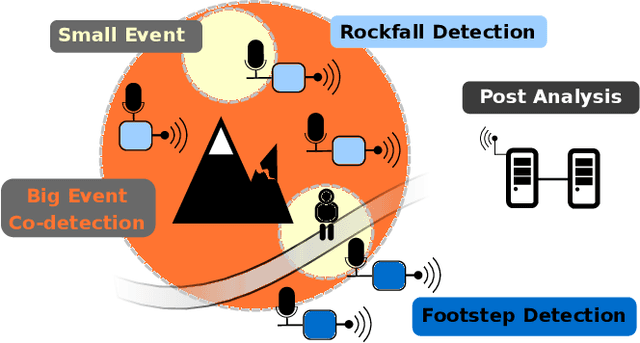
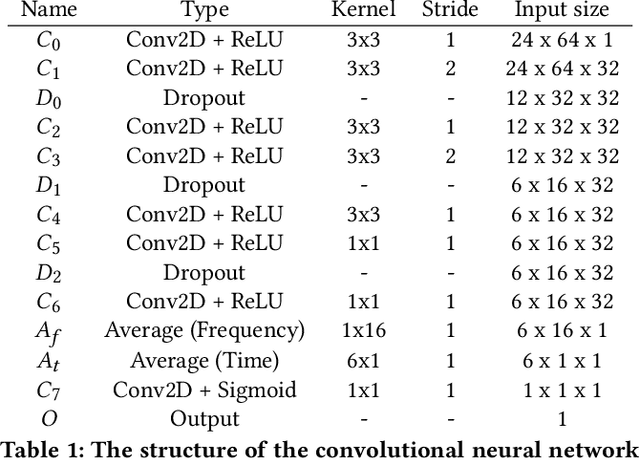
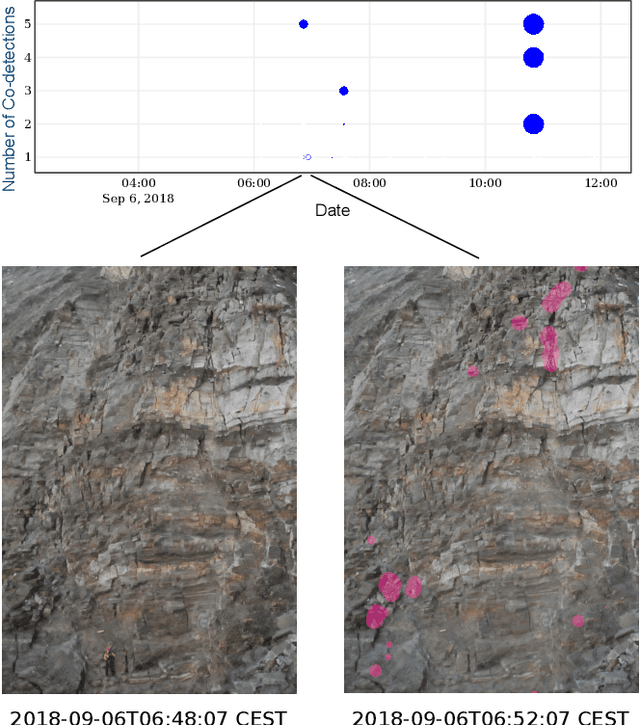
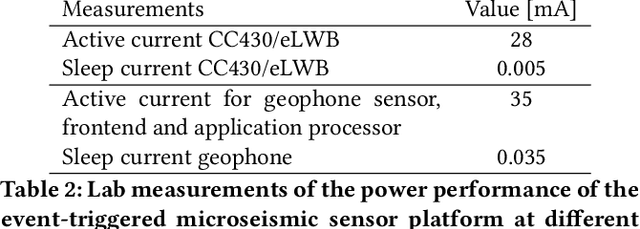
In natural hazard warning systems fast decision making is vital to avoid catastrophes. Decision making at the edge of a wireless sensor network promises fast response times but is limited by the availability of energy, data transfer speed, processing and memory constraints. In this work we present a realization of a wireless sensor network for hazard monitoring which is based on an array of event-triggered seismic sensors with advanced signal processing and characterization capabilities for a novel co-detection technique. On the one hand we leverage an ultra-low power, threshold-triggering circuit paired with on-demand digital signal acquisition capable of extracting relevant information exactly when it matters most and not wasting precious resources when nothing can be observed. On the other hand we use machine-learning-based classification implemented on low-power, off-the-shelf microcontrollers to avoid false positive warnings and to actively identify humans in hazard zones. The sensors' response time and memory requirement is substantially improved by pipelining the inference of a convolutional neural network. In this way, convolutional neural networks that would not run unmodified on a memory constrained device can be executed in real-time and at scale on low-power embedded devices.