 Add to Chrome
 Add to Firefox
 Add to Edge
Neural Cluster First, Route Second: One-Shot Capacitated Vehicle Routing via Differentiable Optimal Transport
May 10, 2026
The Capacitated Vehicle Routing Problem (CVRP) underpins modern last-mile logistics. Current Neural Combinatorial Optimization (NCO) methods construct CVRP solutions autoregressively, inheriting sequential decoding bottlenecks, sensitivity to spatial symmetries, and brittle out-of-distribution behavior. We revisit the classical Cluster-First-Route-Second (CFRS) paradigm -- long known to be asymptotically optimal but largely overlooked by NCO -- and argue that it is structurally aligned with the core strengths of deep learning: similarity and assignment over global context, rather than the construction of long sequential tours. We introduce Neural CFRS, the first purely non-autoregressive one-shot neural CFRS framework for the CVRP. It enforces global fleet-capacity constraints end-to-end via a differentiable entropic Optimal Transport layer, producing a continuous transport plan to sparsify an exact capacitated assignment solver. We provide formal theoretical guarantees that our architecture intrinsically abstracts away $E(2)$ spatial, inter-route permutation, and intra-route traversal symmetries. By equipping the framework with a pre-trained spatial vocabulary, we unlock extreme parameter efficiency and zero-shot scaling. Designed primarily for real-world spatial distributions under a constant capacity setting, Neural CFRS scales robustly to out-of-distribution $N=1000$ instances with a < 4% gap -- retaining an approximate 5% gap at this scale even as an ultra-lightweight, single-layer architecture. Furthermore, when deployed out-of-the-box on standard benchmarks, we achieve a highly competitive 2.73% optimality gap on size-100 problems.

Learning to Deliver: a Foundation Model for the Montreal Capacitated Vehicle Routing Problem
Feb 28, 2024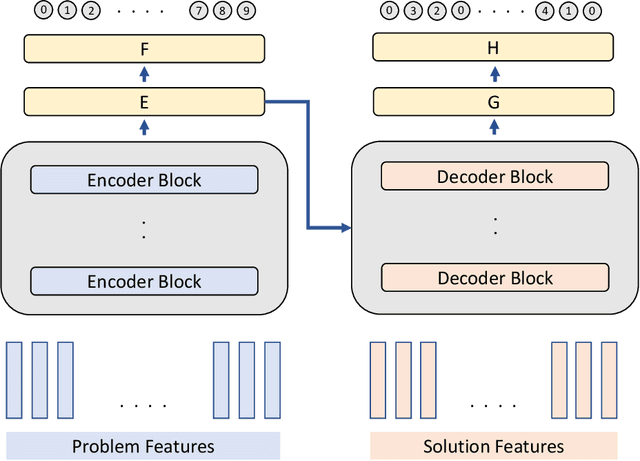
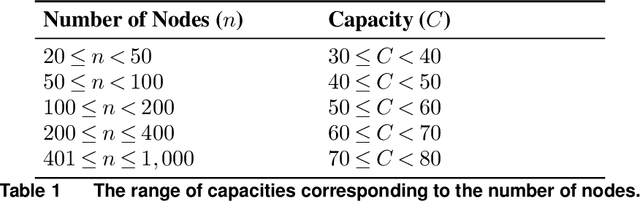

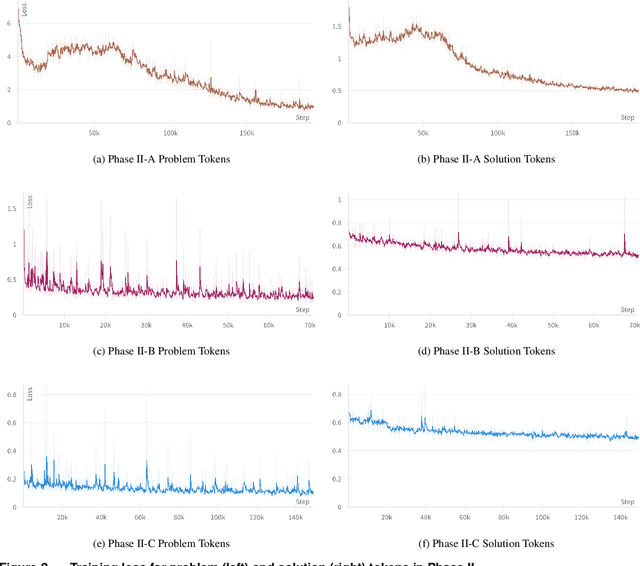
In this paper, we present the Foundation Model for the Montreal Capacitated Vehicle Routing Problem (FM-MCVRP), a novel Deep Learning (DL) model that approximates high-quality solutions to a variant of the Capacitated Vehicle Routing Problem (CVRP) that characterizes many real-world applications. The so-called Montreal Capacitated Vehicle Routing Problem (MCVRP), first formally described by Bengio et al. (2021), is defined on a fixed and finite graph, which is analogous to a city. Each MCVRP instance is essentially the sub-graph connecting a randomly sampled subset of the nodes in the fixed graph, which represent a set of potential addresses in a real-world delivery problem on a given day. Our work exploits this problem structure to frame the MCVRP as an analogous Natural Language Processing (NLP) task. Specifically, we leverage a Transformer architecture embedded in a Large Language Model (LLM) framework to train our model in a supervised manner on computationally inexpensive, sub-optimal MCVRP solutions obtained algorithmically. Through comprehensive computational experiments, we show that FM-MCVRP produces better MCVRP solutions than the training data and generalizes to larger sized problem instances not seen during training. Even when compared to near-optimal solutions from state-of-the-art heuristics, FM-MCVRP yields competitive results despite being trained on inferior data. For instance, for 400-customer problems, FM-MCVRP solutions on average fall within 2% of the benchmark. Our results further demonstrate that unlike prior works in the literature, FM-MCVRP is a unified model, which performs consistently and reliably on a range of problem instance sizes and parameter values such as the vehicle capacity.