 Add to Chrome
 Add to Firefox
 Add to Edge
Scaling Behavior Cloning Improves Causal Reasoning: An Open Model for Real-Time Video Game Playing
Jan 08, 2026
Behavior cloning is enjoying a resurgence in popularity as scaling both model and data sizes proves to provide a strong starting point for many tasks of interest. In this work, we introduce an open recipe for training a video game playing foundation model designed for inference in realtime on a consumer GPU. We release all data (8300+ hours of high quality human gameplay), training and inference code, and pretrained checkpoints under an open license. We show that our best model is capable of playing a variety of 3D video games at a level competitive with human play. We use this recipe to systematically examine the scaling laws of behavior cloning to understand how the model's performance and causal reasoning varies with model and data scale. We first show in a simple toy problem that, for some types of causal reasoning, increasing both the amount of training data and the depth of the network results in the model learning a more causal policy. We then systematically study how causality varies with the number of parameters (and depth) and training steps in scaled models of up to 1.2 billion parameters, and we find similar scaling results to what we observe in the toy problem.

Pixels to Play: A Foundation Model for 3D Gameplay
Aug 19, 2025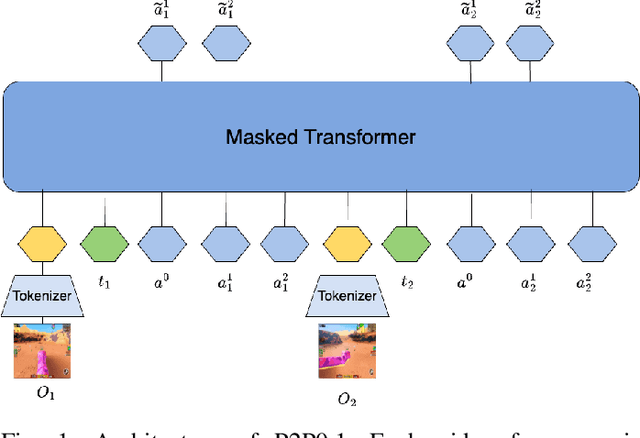
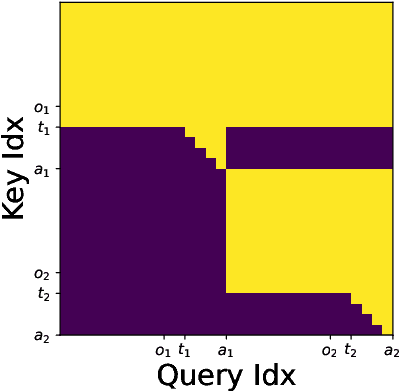
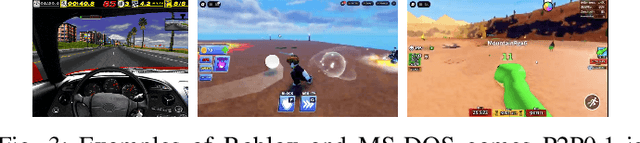
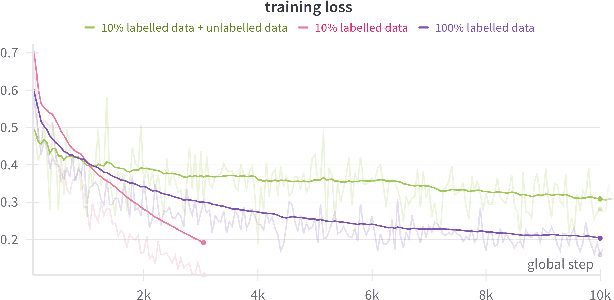
We introduce Pixels2Play-0.1 (P2P0.1), a foundation model that learns to play a wide range of 3D video games with recognizable human-like behavior. Motivated by emerging consumer and developer use cases - AI teammates, controllable NPCs, personalized live-streamers, assistive testers - we argue that an agent must rely on the same pixel stream available to players and generalize to new titles with minimal game-specific engineering. P2P0.1 is trained end-to-end with behavior cloning: labeled demonstrations collected from instrumented human game-play are complemented by unlabeled public videos, to which we impute actions via an inverse-dynamics model. A decoder-only transformer with auto-regressive action output handles the large action space while remaining latency-friendly on a single consumer GPU. We report qualitative results showing competent play across simple Roblox and classic MS-DOS titles, ablations on unlabeled data, and outline the scaling and evaluation steps required to reach expert-level, text-conditioned control.