 Add to Chrome
 Add to Firefox
 Add to Edge
Samuel C. Hoffman

One Explanation Does Not Fit All: A Toolkit and Taxonomy of AI Explainability Techniques
Sep 06, 2019

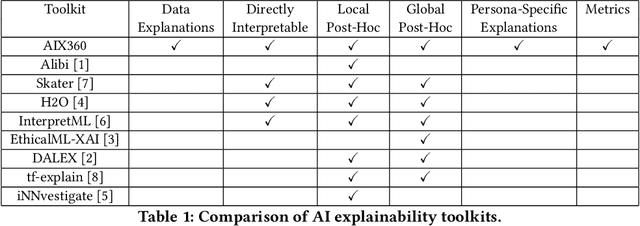
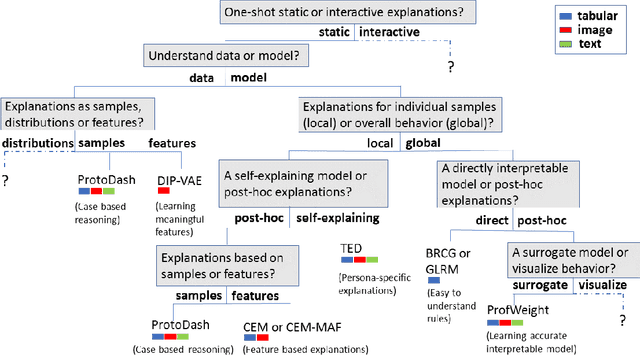
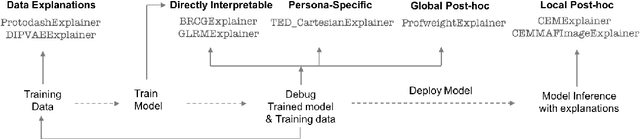
As artificial intelligence and machine learning algorithms make further inroads into society, calls are increasing from multiple stakeholders for these algorithms to explain their outputs. At the same time, these stakeholders, whether they be affected citizens, government regulators, domain experts, or system developers, present different requirements for explanations. Toward addressing these needs, we introduce AI Explainability 360 (http://aix360.mybluemix.net/), an open-source software toolkit featuring eight diverse and state-of-the-art explainability methods and two evaluation metrics. Equally important, we provide a taxonomy to help entities requiring explanations to navigate the space of explanation methods, not only those in the toolkit but also in the broader literature on explainability. For data scientists and other users of the toolkit, we have implemented an extensible software architecture that organizes methods according to their place in the AI modeling pipeline. We also discuss enhancements to bring research innovations closer to consumers of explanations, ranging from simplified, more accessible versions of algorithms, to tutorials and an interactive web demo to introduce AI explainability to different audiences and application domains. Together, our toolkit and taxonomy can help identify gaps where more explainability methods are needed and provide a platform to incorporate them as they are developed.

AI Fairness 360: An Extensible Toolkit for Detecting, Understanding, and Mitigating Unwanted Algorithmic Bias
Oct 03, 2018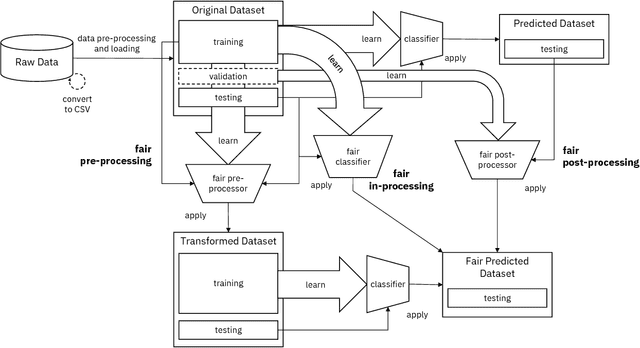
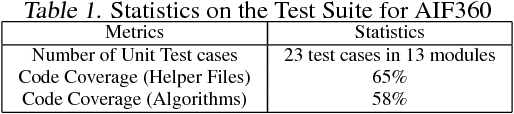
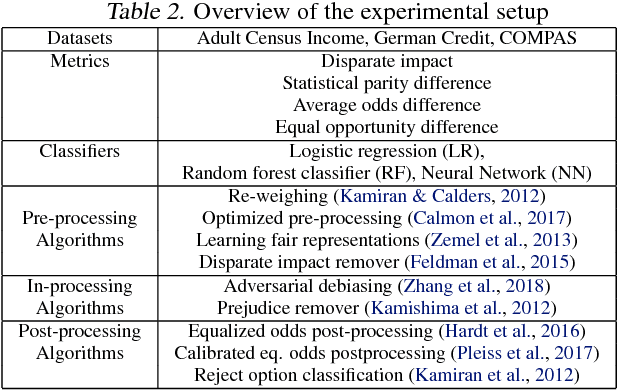
Fairness is an increasingly important concern as machine learning models are used to support decision making in high-stakes applications such as mortgage lending, hiring, and prison sentencing. This paper introduces a new open source Python toolkit for algorithmic fairness, AI Fairness 360 (AIF360), released under an Apache v2.0 license {https://github.com/ibm/aif360). The main objectives of this toolkit are to help facilitate the transition of fairness research algorithms to use in an industrial setting and to provide a common framework for fairness researchers to share and evaluate algorithms. The package includes a comprehensive set of fairness metrics for datasets and models, explanations for these metrics, and algorithms to mitigate bias in datasets and models. It also includes an interactive Web experience (https://aif360.mybluemix.net) that provides a gentle introduction to the concepts and capabilities for line-of-business users, as well as extensive documentation, usage guidance, and industry-specific tutorials to enable data scientists and practitioners to incorporate the most appropriate tool for their problem into their work products. The architecture of the package has been engineered to conform to a standard paradigm used in data science, thereby further improving usability for practitioners. Such architectural design and abstractions enable researchers and developers to extend the toolkit with their new algorithms and improvements, and to use it for performance benchmarking. A built-in testing infrastructure maintains code quality.
Fairness GAN
May 24, 2018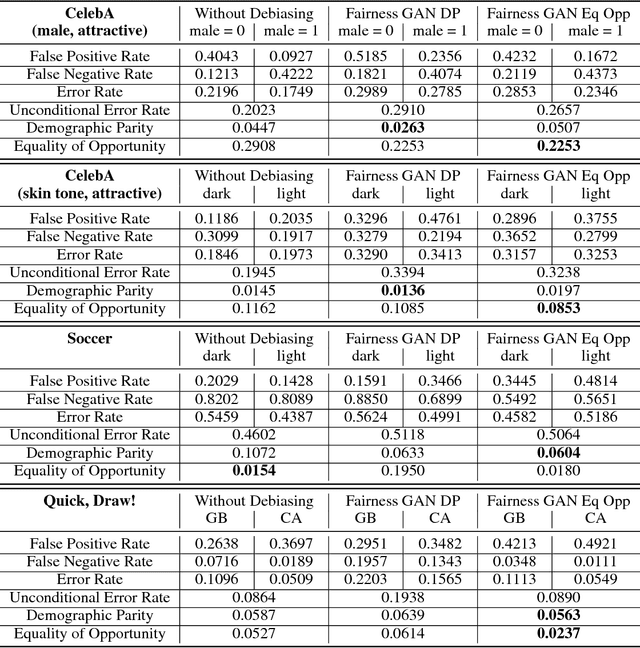
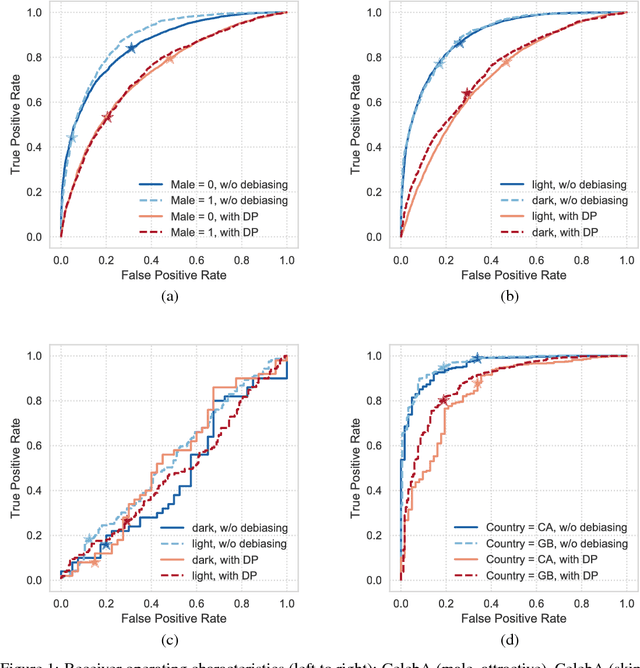
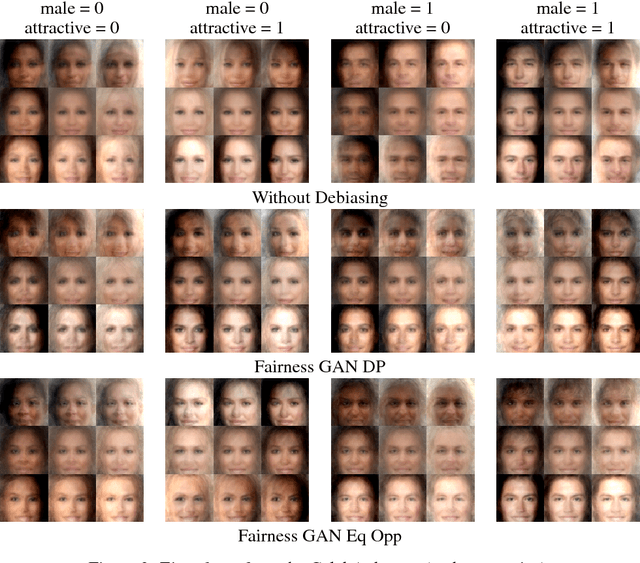
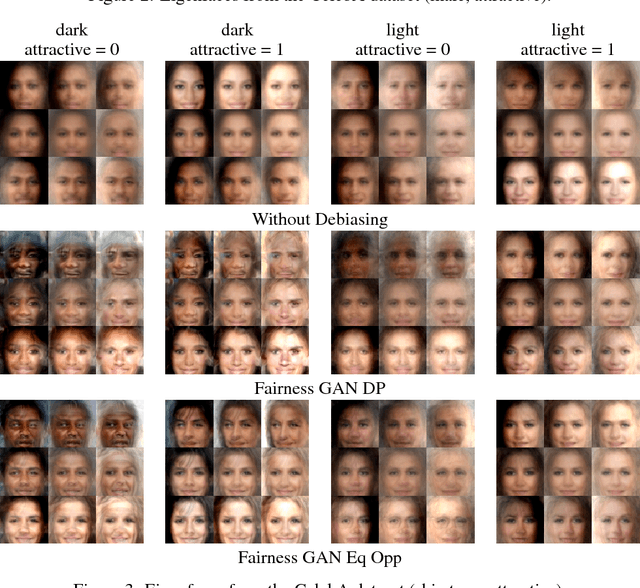
In this paper, we introduce the Fairness GAN, an approach for generating a dataset that is plausibly similar to a given multimedia dataset, but is more fair with respect to protected attributes in allocative decision making. We propose a novel auxiliary classifier GAN that strives for demographic parity or equality of opportunity and show empirical results on several datasets, including the CelebFaces Attributes (CelebA) dataset, the Quick, Draw!\ dataset, and a dataset of soccer player images and the offenses they were called for. The proposed formulation is well-suited to absorbing unlabeled data; we leverage this to augment the soccer dataset with the much larger CelebA dataset. The methodology tends to improve demographic parity and equality of opportunity while generating plausible images.