 Add to Chrome
 Add to Firefox
 Add to Edge
FreqKD: Frequency-Decoupled Cross-Modal Knowledge Distillation for Infrared Object Detection
Jun 10, 2026
Transfer learning from large-scale RGB foundation models to infrared (IR) imagery through knowledge distillation (KD) remains challenging due to fundamental differences in image formation physics. We investigate the spectral structure of the RGB--IR modality gap and observe that feature divergence is not uniform across spatial frequencies: low-frequency components (shape, layout) show greater cross-modal alignment than high-frequency components (texture, fine edges), which reflect modality-specific characteristics. Based on this analysis, we propose FreqKD, a frequency-decoupled distillation framework that applies asymmetric supervision adapted to each band's cross-modal consistency. The method employs strict mean squared error (MSE) on the low-frequency band to preserve shared structural information and a relaxed log-MSE loss (weighted at 0.1) on the high-frequency band to provide edge guidance while tolerating texture differences. Spectral divergence analysis on 500 paired samples shows that high-frequency divergence exceeds low-frequency divergence by a factor of 2.4x on average across all analysed transformer layers. On KAIST multispectral pedestrian detection, FreqKD achieves 64.1 mAP50, improving 2.4 points over the DINOv2 baseline. The learned representation transfers across datasets (FLIR ADAS, +2.1 mAP50), tasks (MFNet segmentation, +1.85 mean intersection-over-union), and architectures (ResNet-50, +1.0 mAP50). Code is available at: https://anonymous.4open.science/r/freq_decoupled_kd-5E5A

SceneMiner: Identity-Preserving Multi-Task Fine-Tuning for Unified BEV Scene Mining
Jun 09, 2026Mining hard, safety-critical scenes from driving logs is bottlenecked by the absence of difficulty labels, and no single proxy, collision risk, trajectory ambiguity, or semantic rarity suffices to find such scenes on its own. We present SceneMiner, a unified, camera-only bird's-eye-view pipeline that emits complementary mining signals from a frozen vision-language backbone in a single forward pass, with no LiDAR or radar: a retrieval embedding for text-prompted scenario search, a multi-label scene-tag distribution, and a continuous physics-based risk score (a motion forecast is a byproduct, not a contribution). Building such a multi-head model exposes our central finding, a failure mode we term cross-task interference: adding or upgrading one head shifts a shared activation stream and degrades weight-frozen sibling heads, so freezing parameters alone is insufficient. Our contribution, identity-preserving multi-task fine-tuning, removes this interference by zero-initializing every new sub-module and freezing every parameter that feeds the shared stream. The mining heads are thereby preserved bit-identically while training only ~102k parameters. The tagging head reaches mAP 0.4614 (micro-F1 0.5557) on 20 scene tags by pooling each scene into 32 visual tokens, and the embedding head supports text-prompted retrieval, validated qualitatively. Code is available at: https://anonymous.4open.science/r/sceneminer_anonymous-64E5
MEVDT: Multi-Modal Event-Based Vehicle Detection and Tracking Dataset
Jul 29, 2024
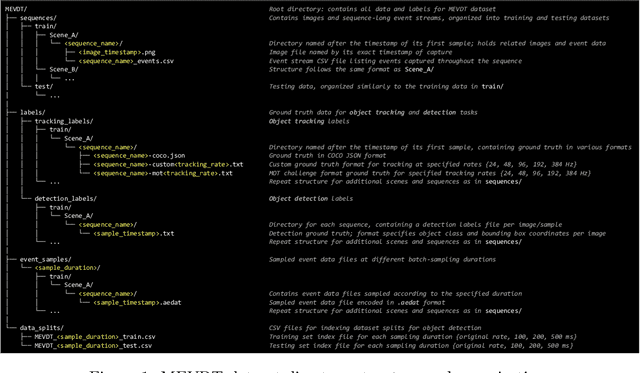
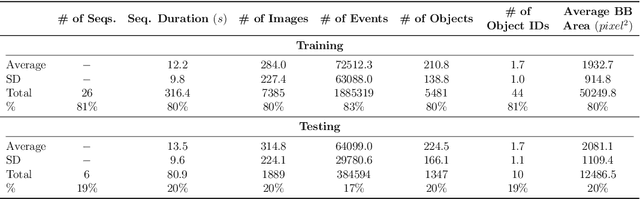
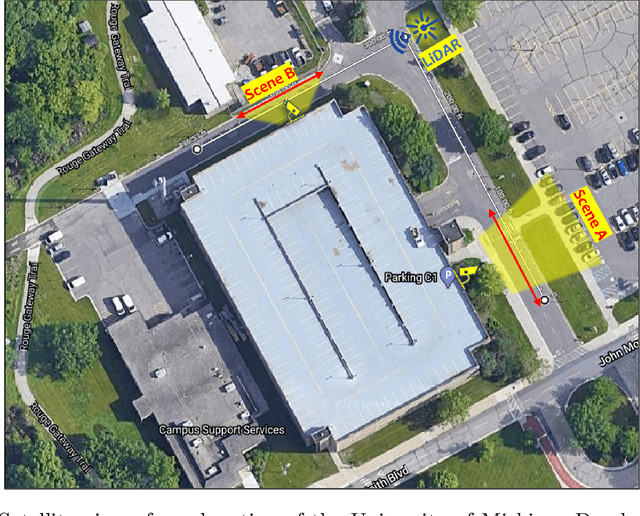
In this data article, we introduce the Multi-Modal Event-based Vehicle Detection and Tracking (MEVDT) dataset. This dataset provides a synchronized stream of event data and grayscale images of traffic scenes, captured using the Dynamic and Active-Pixel Vision Sensor (DAVIS) 240c hybrid event-based camera. MEVDT comprises 63 multi-modal sequences with approximately 13k images, 5M events, 10k object labels, and 85 unique object tracking trajectories. Additionally, MEVDT includes manually annotated ground truth labels $\unicode{x2014}$ consisting of object classifications, pixel-precise bounding boxes, and unique object IDs $\unicode{x2014}$ which are provided at a labeling frequency of 24 Hz. Designed to advance the research in the domain of event-based vision, MEVDT aims to address the critical need for high-quality, real-world annotated datasets that enable the development and evaluation of object detection and tracking algorithms in automotive environments.
SID: Stereo Image Dataset for Autonomous Driving in Adverse Conditions
Jul 06, 2024Robust perception is critical for autonomous driving, especially under adverse weather and lighting conditions that commonly occur in real-world environments. In this paper, we introduce the Stereo Image Dataset (SID), a large-scale stereo-image dataset that captures a wide spectrum of challenging real-world environmental scenarios. Recorded at a rate of 20 Hz using a ZED stereo camera mounted on a vehicle, SID consists of 27 sequences totaling over 178k stereo image pairs that showcase conditions from clear skies to heavy snow, captured during the day, dusk, and night. The dataset includes detailed sequence-level annotations for weather conditions, time of day, location, and road conditions, along with instances of camera lens soiling, offering a realistic representation of the challenges in autonomous navigation. Our work aims to address a notable gap in research for autonomous driving systems by presenting high-fidelity stereo images essential for the development and testing of advanced perception algorithms. These algorithms support consistent and reliable operation across variable weather and lighting conditions, even when handling challenging situations like lens soiling. SID is publicly available at: https://doi.org/10.7302/esz6-nv83.