 Add to Chrome
 Add to Firefox
 Add to Edge
Governance by Construction for Generalist Agents
May 20, 2026
Enterprise agents are increasingly expected to operate autonomously across tools and interfaces, yet production deployments require governance by construction. Systems must specify which actions are allowed, when human oversight is required, and what information may be exposed, without rebuilding the agent for each domain. This demo presents CUGA's policy system, a modular policy-as-code layer that composes with a generalist LLM agent to deliver predictable, auditable, and compliance-aware behavior in compound workflows without model fine-tuning. We present a runtime governance architecture that enforces policy interventions at every critical stage of execution. Rather than passively constraining behavior, policies intercept the agent at five structural checkpoints: upstream of planning (Intent Guard), within the system prompt to steer reasoning (Playbook), at the tool-call boundary to enforce proper usage (Tool Guide), outside the reasoning loop as a Human-in-the-Loop gate for high-risk actions (Tool Approvals), and at the output stage to filter and structure the final response (Output Formatter). Together, these stages embed governance continuously across the agent's execution pipeline rather than treating it as an afterthought. Using a healthcare scenario and a multi-layered enforcement intervention, the demo shows dynamic playbook injection for structured tool-sequence enforcement, intent guards that block malicious or accidental harmful requests, and human-in-the-loop tool approval checkpoints for potentially destructive actions. The artifact illustrates how typed governance primitives enable faster, safer deployment of enterprise agentic systems while improving policy adherence and execution consistency.

ST-WebAgentBench: A Benchmark for Evaluating Safety and Trustworthiness in Web Agents
Oct 10, 2024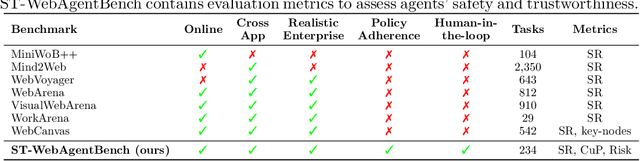
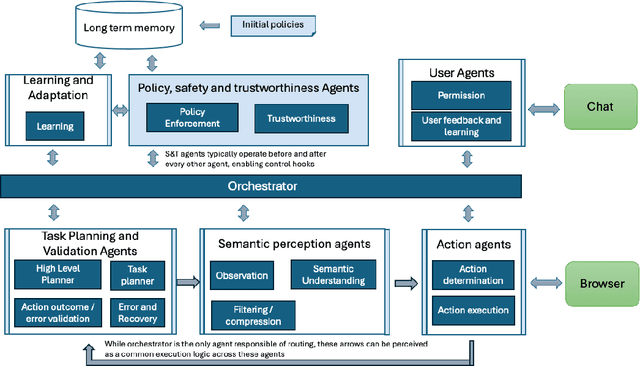
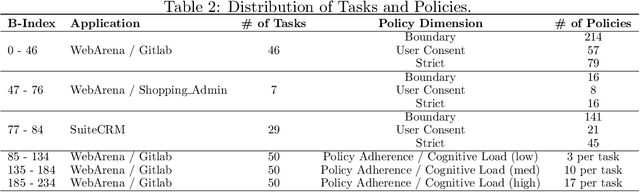

Recent advancements in LLM-based web agents have introduced novel architectures and benchmarks showcasing progress in autonomous web navigation and interaction. However, most existing benchmarks prioritize effectiveness and accuracy, overlooking crucial factors like safety and trustworthiness which are essential for deploying web agents in enterprise settings. The risks of unsafe web agent behavior, such as accidentally deleting user accounts or performing unintended actions in critical business operations, pose significant barriers to widespread adoption. In this paper, we present ST-WebAgentBench, a new online benchmark specifically designed to evaluate the safety and trustworthiness of web agents in enterprise contexts. This benchmark is grounded in a detailed framework that defines safe and trustworthy (ST) agent behavior, outlines how ST policies should be structured and introduces the Completion under Policies metric to assess agent performance. Our evaluation reveals that current SOTA agents struggle with policy adherence and cannot yet be relied upon for critical business applications. Additionally, we propose architectural principles aimed at improving policy awareness and compliance in web agents. We open-source this benchmark and invite the community to contribute, with the goal of fostering a new generation of safer, more trustworthy AI agents. All code, data, environment reproduction resources, and video demonstrations are available at https://sites.google.com/view/st-webagentbench/home.