 Add to Chrome
 Add to Firefox
 Add to Edge
EquiformerV3: Scaling Efficient, Expressive, and General SE(3)-Equivariant Graph Attention Transformers
Apr 10, 2026
As $SE(3)$-equivariant graph neural networks mature as a core tool for 3D atomistic modeling, improving their efficiency, expressivity, and physical consistency has become a central challenge for large-scale applications. In this work, we introduce EquiformerV3, the third generation of the $SE(3)$-equivariant graph attention Transformer, designed to advance all three dimensions: efficiency, expressivity, and generality. Building on EquiformerV2, we have the following three key advances. First, we optimize the software implementation, achieving $1.75\times$ speedup. Second, we introduce simple and effective modifications to EquiformerV2, including equivariant merged layer normalization, improved feedforward network hyper-parameters, and attention with smooth radius cutoff. Third, we propose SwiGLU-$S^2$ activations to incorporate many-body interactions for better theoretical expressivity and to preserve strict equivariance while reducing the complexity of sampling $S^2$ grids. Together, SwiGLU-$S^2$ activations and smooth-cutoff attention enable accurate modeling of smoothly varying potential energy surfaces (PES), generalizing EquiformerV3 to tasks requiring energy-conserving simulations and higher-order derivatives of PES. With these improvements, EquiformerV3 trained with the auxiliary task of denoising non-equilibrium structures (DeNS) achieves state-of-the-art results on OC20, OMat24, and Matbench Discovery.

Zero Shot Molecular Generation via Similarity Kernels
Feb 13, 2024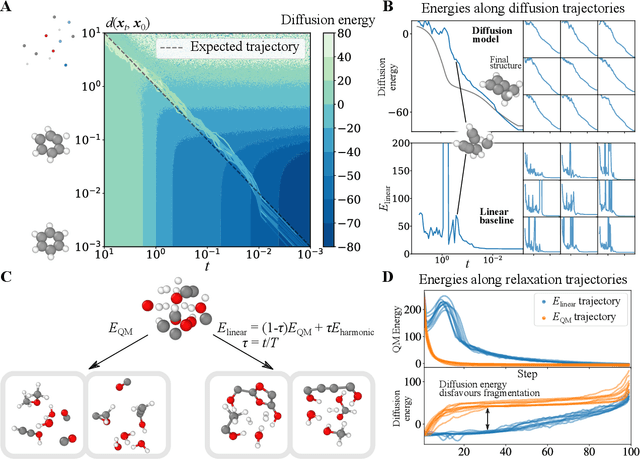
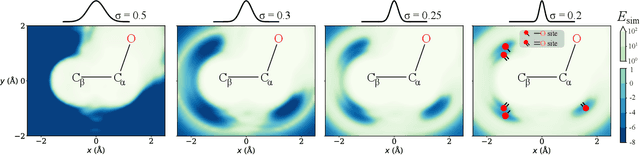
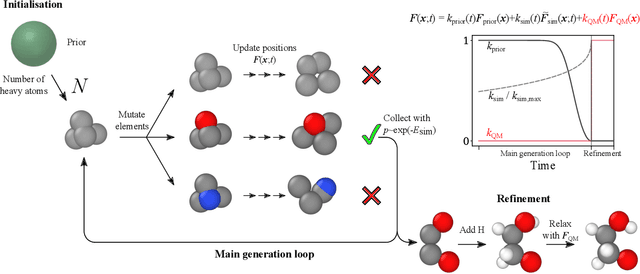
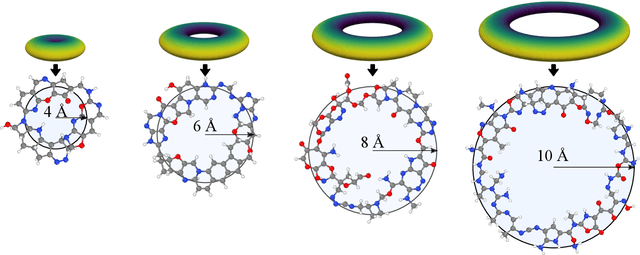
Generative modelling aims to accelerate the discovery of novel chemicals by directly proposing structures with desirable properties. Recently, score-based, or diffusion, generative models have significantly outperformed previous approaches. Key to their success is the close relationship between the score and physical force, allowing the use of powerful equivariant neural networks. However, the behaviour of the learnt score is not yet well understood. Here, we analyse the score by training an energy-based diffusion model for molecular generation. We find that during the generation the score resembles a restorative potential initially and a quantum-mechanical force at the end. In between the two endpoints, it exhibits special properties that enable the building of large molecules. Using insights from the trained model, we present Similarity-based Molecular Generation (SiMGen), a new method for zero shot molecular generation. SiMGen combines a time-dependent similarity kernel with descriptors from a pretrained machine learning force field to generate molecules without any further training. Our approach allows full control over the molecular shape through point cloud priors and supports conditional generation. We also release an interactive web tool that allows users to generate structures with SiMGen online (https://zndraw.icp.uni-stuttgart.de).