 Add to Chrome
 Add to Firefox
 Add to Edge
Facial Spatiotemporal Graphs: Leveraging the 3D Facial Surface for Remote Physiological Measurement
Jan 20, 2026
Facial remote photoplethysmography (rPPG) methods estimate physiological signals by modeling subtle color changes on the 3D facial surface over time. However, existing methods fail to explicitly align their receptive fields with the 3D facial surface-the spatial support of the rPPG signal. To address this, we propose the Facial Spatiotemporal Graph (STGraph), a novel representation that encodes facial color and structure using 3D facial mesh sequences-enabling surface-aligned spatiotemporal processing. We introduce MeshPhys, a lightweight spatiotemporal graph convolutional network that operates on the STGraph to estimate physiological signals. Across four benchmark datasets, MeshPhys achieves state-of-the-art or competitive performance in both intra- and cross-dataset settings. Ablation studies show that constraining the model's receptive field to the facial surface acts as a strong structural prior, and that surface-aligned, 3D-aware node features are critical for robustly encoding facial surface color. Together, the STGraph and MeshPhys constitute a novel, principled modeling paradigm for facial rPPG, enabling robust, interpretable, and generalizable estimation. Code is available at https://samcantrill.github.io/facial-stgraph-rppg/ .

Orientation-conditioned Facial Texture Mapping for Video-based Facial Remote Photoplethysmography Estimation
Apr 16, 2024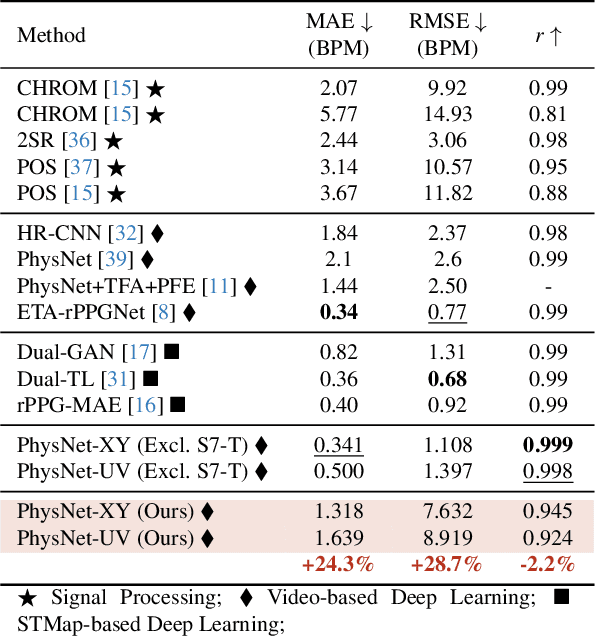
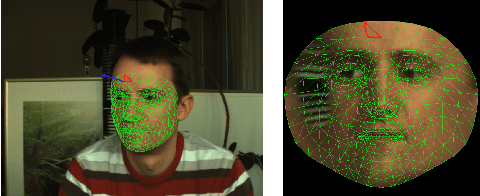
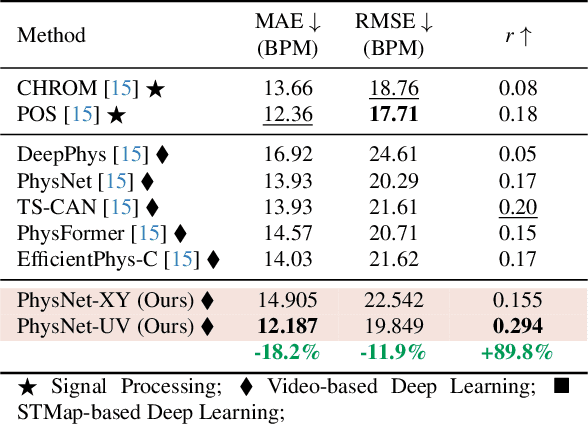
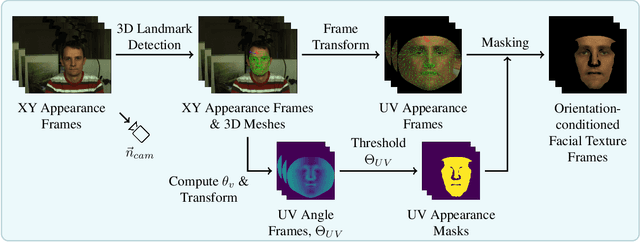
Camera-based remote photoplethysmography (rPPG) enables contactless measurement of important physiological signals such as pulse rate (PR). However, dynamic and unconstrained subject motion introduces significant variability into the facial appearance in video, confounding the ability of video-based methods to accurately extract the rPPG signal. In this study, we leverage the 3D facial surface to construct a novel orientation-conditioned facial texture video representation which improves the motion robustness of existing video-based facial rPPG estimation methods. Our proposed method achieves a significant 18.2% performance improvement in cross-dataset testing on MMPD over our baseline using the PhysNet model trained on PURE, highlighting the efficacy and generalization benefits of our designed video representation. We demonstrate significant performance improvements of up to 29.6% in all tested motion scenarios in cross-dataset testing on MMPD, even in the presence of dynamic and unconstrained subject motion, emphasizing the benefits of disentangling motion through modeling the 3D facial surface for motion robust facial rPPG estimation. We validate the efficacy of our design decisions and the impact of different video processing steps through an ablation study. Our findings illustrate the potential strengths of exploiting the 3D facial surface as a general strategy for addressing dynamic and unconstrained subject motion in videos. The code is available at https://samcantrill.github.io/orientation-uv-rppg/.