 Add to Chrome
 Add to Firefox
 Add to Edge
Integrating Object Detection, LiDAR-Enhanced Depth Estimation, and Segmentation Models for Railway Environments
Apr 16, 2026
Obstacle detection in railway environments is crucial for ensuring safety. However, very few studies address the problem using a complete, modular, and flexible system that can both detect objects in the scene and estimate their distance from the vehicle. Most works focus solely on detection, others attempt to identify the track, and only a few estimate obstacle distances. Additionally, evaluating these systems is challenging due to the lack of ground truth data. In this paper, we propose a modular and flexible framework that identifies the rail track, detects potential obstacles, and estimates their distance by integrating three neural networks for object detection, track segmentation, and monocular depth estimation with LiDAR point clouds. To enable a reliable and quantitative evaluation, the proposed framework is assessed using a synthetic dataset (SynDRA), which provides accurate ground truth annotations, allowing for direct performance comparison with existing methods. The proposed system achieves a mean absolute error (MAE) as low as 0.63 meters by integrating monocular depth maps with LiDAR, enabling not only accurate distance estimates but also spatial perception of the scene.

TrainSim: A Railway Simulation Framework for LiDAR and Camera Dataset Generation
Feb 28, 2023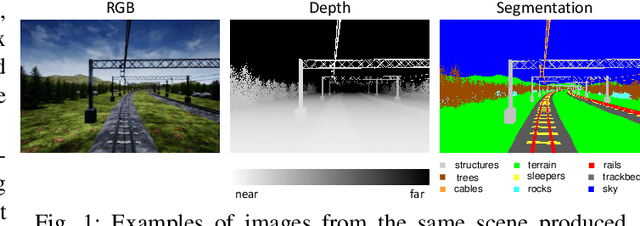
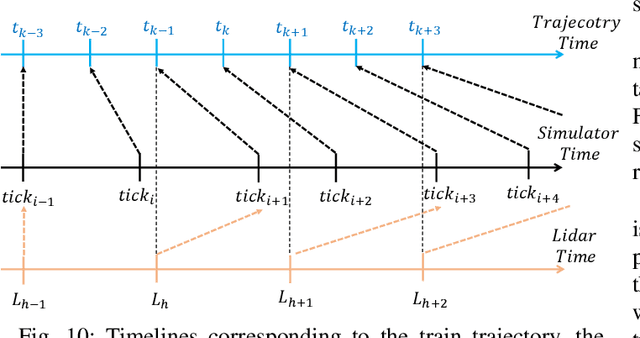
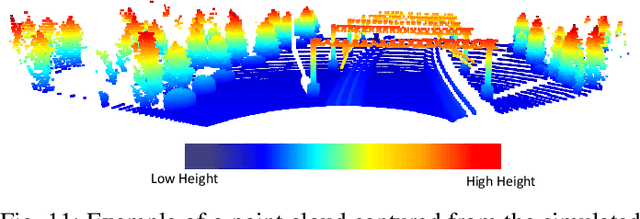
The railway industry is searching for new ways to automate a number of complex train functions, such as object detection, track discrimination, and accurate train positioning, which require the artificial perception of the railway environment through different types of sensors, including cameras, LiDARs, wheel encoders, and inertial measurement units. A promising approach for processing such sensory data is the use of deep learning models, which proved to achieve excellent performance in other application domains, as robotics and self-driving cars. However, testing new algorithms and solutions requires the availability of a large amount of labeled data, acquired in different scenarios and operating conditions, which are difficult to obtain in a real railway setting due to strict regulations and practical constraints in accessing the trackside infrastructure and equipping a train with the required sensors. To address such difficulties, this paper presents a visual simulation framework able to generate realistic railway scenarios in a virtual environment and automatically produce inertial data and labeled datasets from emulated LiDARs and cameras useful for training deep neural networks or testing innovative algorithms. A set of experimental results are reported to show the effectiveness of the proposed approach.