 Add to Chrome
 Add to Firefox
 Add to Edge
Med-SegLens: Latent-Level Model Diffing for Interpretable Medical Image Segmentation
Feb 11, 2026
Modern segmentation models achieve strong predictive performance but remain largely opaque, limiting our ability to diagnose failures, understand dataset shift, or intervene in a principled manner. We introduce Med-SegLens, a model-diffing framework that decomposes segmentation model activations into interpretable latent features using sparse autoencoders trained on SegFormer and U-Net. Through cross-architecture and cross-dataset latent alignment across healthy, adult, pediatric, and sub-Saharan African glioma cohorts, we identify a stable backbone of shared representations, while dataset shift is driven by differential reliance on population-specific latents. We show that these latents act as causal bottlenecks for segmentation failures, and that targeted latent-level interventions can correct errors and improve cross-dataset adaption without retraining, recovering performance in 70% of failure cases and improving Dice score from 39.4% to 74.2%. Our results demonstrate that latent-level model diffing provides a practical and mechanistic tool for diagnosing failures and mitigating dataset shift in segmentation models.

Improving Targeted Molecule Generation through Language Model Fine-Tuning Via Reinforcement Learning
May 10, 2024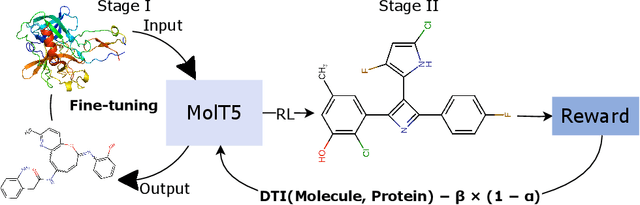
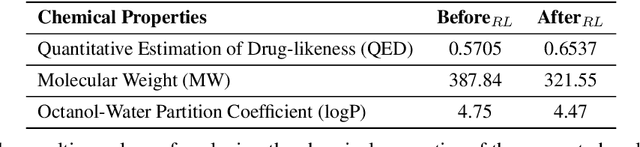
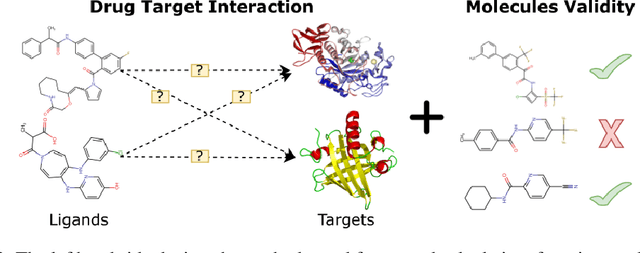
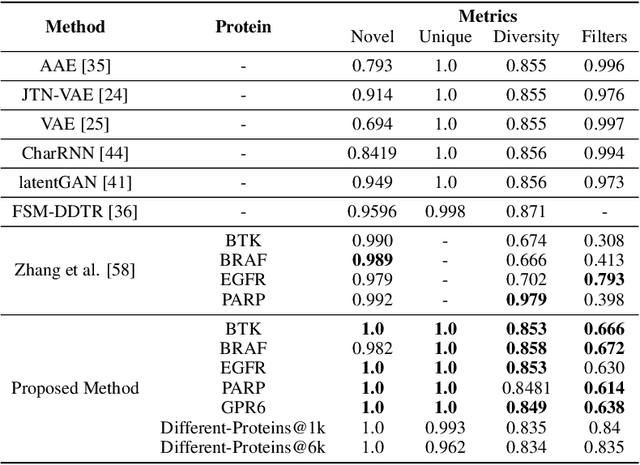
Developing new drugs is laborious and costly, demanding extensive time investment. In this study, we introduce an innovative de-novo drug design strategy, which harnesses the capabilities of language models to devise targeted drugs for specific proteins. Employing a Reinforcement Learning (RL) framework utilizing Proximal Policy Optimization (PPO), we refine the model to acquire a policy for generating drugs tailored to protein targets. Our method integrates a composite reward function, combining considerations of drug-target interaction and molecular validity. Following RL fine-tuning, our approach demonstrates promising outcomes, yielding notable improvements in molecular validity, interaction efficacy, and critical chemical properties, achieving 65.37 for Quantitative Estimation of Drug-likeness (QED), 321.55 for Molecular Weight (MW), and 4.47 for Octanol-Water Partition Coefficient (logP), respectively. Furthermore, out of the generated drugs, only 0.041\% do not exhibit novelty.