 Add to Chrome
 Add to Firefox
 Add to Edge
C-GAP: Class-Aware and Online Prompting Improves Vision-Language Models on Imbalanced Classes
Jul 10, 2026
Safety-critical perception systems must reliably detect rare object classes within small label spaces, a setting that long-tailed detection methods, designed for hundreds of classes with dense annotation, fundamentally do not address. Open-vocabulary detectors offer a promising alternative, as they use natural language queries at inference time, making prompt quality a first-class lever for detection performance. We exploit this property to address class imbalance: rather than retraining models or collecting additional annotations, we ask whether iteratively refining the language prompts, fed to frozen detectors, can improve minority class detection. We introduce C-GAP Caption-Guided Augmentation and Prompting), a detector-agnostic, annotation-free framework that operates in two phases. First, we establish a composite caption baseline combining per-image scene descriptions with class-quantity context, which we show outperforms scene-description only or class-quantity-only prompts across multiple open-vocabulary architectures and benchmarks. Second, an LLM iteratively refines each image's caption individually, with trials triaged into accept, tentative, or regenerate buckets based on minority-class AP@0.5 against a dynamic threshold derived from the composite baseline. Refinement terminates early once sufficient AP@0.5 gain is achieved. No detector weights are updated at any stage. Our experiments shows that C-GAP improves minority-class average precision up to 53% over the baselines. On COCO, C-GAP improves minority-class AP@0.5 by ~81% relative over the composite baseline (17.69 -> 32.09). Experiments confirm that composite captions provide the critical foundation for effective refinement: using scene-description-only or class-quantity-only prompts as the refinement starting point yields diminishing returns, supporting both stages of C-GAP as necessary contributions.

Cross-Contextual Vision-Language Adaptation with LoRA for Personalized Severe Adverse Event Detection in Clinical Wound Monitoring
Jul 06, 2026Wound monitoring is a critical yet underserved clinical challenge, where timely identification of severe adverse events (SAEs) such as infection, tissue deterioration, and delayed healing can significantly impact patient outcomes. While vision-language models (VLMs) show strong multimodal reasoning, they often lack domain-specific grounding to integrate wound imagery with heterogeneous clinical information, and provide limited mechanisms for detecting cases that diverge from the training distribution. We present a multimodal framework for automated wound monitoring and SAE detection. Our approach leverages paired clinical notes and wound descriptions capturing visual characteristics such as appearance, surrounding skin condition, color changes, and signs of inflammation or healing progression, encoded through a dual-stream Low-Rank Adaptation (LoRA) framework built on a frozen BiomedCLIP backbone. We introduce a cross-contextual LoRA fusion mechanism enabling information exchange between clinical semantics and visual wound descriptors, producing context-aware multimodal representations without full model fine-tuning. To identify personalized SAEs, we propose a wound-specific out-of-distribution (OOD) detection framework combining semantic matching, visual typicality, caption-text alignment, and caption-visual alignment into a unified SAE (OOD) score. To capture healing dynamics, we incorporate covariate consistency and temporal drift penalties that leverage changes in wound characteristics across visits. Experiments on a longitudinal wound dataset collected through clinical visits show promising performance on both wound healing assessment and SAE detection, highlighting the potential of semantically enriched, temporally aware vision-language systems for clinical wound monitoring and early risk identification.
Theoretical Grounding of Out-Of-Distribution Detection With Reinforcement Learning Optimizer
Jun 16, 2026Out-of-distribution (OOD) detection in dynamic open-world environments requires a model to continually adapt to evolving data distributions while generalizing to covariate-shifted inputs and rejecting semantic-shifted OOD examples. Most existing OOD detection methods optimize only the current-step objective and do not explicitly account for how post-deployment environment changes affect future OOD behavior. In this paper, we establish a theoretical grounding for dynamic OOD detection using a reinforcement learning (RL)-guided optimizer that explicitly favors updates that reduce the semantic OOD false positive rate over time. We develop a novel augmented optimizer that uses an RL-guided correction term on top of standard gradient descent (GD) and show its improvement over both future-domain generalization and semantic-OOD rejection. We analyze temporal error decomposition in terms of model-change and environment-change generalization errors and develop a new theoretical framework for comparing the generalization errors under both GD and RL-guided optimizers.
Understanding Cross-Modal Contributions in Continual Vision-Language Models: A Theoretical Perspective
Jun 12, 2026Continual vision-language models are commonly addressed through sequential fine-tuning; however, although this paradigm enables adaptation to new environments (tasks), it inherently emphasizes the contribution of previously learned environments (tasks) at the expense of the stability required to preserve previously acquired knowledge. While existing approaches have adequately studied continual learning and catastrophic forgetting in vision-language models (VLMs), the theoretical understanding of modality-specific contributions across a sequence of environments remains largely unexplored. In this paper, we present a new theoretical perspective to understand the cross-modal (vision-language) contributions to consecutive environments. We empirically evaluate our theoretical findings on large VLMs and demonstrate their effectiveness in capturing environment-level cross-modal contributions. Our analysis provides deeper insights into continual VLMs, highlighting their contribution robustness to varying task orders and inter-task similarities, and their improved generalization performance.
T-QPM: Enabling Temporal Out-Of-Distribution Detection and Domain Generalization for Vision-Language Models in Open-World
Mar 19, 2026Out-of-distribution (OOD) detection remains a critical challenge in open-world learning, where models must adapt to evolving data distributions. While recent vision-language models (VLMS) like CLIP enable multimodal OOD detection through Dual-Pattern Matching (DPM), existing methods typically suffer from two major shortcomings: (1) They rely on fixed fusion rules and assume static environments, failing under temporal drift; and (2) they lack robustness against covariate shifted inputs. In this paper, we propose a novel two-step framework to enhance OOD detection and covariate distribution shift robustness in dynamic settings. We extend the dual-pattern regime into Temporal Quadruple-Pattern Matching (T-QPM). First, by pairing OOD images with text descriptions, we introduce cross-modal consistency patterns between ID and OOD signals, refining the decision boundary through joint image-text reasoning. Second, we address temporal distribution shifts by learning lightweight fusion weights to optimally combine semantic matching and visual typicality. To ensure stability, we enforce explicit regularization based on Average Thresholded Confidence (ATC), preventing performance degradation as distributions evolve. Experiments on temporally partitioned benchmarks demonstrate that our approach significantly outperforms static baselines, offering a robust, temporally-consistent framework for multimodal OOD detection in non-stationary environments.
Weather-Aware Object Detection Transformer for Domain Adaptation
Apr 15, 2025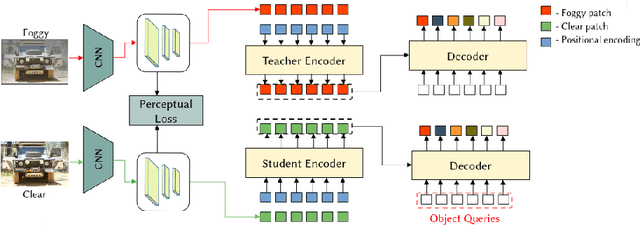
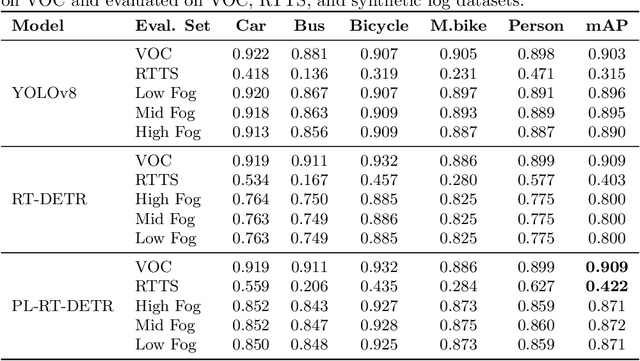
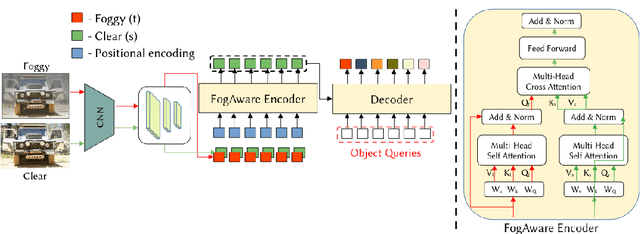
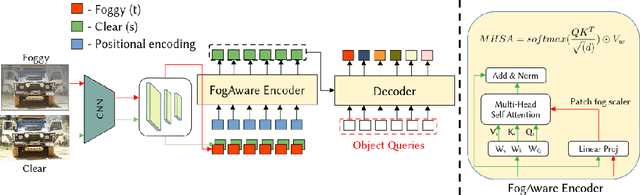
RT-DETRs have shown strong performance across various computer vision tasks but are known to degrade under challenging weather conditions such as fog. In this work, we investigate three novel approaches to enhance RT-DETR robustness in foggy environments: (1) Domain Adaptation via Perceptual Loss, which distills domain-invariant features from a teacher network to a student using perceptual supervision; (2) Weather Adaptive Attention, which augments the attention mechanism with fog-sensitive scaling by introducing an auxiliary foggy image stream; and (3) Weather Fusion Encoder, which integrates a dual-stream encoder architecture that fuses clear and foggy image features via multi-head self and cross-attention. Despite the architectural innovations, none of the proposed methods consistently outperform the baseline RT-DETR. We analyze the limitations and potential causes, offering insights for future research in weather-aware object detection.