 Add to Chrome
 Add to Firefox
 Add to Edge
Projected Hessian Learning: Fast Curvature Supervision for Accurate Machine-Learning Interatomic Potentials
Mar 04, 2026
The Hessian matrix (second derivatives) encodes far richer local curvature of the potential energy surface than energies and forces alone. However, training machine-learning interatomic potentials (MLIPs) with full Hessians is often impractical because explicitly forming and storing Hessian matrices scales quadratically in cost and memory. We introduce Projected Hessian Learning (PHL), a scalable second-order training framework that injects curvature information using only Hessian-vector products (HVPs). Rather than constructing the Hessian, PHL projects curvature along stochastic probe directions and uses an unbiased stochastic trace-based loss with favorable system-size scaling, enabling curvature-informed training without quadratic memory growth. We benchmark PHL on a chemically diverse dataset of reactants, products, transition states, intrinsic reaction coordinates, and normal-mode sampled geometries computed at omegaB97XD/6-31G(d). We compare energy-force training (E-F), two HVP-based schemes (E-F-HVP with one-hot or randomized probes), and full energy-force-Hessian training (E-F-H). With randomized probes per minibatch, both HVP schemes match full-Hessian training in energy, force, and Hessian accuracy while delivering >24x epoch speedups for the small molecular systems studied. In a fixed-probe regime with one HVP per molecule, randomized projections consistently outperform one-column probing, especially for far-from-equilibrium geometries. Overall, PHL replaces explicit Hessian supervision with force-complexity curvature training, retaining most second-order accuracy gains while scaling to larger, more complex molecular systems.

Ensemble Knowledge Distillation for Machine Learning Interatomic Potentials
Mar 19, 2025Machine learning interatomic potentials (MLIPs) are a promising tool to accelerate atomistic simulations and molecular property prediction. The quality of MLIPs strongly depends on the quantity of available training data as well as the quantum chemistry (QC) level of theory used to generate that data. Datasets generated with high-fidelity QC methods, such as coupled cluster, are typically restricted to small molecules and may be missing energy gradients. With this limited quantity of data, it is often difficult to train good MLIP models. We present an ensemble knowledge distillation (EKD) method to improve MLIP accuracy when trained to energy-only datasets. In our EKD approach, first, multiple teacher models are trained to QC energies and then used to generate atomic forces for all configurations in the dataset. Next, a student MLIP is trained to both QC energies and to ensemble-averaged forces generated by the teacher models. We apply this workflow on the ANI-1ccx dataset which consists of organic molecules with configuration energies computed at the coupled cluster level of theory. The resulting student MLIPs achieve new state-of-the-art accuracy on the out-of-sample COMP6 benchmark and improved stability for molecular dynamics simulations. The EKD approach for MLIP is broadly applicable for chemical, biomolecular and materials science simulations.
Teacher-student training improves accuracy and efficiency of machine learning inter-atomic potentials
Feb 07, 2025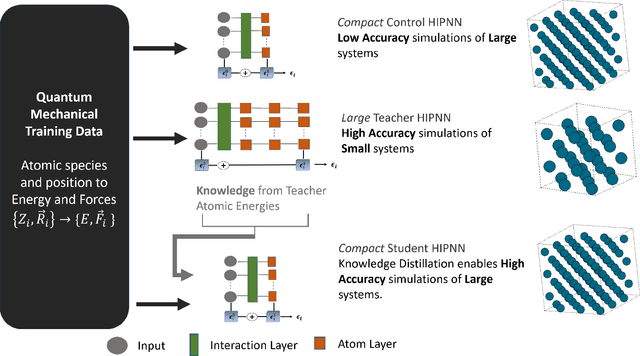
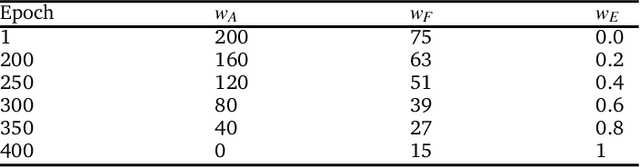
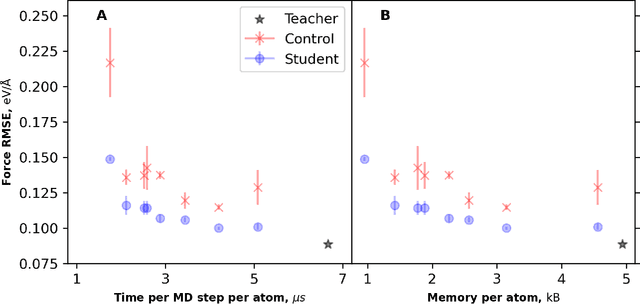
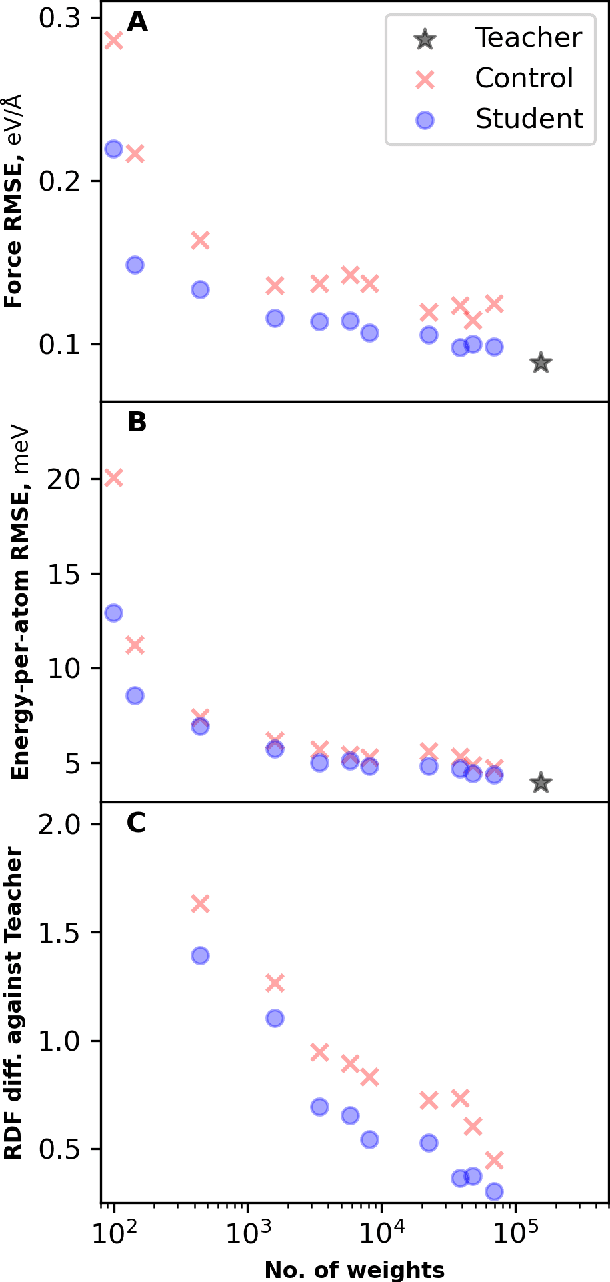
Machine learning inter-atomic potentials (MLIPs) are revolutionizing the field of molecular dynamics (MD) simulations. Recent MLIPs have tended towards more complex architectures trained on larger datasets. The resulting increase in computational and memory costs may prohibit the application of these MLIPs to perform large-scale MD simulations. Here, we present a teacher-student training framework in which the latent knowledge from the teacher (atomic energies) is used to augment the students' training. We show that the light-weight student MLIPs have faster MD speeds at a fraction of the memory footprint compared to the teacher models. Remarkably, the student models can even surpass the accuracy of the teachers, even though both are trained on the same quantum chemistry dataset. Our work highlights a practical method for MLIPs to reduce the resources required for large-scale MD simulations.
Thermodynamic Transferability in Coarse-Grained Force Fields using Graph Neural Networks
Jun 17, 2024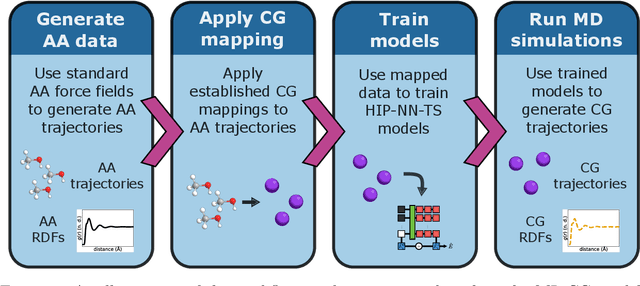
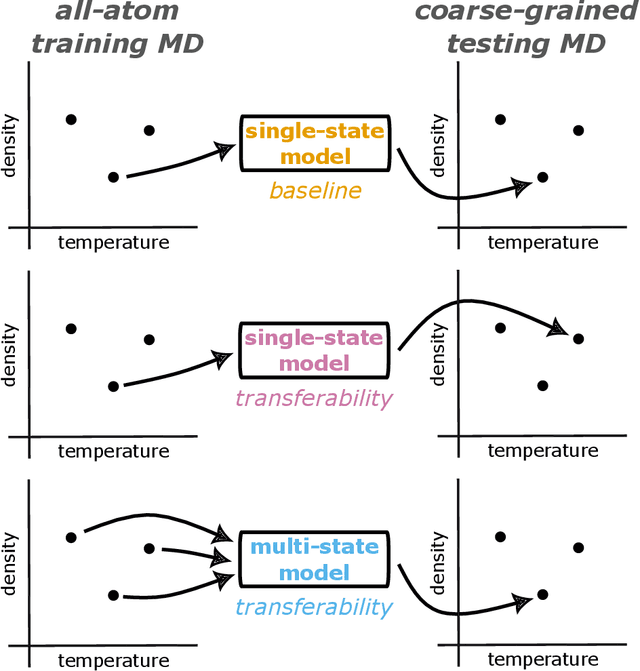
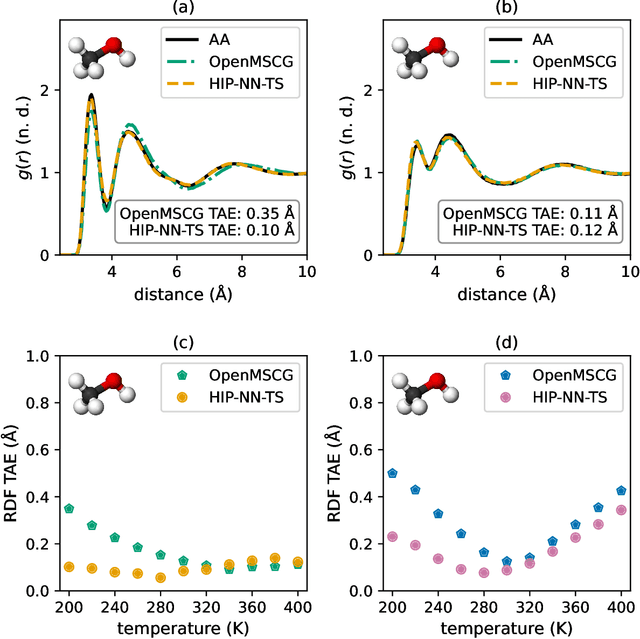
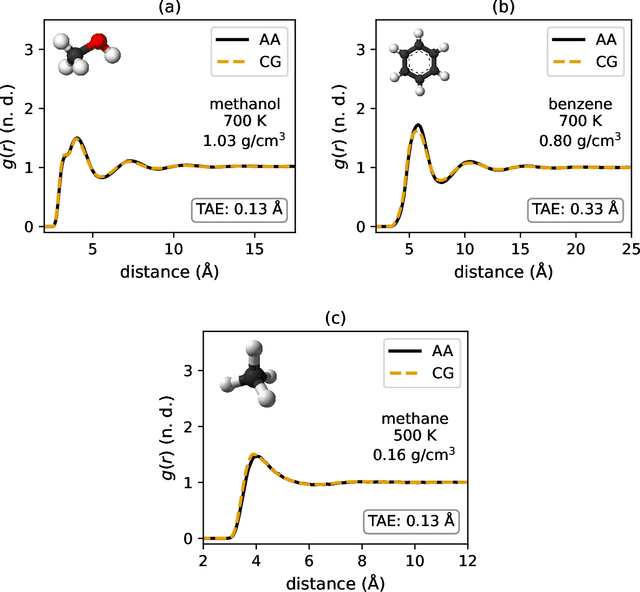
Coarse-graining is a molecular modeling technique in which an atomistic system is represented in a simplified fashion that retains the most significant system features that contribute to a target output, while removing the degrees of freedom that are less relevant. This reduction in model complexity allows coarse-grained molecular simulations to reach increased spatial and temporal scales compared to corresponding all-atom models. A core challenge in coarse-graining is to construct a force field that represents the interactions in the new representation in a way that preserves the atomistic-level properties. Many approaches to building coarse-grained force fields have limited transferability between different thermodynamic conditions as a result of averaging over internal fluctuations at a specific thermodynamic state point. Here, we use a graph-convolutional neural network architecture, the Hierarchically Interacting Particle Neural Network with Tensor Sensitivity (HIP-NN-TS), to develop a highly automated training pipeline for coarse grained force fields which allows for studying the transferability of coarse-grained models based on the force-matching approach. We show that this approach not only yields highly accurate force fields, but also that these force fields are more transferable through a variety of thermodynamic conditions. These results illustrate the potential of machine learning techniques such as graph neural networks to improve the construction of transferable coarse-grained force fields.