 Add to Chrome
 Add to Firefox
 Add to Edge
Beyond Top-K: Replacing Black-Box Retrieval with Interpretable Agentic Operations
Aug 07, 2026
Retrieval-augmented generation over long documents is dominated by one design: chunk the text, embed the chunks, and surface the top-k nearest neighbours of the query. We argue that for an important class of documents -- financial statements, audit reports, regulatory returns -- this design is structurally unsound, and we make the argument measurable. On a 780-page government financial report, 86.8% of content lines are table rows, thousands of near-identical figures compete in one embedding space, and a figure inherits its unit from a header a median of 13 lines above it -- so a chunk boundary routinely separates a number from whether it is in lakh or crore, an error of two orders of magnitude. A table-aware chunker built as a steelman fixes the unit problem but leaves 27-30% of numeric chunks with no fiscal-year header at every chunk size we tried. We propose READ (Reliable Embedding-free Agentic Document-search), in which an agent reads the raw document through three deterministic operations -- normalized lexical search, structural navigation, and bounded span reads -- exposed over the Model Context Protocol, so a trajectory is a replayable audit trail, not an opaque similarity score. On 51 verified questions READ answers 58.8% against dense retrieval's 15.7% (p_Holm = 2 x 10^-5) -- or 35.3% tuned, which READ still leads by 23.5 points (p_Holm = 0.017). An agent given the same loop but a top-k tool reaches only 27.5%, locating the gain in the interface rather than in iteration. We also report what the evidence does not support: BM25 is statistically indistinguishable from READ, so our result separates embedding-based from embedding-free retrieval, not agentic from lexical search.

Enforcement Agents: Enhancing Accountability and Resilience in Multi-Agent AI Frameworks
Apr 05, 2025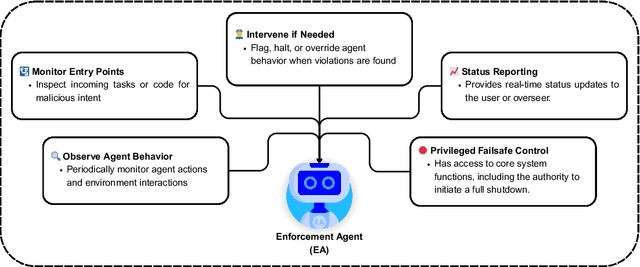
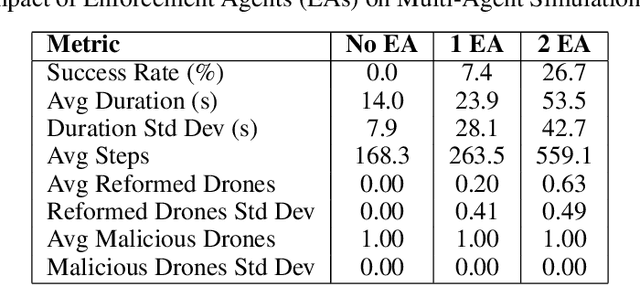
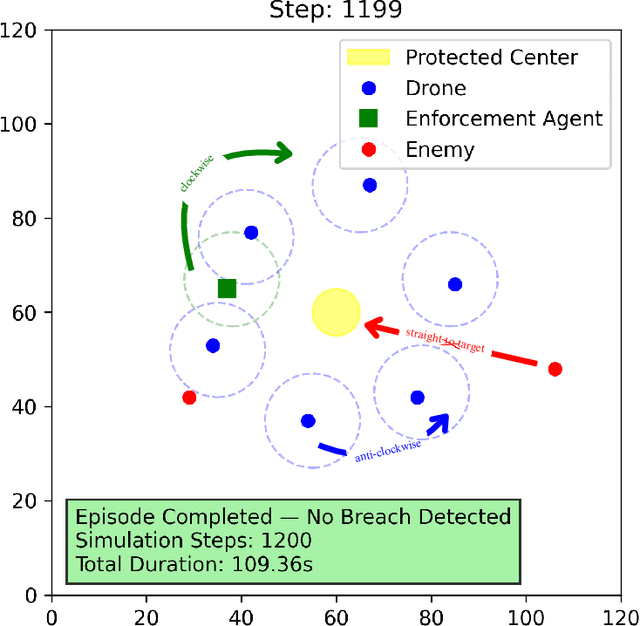
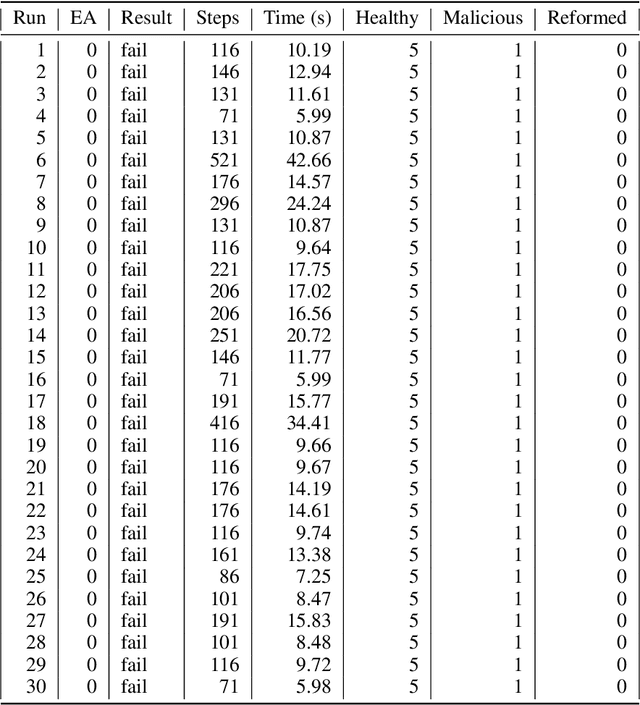
As autonomous agents become more powerful and widely used, it is becoming increasingly important to ensure they behave safely and stay aligned with system goals, especially in multi-agent settings. Current systems often rely on agents self-monitoring or correcting issues after the fact, but they lack mechanisms for real-time oversight. This paper introduces the Enforcement Agent (EA) Framework, which embeds dedicated supervisory agents into the environment to monitor others, detect misbehavior, and intervene through real-time correction. We implement this framework in a custom drone simulation and evaluate it across 90 episodes using 0, 1, and 2 EA configurations. Results show that adding EAs significantly improves system safety: success rates rise from 0.0% with no EA to 7.4% with one EA and 26.7% with two EAs. The system also demonstrates increased operational longevity and higher rates of malicious drone reformation. These findings highlight the potential of lightweight, real-time supervision for enhancing alignment and resilience in multi-agent systems.