 Add to Chrome
 Add to Firefox
 Add to Edge
Verifiable Rewards for Calibrated Probabilistic Forecasting
Jun 30, 2026
Reinforcement learning with verifiable rewards can in principle train calibrated probabilistic forecasters, since a proper scoring rule such as the Brier score is computed from outcomes alone and is minimized in expectation by the true probability. In practice it degrades calibration, and existing remedies address epistemic uncertainty, where a model's confidence accompanies a verifiably correct or incorrect answer. We study aleatoric forecasting, where the forecast itself is the output and the label is one stochastic outcome, taking NFL in-game win probability as a testbed with the betting market as a reference. Rewarding the realized per-play outcome fails, because the single outcome is a noisy target and the policy gradient corrupts the chain of thought. We introduce a verifiable, label-free reward, a state-conditioned empirical win rate estimated from past outcomes, that removes the label noise, and we keep the gradient off the reasoning, by direct prediction or a gradient mask, so it cannot be corrupted. Trained with this reward alone, without human labels or supervised fine-tuning, a 7B model reaches the calibration of the betting market by direct prediction and is better calibrated than a zero-shot frontier model. That frontier model and a tabular estimator reach the same Brier score as this model, identifying the market's small remaining edge as live in-game information beyond their shared inputs. Masking the gradient, rather than dropping the chain of thought, preserves reasoning from which the forecast follows, which ordinary chain-of-thought training corrupts.

Beyond the Smile: A Hybrid Convolutional VAE for Crypto Volatility Surfaces
Jun 15, 2026We present a convolutional variational autoencoder for cryptocurrency implied-volatility surfaces, together with a deployable predictor that combines it with a quadratic smile re-fit through a deterministic per-tenor routing rule. Trained on 6,034 fully-filled hourly Binance Options surfaces of BTC and ETH spanning May-October 2023 and parameterised on a common $6 \times 7$ tenor-delta grid, the model attains a hidden-cell surface-completion RMSE in the 0.94-1.56 vol-point range across both markets and mask rates 10-50%. The hybrid predictor attains 0.83 vol points at 50% masking against 7.00 for the smile re-fit alone, an eightfold reduction obtained at no additional inference cost. Under structurally-correlated hole patterns that emulate the withdrawal of an entire tenor of strikes, the smile re-fit incurs 9.6-13.1 vol points of error while the learned model remains at 1.5-1.9, isolating a regime in which the generative model is the only viable predictor. Joint training on BTC and ETH improves the in-distribution model on both markets by 9-27% relative to the better-performing single-symbol counterpart, indicating a substantially shared vol-surface manifold across the two largest cryptocurrencies over the observation window. The hybrid is calendar- and butterfly-arbitrage-free at the listed strikes, a property that the parametric smile re-fit alone fails at high mask rates. The per-snapshot reconstruction error of the trained model flags the late-October ETF-anticipation rally and the August $17$, $2023$ flash crash as elevated-error periods without supervision. All training and evaluation infrastructure is released to support reproducible follow-on work.
Deep is a Luxury We Don't Have
Aug 11, 2022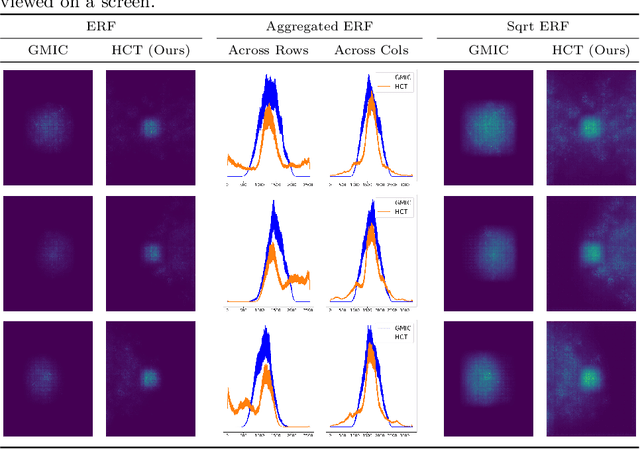
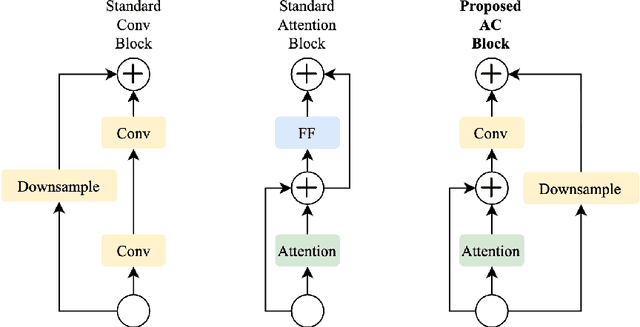
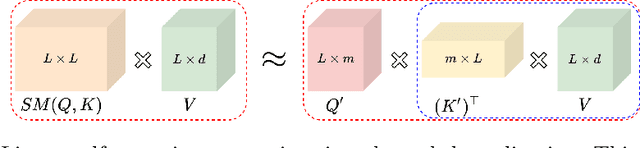
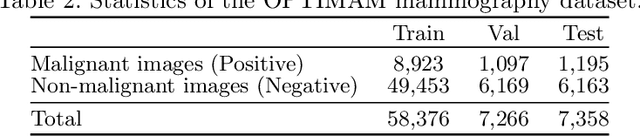
Medical images come in high resolutions. A high resolution is vital for finding malignant tissues at an early stage. Yet, this resolution presents a challenge in terms of modeling long range dependencies. Shallow transformers eliminate this problem, but they suffer from quadratic complexity. In this paper, we tackle this complexity by leveraging a linear self-attention approximation. Through this approximation, we propose an efficient vision model called HCT that stands for High resolution Convolutional Transformer. HCT brings transformers' merits to high resolution images at a significantly lower cost. We evaluate HCT using a high resolution mammography dataset. HCT is significantly superior to its CNN counterpart. Furthermore, we demonstrate HCT's fitness for medical images by evaluating its effective receptive field.Code available at https://bit.ly/3ykBhhf
A multi-site study of a breast density deep learning model for full-field digital mammography and digital breast tomosynthesis exams
Jan 23, 2020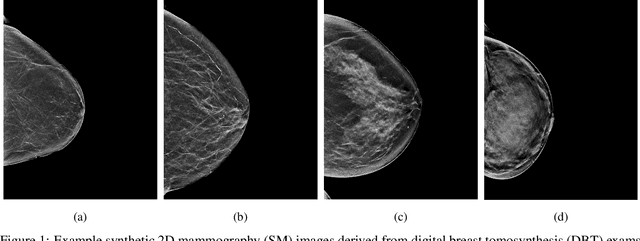
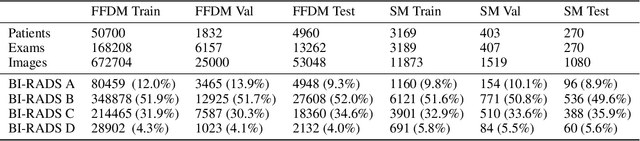
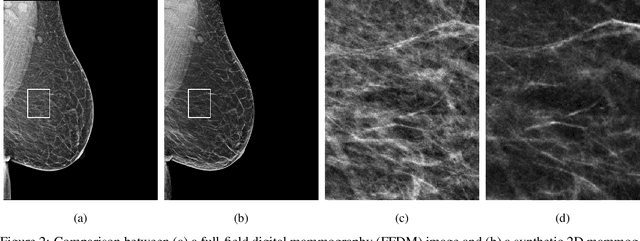
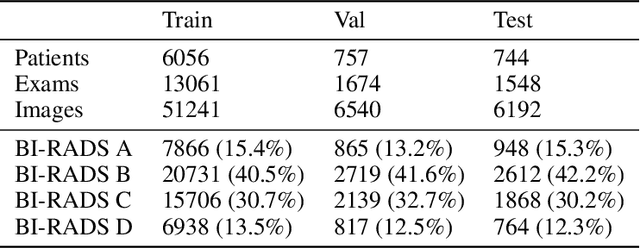
$\textbf{Purpose:}$ To develop a Breast Imaging Reporting and Data System (BI-RADS) breast density DL model in a multi-site setting for synthetic 2D mammography (SM) images derived from 3D DBT exams using FFDM images and limited SM data. $\textbf{Materials and Methods:}$ A DL model was trained to predict BI-RADS breast density using FFDM images acquired from 2008 to 2017 (Site 1: 57492 patients, 187627 exams, 750752 images) for this retrospective study. The FFDM model was evaluated using SM datasets from two institutions (Site 1: 3842 patients, 3866 exams, 14472 images, acquired from 2016 to 2017; Site 2: 7557 patients, 16283 exams, 63973 images, 2015 to 2019). Adaptation methods were investigated to improve performance on the SM datasets and the effect of dataset size on each adaptation method is considered. Statistical significance was assessed using confidence intervals (CI), estimated by bootstrapping. $\textbf{Results:}$ Without adaptation, the model demonstrated close agreement with the original reporting radiologists for all three datasets (Site 1 FFDM: linearly-weighted $\kappa_w$ = 0.75, 95\% CI: [0.74, 0.76]; Site 1 SM: $\kappa_w$ = 0.71, CI: [0.64, 0.78]; Site 2 SM: $\kappa_w$ = 0.72, CI: [0.70, 0.75]). With adaptation, performance improved for Site 2 (Site 1: $\kappa_w$ = 0.72, CI: [0.66, 0.79], Site 2: $\kappa_w$ = 0.79, CI: [0.76, 0.81]) using only 500 SM images from each site. $\textbf{Conclusion:}$ A BI-RADS breast density DL model demonstrated strong performance on FFDM and SM images from two institutions without training on SM images and improved using few SM images.
A Hypersensitive Breast Cancer Detector
Jan 23, 2020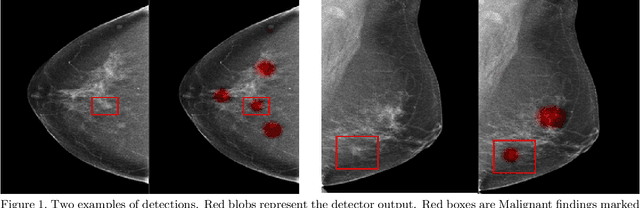
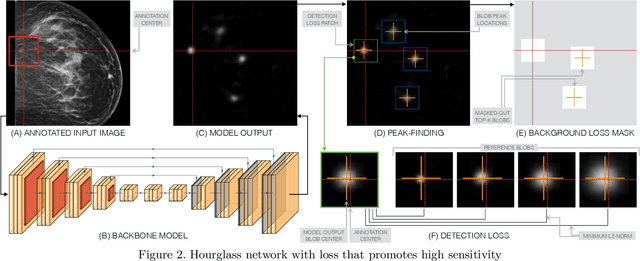
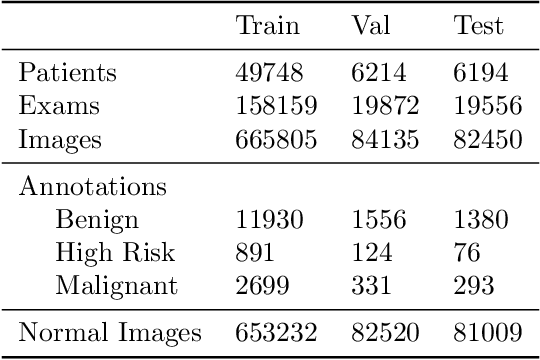
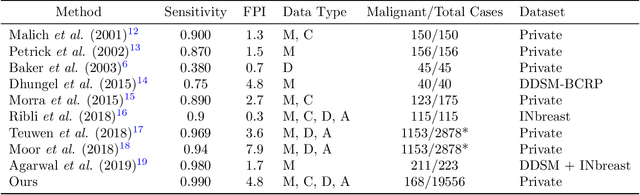
Early detection of breast cancer through screening mammography yields a 20-35% increase in survival rate; however, there are not enough radiologists to serve the growing population of women seeking screening mammography. Although commercial computer aided detection (CADe) software has been available to radiologists for decades, it has failed to improve the interpretation of full-field digital mammography (FFDM) images due to its low sensitivity over the spectrum of findings. In this work, we leverage a large set of FFDM images with loose bounding boxes of mammographically significant findings to train a deep learning detector with extreme sensitivity. Building upon work from the Hourglass architecture, we train a model that produces segmentation-like images with high spatial resolution, with the aim of producing 2D Gaussian blobs centered on ground-truth boxes. We replace the pixel-wise $L_2$ norm with a weak-supervision loss designed to achieve high sensitivity, asymmetrically penalizing false positives and false negatives while softening the noise of the loose bounding boxes by permitting a tolerance in misaligned predictions. The resulting system achieves a sensitivity for malignant findings of 0.99 with only 4.8 false positive markers per image. When utilized in a CADe system, this model could enable a novel workflow where radiologists can focus their attention with trust on only the locations proposed by the model, expediting the interpretation process and bringing attention to potential findings that could otherwise have been missed. Due to its nearly perfect sensitivity, the proposed detector can also be used as a high-performance proposal generator in two-stage detection systems.
Adaptation of a deep learning malignancy model from full-field digital mammography to digital breast tomosynthesis
Jan 23, 2020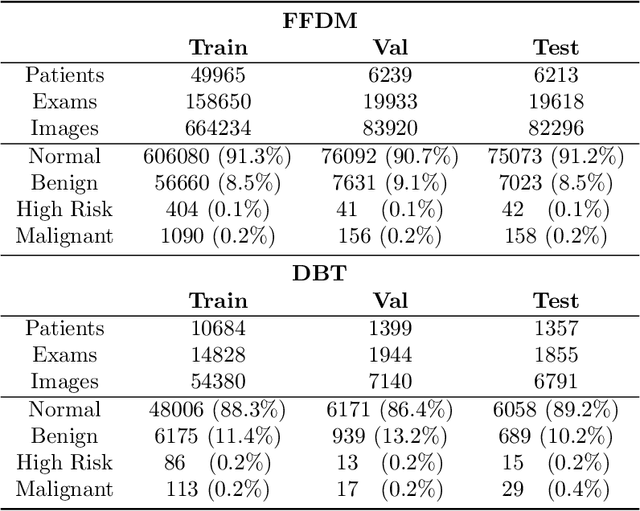
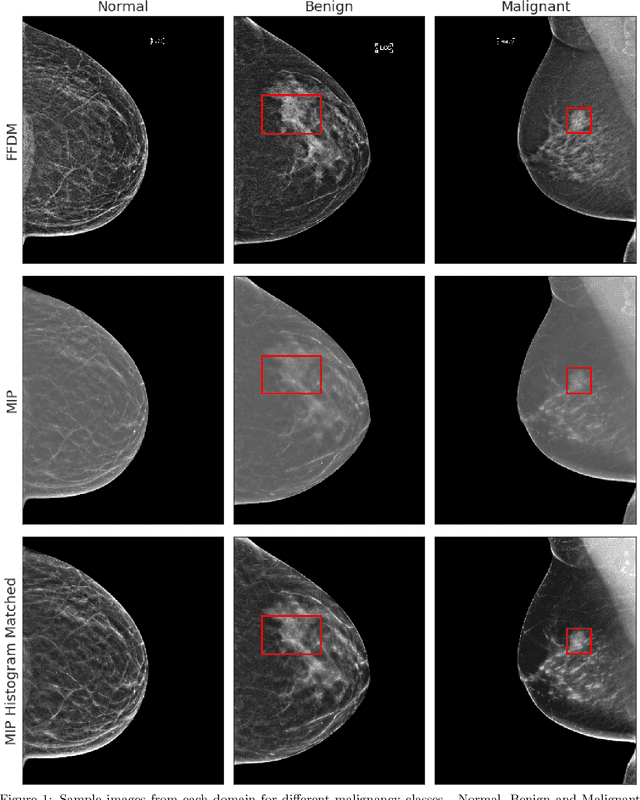
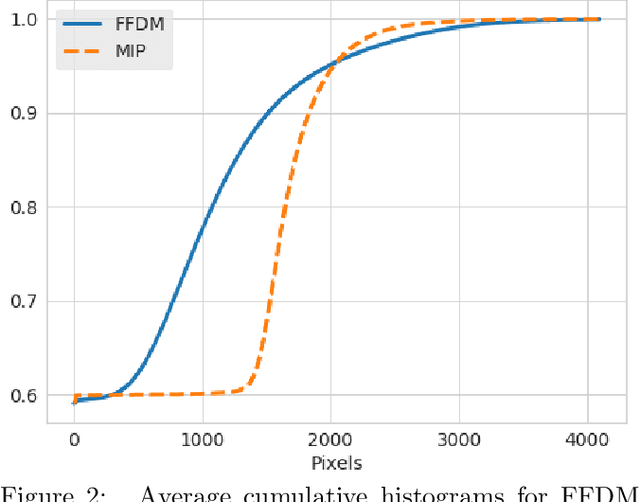
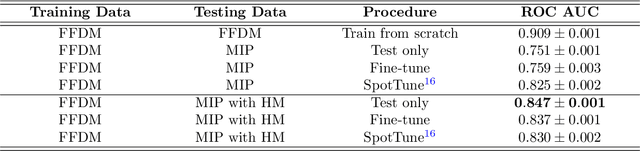
Mammography-based screening has helped reduce the breast cancer mortality rate, but has also been associated with potential harms due to low specificity, leading to unnecessary exams or procedures, and low sensitivity. Digital breast tomosynthesis (DBT) improves on conventional mammography by increasing both sensitivity and specificity and is becoming common in clinical settings. However, deep learning (DL) models have been developed mainly on conventional 2D full-field digital mammography (FFDM) or scanned film images. Due to a lack of large annotated DBT datasets, it is difficult to train a model on DBT from scratch. In this work, we present methods to generalize a model trained on FFDM images to DBT images. In particular, we use average histogram matching (HM) and DL fine-tuning methods to generalize a FFDM model to the 2D maximum intensity projection (MIP) of DBT images. In the proposed approach, the differences between the FFDM and DBT domains are reduced via HM and then the base model, which was trained on abundant FFDM images, is fine-tuned. When evaluating on image patches extracted around identified findings, we are able to achieve similar areas under the receiver operating characteristic curve (ROC AUC) of $\sim 0.9$ for FFDM and $\sim 0.85$ for MIP images, as compared to a ROC AUC of $\sim 0.75$ when tested directly on MIP images.