 Add to Chrome
 Add to Firefox
 Add to Edge
Hydrodynamic Performance Enhancement of Unmanned Underwater Gliders with Soft Robotic Morphing Wings for Agility Improvement
Feb 23, 2026
This work assesses the hydrodynamic efficiency of Underwater Unmanned Vehicles (UUVs) equipped with soft morphing wings compared to conventional rigid wings. Unlike rigid wings, deformable counterparts can alter their aerodynamic properties on demand. Improvements in hydrodynamic efficiency extend a UUV's operational range and may determine mission feasibility. Structural and Computational Fluid Dynamics (CFD) simulations were conducted for both a soft morphing wing and a UUV incorporating it. The results show that a UUV employing soft wings achieves 9.75 percent higher overall efficiency than an equivalent vehicle with traditional rigid wings. These findings confirm the potential of soft robotics to enhance underwater vehicle performance, particularly in applications requiring pressure-agnostic operation.

AMBER: Aerial deployable gripping crawler with compliant microspine for canopy manipulation
Dec 08, 2025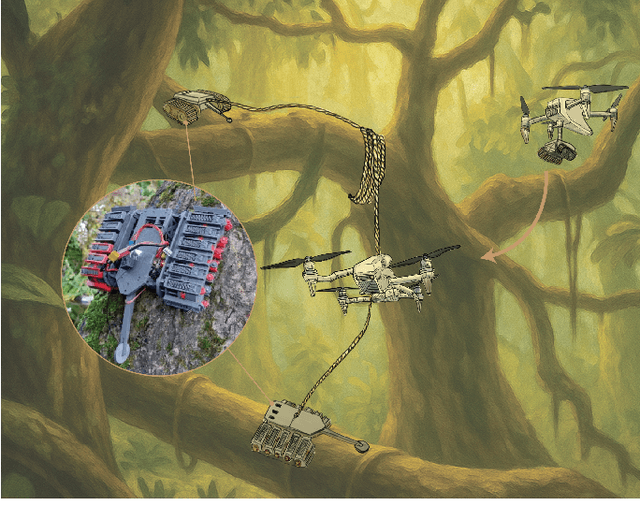
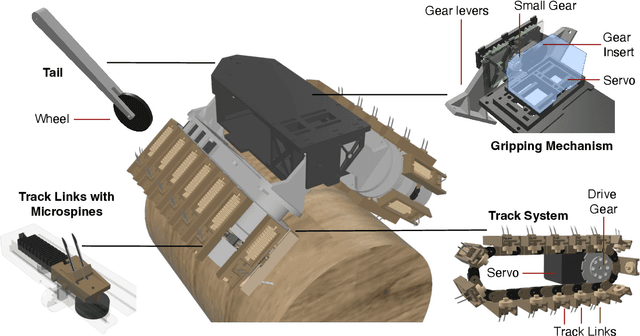
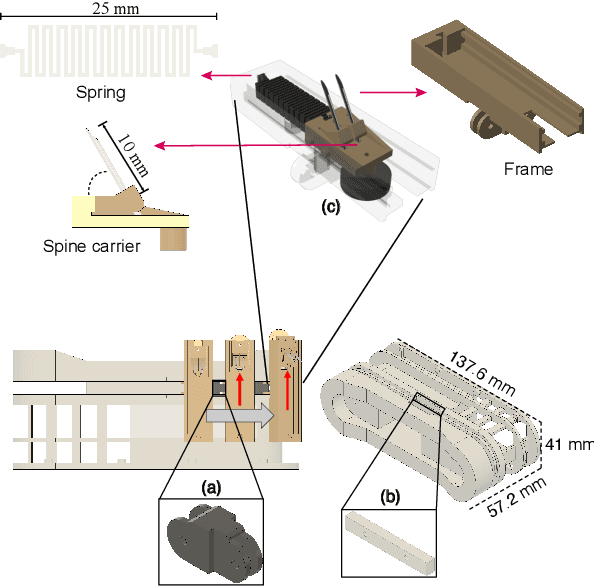
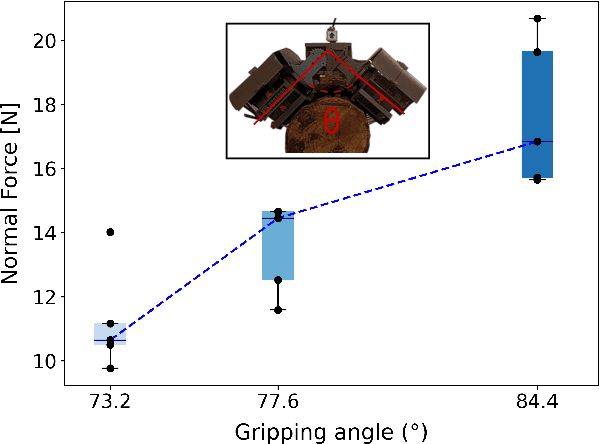
This paper presents an aerially deployable crawler designed for adaptive locomotion and manipulation within tree canopies. The system combines compliant microspine-based tracks, a dual-track rotary gripper, and an elastic tail, enabling secure attachment and stable traversal across branches of varying curvature and inclination. Experiments demonstrate reliable gripping up to 90 degrees of body roll and inclination, while effective climbing on branches inclined up to 67.5 degrees, achieving a maximum speed of 0.55 body lengths per second on horizontal branches. The compliant tracks allow yaw steering of up to 10 degrees, enhancing maneuverability on irregular surfaces. Power measurements show efficient operation with a dimensionless cost of transport over an order of magnitude lower than typical hovering power consumption in aerial robots. Integrated within a drone-tether deployment system, the crawler provides a robust, low-power platform for environmental sampling and in-canopy sensing, bridging the gap between aerial and surface-based ecological robotics.
TumblerBots: Tumbling Robotic sensors for Minimally-invasive Benthic Monitoring
Oct 30, 2024Robotic systems show significant promise for water environmental sensing applications such as water quality monitoring, pollution mapping and biodiversity data collection. Conventional deployment methods often disrupt fragile ecosystems, preventing depiction of the undisturbed environmental condition. In response to this challenge, we propose a novel framework utilizing a lightweight tumbler system equipped with a sensing unit, deployed via a drone. This design minimizes disruption to the water habitat by maintaining a slow descent. The sensing unit is detached once on the water surface, enabling precise and non-invasive data collection from the benthic zone. The tumbler is designed to be lightweight and compact, enabling deployment via a drone. The sensing pod, which detaches from the tumbler and descends to the bottom of the water body, is equipped with temperature and pressure sensors, as well as a buoyancy system. The later, activated upon task completion, utilizes a silicon membrane inflated via a chemical reaction. The reaction generates a pressure of 70 kPa, causing the silicon membrane to expand by 30\%, which exceeds the 5.7\% volume increase required for positive buoyancy. The tumblers, made from ecofriendly materials to minimize environmental impact when lost during the mission, were tested for their gliding ratio and descent rate. They exhibit a low descent rate, in the range of 0.8 to 2.5 meters per seconds, which minimizes disturbance to the ecosystem upon water landing. Additionally, the system demonstrated robustness in moderate to strong wind conditions during outdoor tests, validating the overall framework.