 Add to Chrome
 Add to Firefox
 Add to Edge
LLMStructBench: Benchmarking Large Language Model Structured Data Extraction
Feb 16, 2026
We present LLMStructBench, a novel benchmark for evaluating Large Language Models (LLMs) on extracting structured data and generating valid JavaScript Object Notation (JSON) outputs from natural-language text. Our open dataset comprises diverse, manually verified parsing scenarios of varying complexity and enables systematic testing across 22 models and five prompting strategies. We further introduce complementary performance metrics that capture both token-level accuracy and document-level validity, facilitating rigorous comparison of model, size, and prompting effects on parsing reliability. In particular, we show that choosing the right prompting strategy is more important than standard attributes such as model size. This especially ensures structural validity for smaller or less reliable models but increase the number of semantic errors. Our benchmark suite is an step towards future research in the area of LLM applied to parsing or Extract, Transform and Load (ETL) applications.

Feedback-driven object detection and iterative model improvement
Nov 29, 2024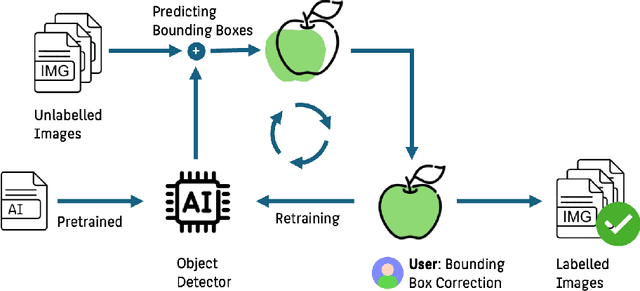
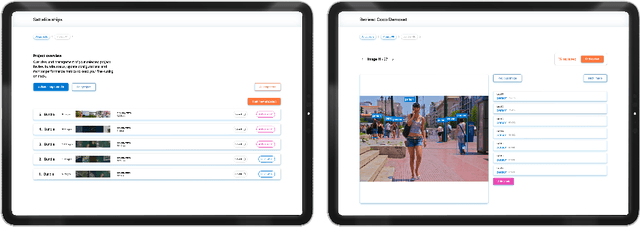

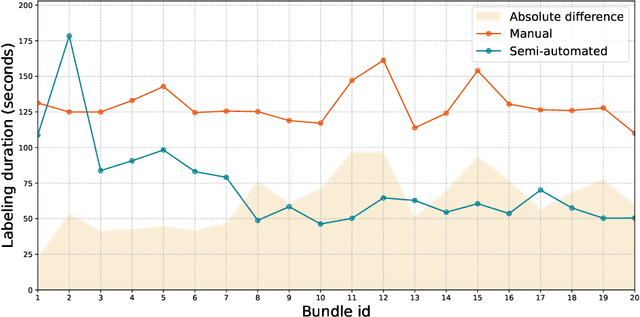
Automated object detection has become increasingly valuable across diverse applications, yet efficient, high-quality annotation remains a persistent challenge. In this paper, we present the development and evaluation of a platform designed to interactively improve object detection models. The platform allows uploading and annotating images as well as fine-tuning object detection models. Users can then manually review and refine annotations, further creating improved snapshots that are used for automatic object detection on subsequent image uploads - a process we refer to as semi-automatic annotation resulting in a significant gain in annotation efficiency. Whereas iterative refinement of model results to speed up annotation has become common practice, we are the first to quantitatively evaluate its benefits with respect to time, effort, and interaction savings. Our experimental results show clear evidence for a significant time reduction of up to 53% for semi-automatic compared to manual annotation. Importantly, these efficiency gains did not compromise annotation quality, while matching or occasionally even exceeding the accuracy of manual annotations. These findings demonstrate the potential of our lightweight annotation platform for creating high-quality object detection datasets and provide best practices to guide future development of annotation platforms. The platform is open-source, with the frontend and backend repositories available on GitHub.