 Add to Chrome
 Add to Firefox
 Add to Edge
Constraint-Aware Counterfactual Editing for Aspect-Based Sentiment Analysis
Jul 15, 2026
Aspect-Based Sentiment Analysis (ABSA) requires models to identify sentiment toward specific aspects rather than relying on the global polarity of a sentence. This makes counterfactual evaluation especially challenging: a valid counterfactual should flip the sentiment of one target aspect while preserving the sentiment of all non-target aspects, semantic meaning, fluency, and factual consistency. Existing counterfactual generation methods often focus on sentence-level label flipping and may produce edits that are fluent but aspect-invalid, semantically drifting, or contradictory. To address this limitation, we propose CAVE-ABSA, a Constraint-Aware Validated Editing framework for generating and validating aspect-level counterfactuals. CAVE-ABSA localizes the opinion span associated with the target aspect, performs controlled counterfactual rewriting, refines candidates through a repair module, and filters them using aspect-level verification, semantic similarity, AMR-guided structural preservation, edit minimality, fluency, and contradiction detection. The framework is designed to construct validated counterfactual ABSA datasets for robustness evaluation and data augmentation. By explicitly separating generation from validation, CAVE-ABSA provides a principled approach for producing meaningful aspect-local counterfactuals and for testing whether ABSA models truly rely on aspect-grounded sentiment reasoning.

Exploiting Adaptive Contextual Masking for Aspect-Based Sentiment Analysis
Feb 21, 2024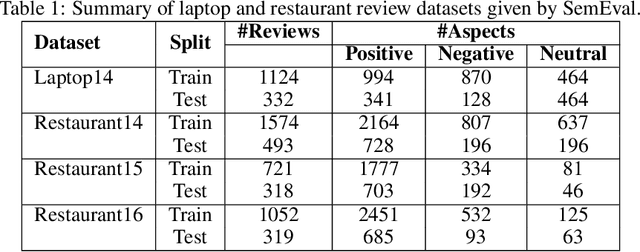
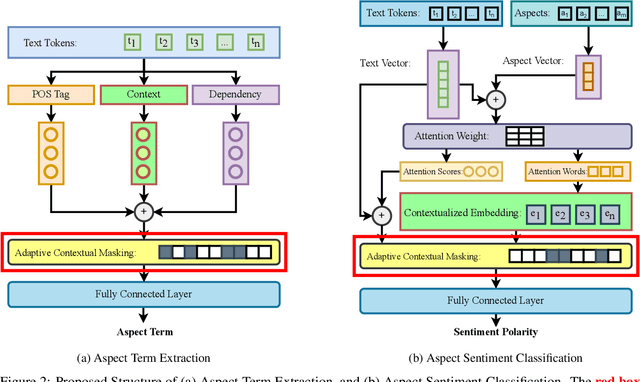
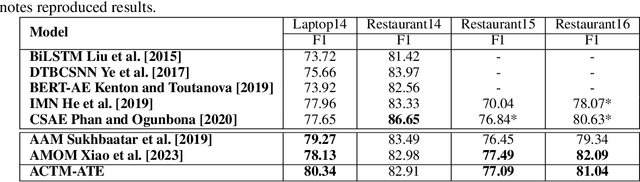
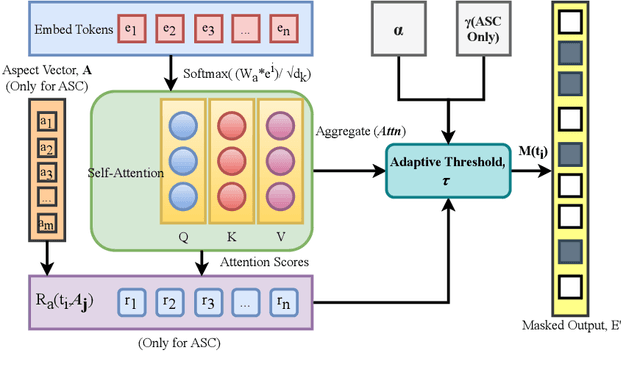
Aspect-Based Sentiment Analysis (ABSA) is a fine-grained linguistics problem that entails the extraction of multifaceted aspects, opinions, and sentiments from the given text. Both standalone and compound ABSA tasks have been extensively used in the literature to examine the nuanced information present in online reviews and social media posts. Current ABSA methods often rely on static hyperparameters for attention-masking mechanisms, which can struggle with context adaptation and may overlook the unique relevance of words in varied situations. This leads to challenges in accurately analyzing complex sentences containing multiple aspects with differing sentiments. In this work, we present adaptive masking methods that remove irrelevant tokens based on context to assist in Aspect Term Extraction and Aspect Sentiment Classification subtasks of ABSA. We show with our experiments that the proposed methods outperform the baseline methods in terms of accuracy and F1 scores on four benchmark online review datasets. Further, we show that the proposed methods can be extended with multiple adaptations and demonstrate a qualitative analysis of the proposed approach using sample text for aspect term extraction.