 Add to Chrome
 Add to Firefox
 Add to Edge
DeReCo: Decoupling Representation and Coordination Learning for Object-Adaptive Decentralized Multi-Robot Cooperative Transport
Mar 09, 2026
Generalizing decentralized multi-robot cooperative transport across objects with diverse shapes and physical properties remains a fundamental challenge. Under decentralized execution, two key challenges arise: object-dependent representation learning under partial observability and coordination learning in multi-agent reinforcement learning (MARL) under non-stationarity. A typical approach jointly optimizes object-dependent representations and coordinated policies in an end-to-end manner while randomizing object shapes and physical properties during training. However, this joint optimization tightly couples representation and coordination learning, introducing bidirectional interference: inaccurate representations under partial observability destabilize coordination learning, while non-stationarity in MARL further degrades representation learning, resulting in sample-inefficient training. To address this structural coupling, we propose DeReCo, a novel MARL framework that decouples representation and coordination learning for object-adaptive multi-robot cooperative transport, improving sample efficiency and generalization across objects and transport scenarios. DeReCo adopts a three-stage training strategy: (1) centralized coordination learning with privileged object information, (2) reconstruction of object-dependent representations from local observations, and (3) progressive removal of privileged information for decentralized execution. This decoupling mitigates interference between representation and coordination learning and enables stable and sample-efficient training. Experimental results show that DeReCo outperforms baselines in simulation on three training objects, generalizes to six unseen objects with varying masses and friction coefficients, and achieves superior performance on two unseen objects in real-robot experiments.

Cooperative Grasping and Transportation using Multi-agent Reinforcement Learning with Ternary Force Representation
Nov 21, 2024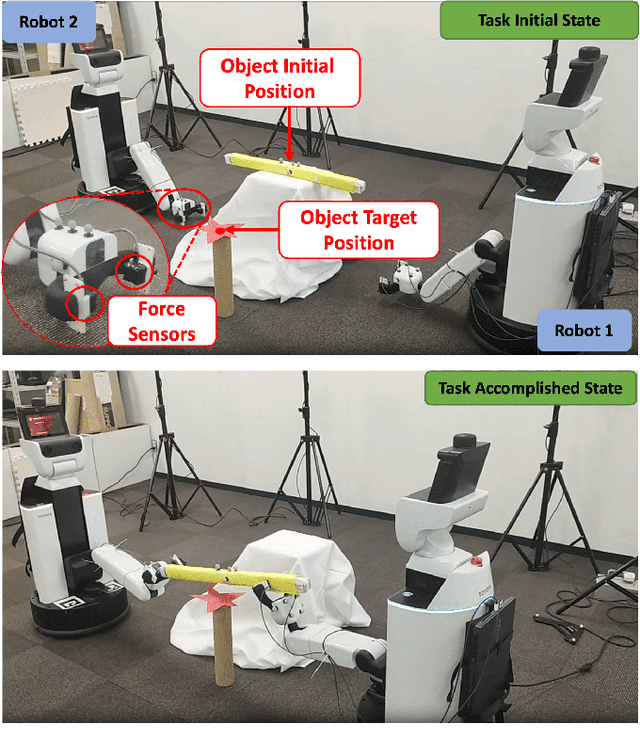
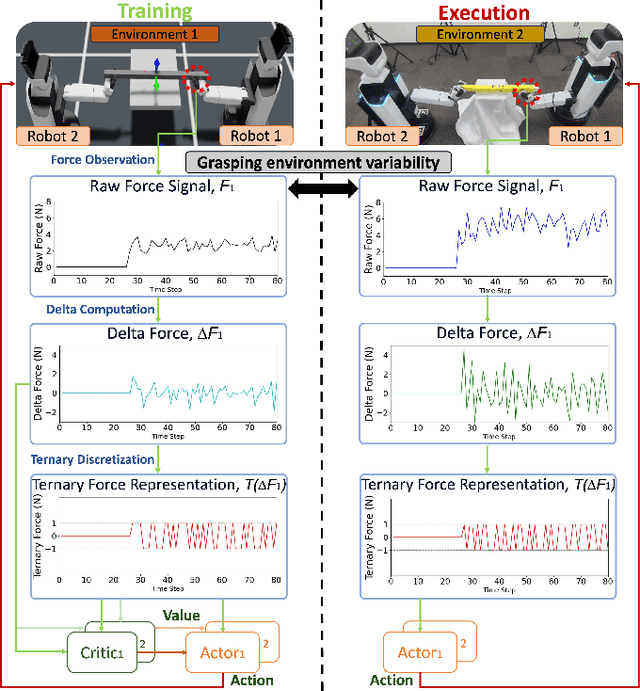
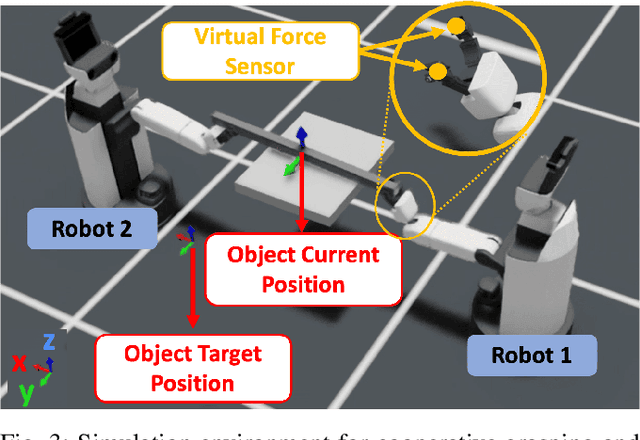
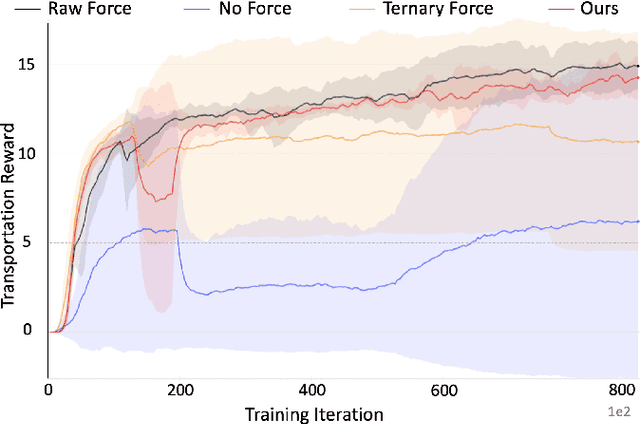
Cooperative grasping and transportation require effective coordination to complete the task. This study focuses on the approach leveraging force-sensing feedback, where robots use sensors to detect forces applied by others on an object to achieve coordination. Unlike explicit communication, it avoids delays and interruptions; however, force-sensing is highly sensitive and prone to interference from variations in grasping environment, such as changes in grasping force, grasping pose, object size and geometry, which can interfere with force signals, subsequently undermining coordination. We propose multi-agent reinforcement learning (MARL) with ternary force representation, a force representation that maintains consistent representation against variations in grasping environment. The simulation and real-world experiments demonstrate the robustness of the proposed method to changes in grasping force, object size and geometry as well as inherent sim2real gap.