 Add to Chrome
 Add to Firefox
 Add to Edge
End-to-end Differentiable Calibration and Reconstruction for Optical Particle Detectors
Feb 27, 2026
Large-scale homogeneous detectors with optical readouts are widely used in particle detection, with Cherenkov and scintillator neutrino detectors as prominent examples. Analyses in experimental physics rely on high-fidelity simulators to translate sensor-level information into physical quantities of interest. This task critically depends on accurate calibration, which aligns simulation behavior with real detector data, and on tracking, which infers particle properties from optical signals. We present the first end-to-end differentiable optical particle detector simulator, enabling simultaneous calibration and reconstruction through gradient-based optimization. Our approach unifies simulation, calibration, and tracking, which are traditionally treated as separate problems, within a single differentiable framework. We demonstrate that it achieves smooth and physically meaningful gradients across all key stages of light generation, propagation, and detection while maintaining computational efficiency. We show that gradient-based calibration and reconstruction greatly simplify existing analysis pipelines while matching or surpassing the performance of conventional non-differentiable methods in both accuracy and speed. Moreover, the framework's modularity allows straightforward adaptation to diverse detector geometries and target materials, providing a flexible foundation for experiment design and optimization. The results demonstrate the readiness of this technique for adoption in current and future optical detector experiments, establishing a new paradigm for simulation and reconstruction in particle physics.

Machine Learning Guided Discovery of Gigantic Magnetocaloric Effect in HoB$_{2}$ Near Hydrogen Liquefaction Temperature
May 12, 2020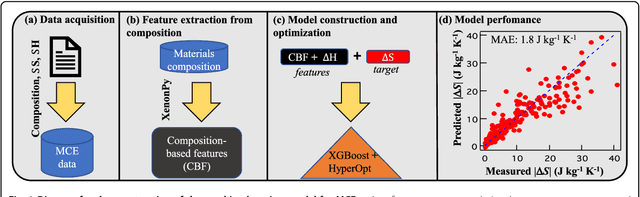

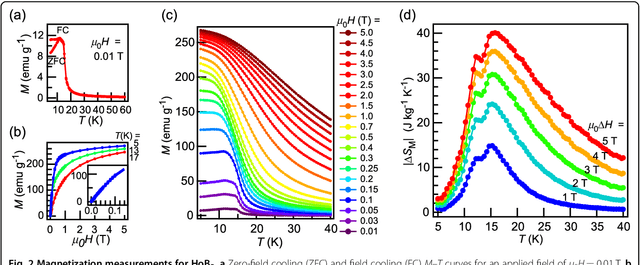
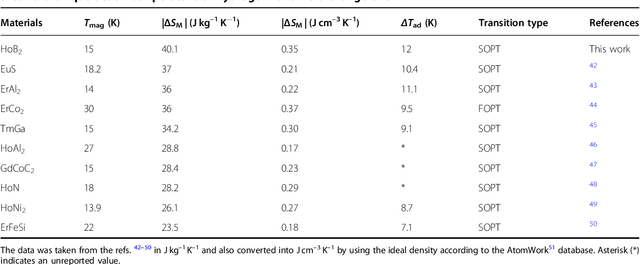
Magnetic refrigeration exploits the magnetocaloric effect which is the entropy change upon application and removal of magnetic fields in materials, providing an alternate path for refrigeration other than the conventional gas cycles. While intensive research has uncovered a vast number of magnetic materials which exhibits large magnetocaloric effect, these properties for a large number of compounds still remain unknown. To explore new functional materials in this unknown space, machine learning is used as a guide for selecting materials which could exhibit large magnetocaloric effect. By this approach, HoB$_{2}$ is singled out, synthesized and its magnetocaloric properties are evaluated, leading to the experimental discovery of gigantic magnetic entropy change 40.1 J kg$^{-1}$ K$^{-1}$ (0.35 J cm$^{-3}$ K$^{-1}$) for a field change of 5 T in the vicinity of a ferromagnetic second-order phase transition with a Curie temperature of 15 K. This is the highest value reported so far, to our knowledge, near the hydrogen liquefaction temperature thus it is a highly suitable material for hydrogen liquefaction and low temperature magnetic cooling applications.
* 12 pages including 3 figures and 1 table + 11 pages of supplementary information. Published version available at: https://rdcu.be/b36ep