 Add to Chrome
 Add to Firefox
 Add to Edge
WAR: Workload-Aware Rollouts for Synchronous Agentic Reinforcement Learning
Jul 19, 2026
Long-horizon rollout generation has become the dominant systems bottleneck in agentic reinforcement learning (RL). As agents interact with environments over many turns, trajectories rapidly grow to tens of thousands of tokens, making synchronous RL training increasingly constrained by rollout. We propose WAR, a workload-aware rollout system that substantially accelerates synchronous agentic RL by jointly optimizing decoding and scheduling. WAR is built on a key observation: the optimal rollout optimization strategy depends on runtime load: (1) Under low load, WAR enables model-free speculative decoding with SuffixDecoding, which reuses suffix patterns from previously completed trajectories as speculative drafts for future rollouts. Unlike model-based drafters, SuffixDecoding introduces no additional draft model and avoids GPU contention with rollout generation. (2) Under high load, where saturated batched decoding leaves limited room for speculative speedup, WAR shifts the optimization focus to cache-aware scheduling. A global scheduler places requests across rollout replicas based on cache locality, trajectory progress and server load, reducing redundant KV-cache recomputation and mitigating load imbalance. By combining decoding-level suffix reuse with system-level rollout scheduling, WAR delivers robust throughput improvements across workload regimes without changing the underlying RL algorithm. WAR improves long-context agentic rollout throughput by 1.4x under low load and up to 1.6x under high load. These results show that WAR removes a major rollout bottleneck in synchronous agentic RL and provides a practical path toward scalable long-context agent training.

Semantic Context Matters: Improving Conditioning for Autoregressive Models
Nov 18, 2025Recently, autoregressive (AR) models have shown strong potential in image generation, offering better scalability and easier integration with unified multi-modal systems compared to diffusion-based methods. However, extending AR models to general image editing remains challenging due to weak and inefficient conditioning, often leading to poor instruction adherence and visual artifacts. To address this, we propose SCAR, a Semantic-Context-driven method for Autoregressive models. SCAR introduces two key components: Compressed Semantic Prefilling, which encodes high-level semantics into a compact and efficient prefix, and Semantic Alignment Guidance, which aligns the last visual hidden states with target semantics during autoregressive decoding to enhance instruction fidelity. Unlike decoding-stage injection methods, SCAR builds upon the flexibility and generality of vector-quantized-based prefilling while overcoming its semantic limitations and high cost. It generalizes across both next-token and next-set AR paradigms with minimal architectural changes. SCAR achieves superior visual fidelity and semantic alignment on both instruction editing and controllable generation benchmarks, outperforming prior AR-based methods while maintaining controllability. All code will be released.
Benchmarking LLM Code Generation for Audio Programming with Visual Dataflow Languages
Sep 01, 2024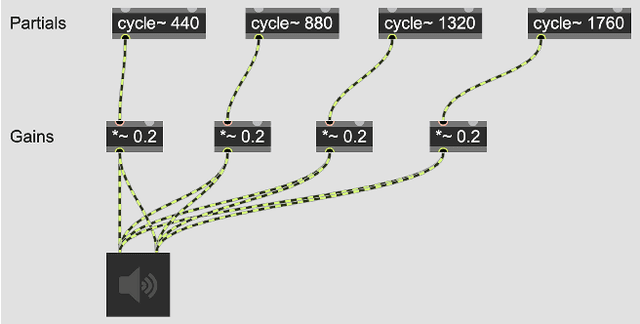
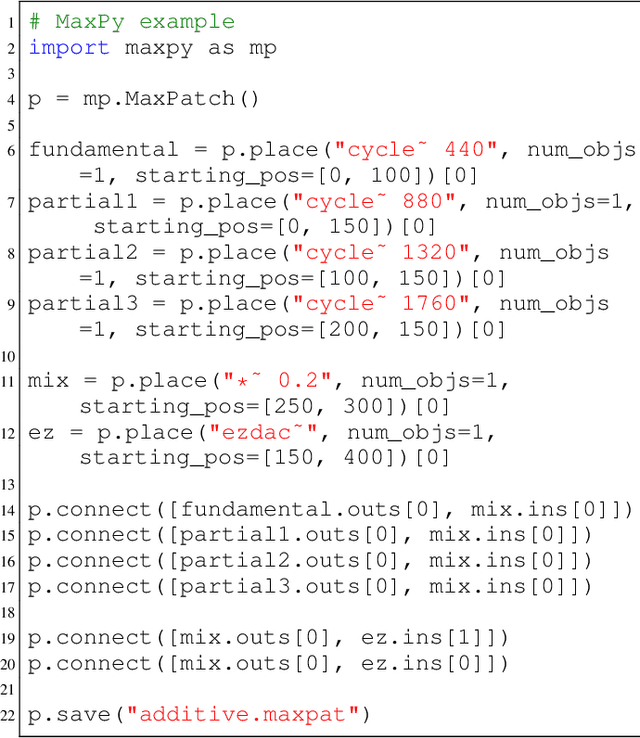
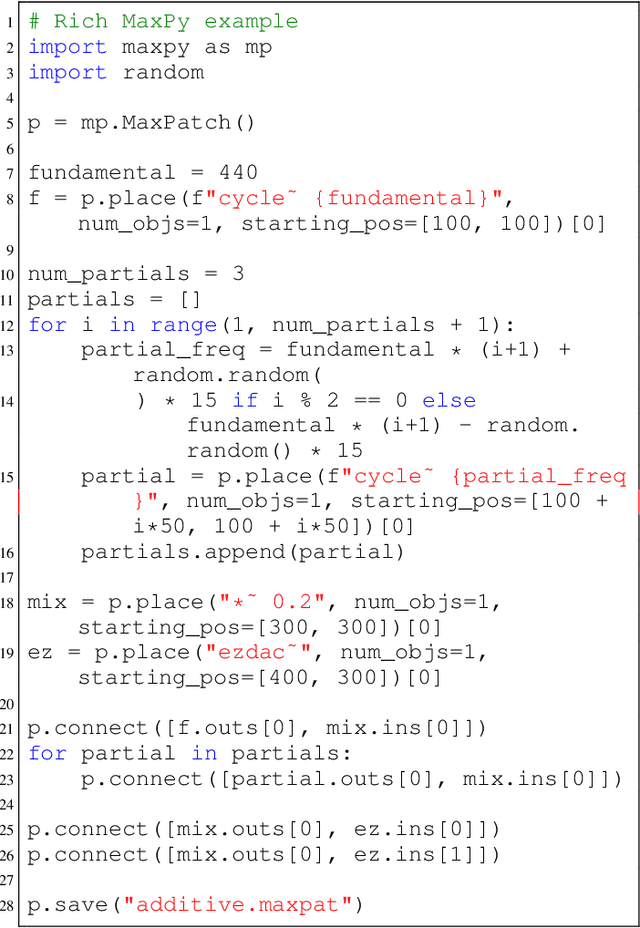
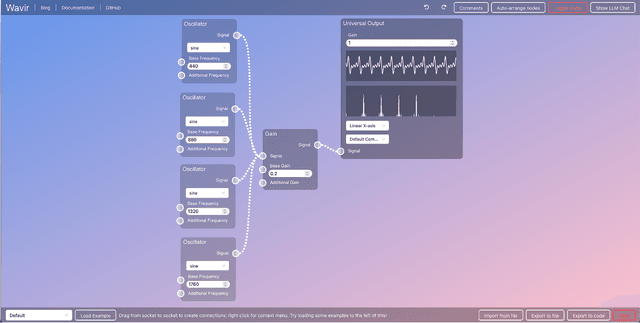
Node-based programming languages are increasingly popular in media arts coding domains. These languages are designed to be accessible to users with limited coding experience, allowing them to achieve creative output without an extensive programming background. Using LLM-based code generation to further lower the barrier to creative output is an exciting opportunity. However, the best strategy for code generation for visual node-based programming languages is still an open question. In particular, such languages have multiple levels of representation in text, each of which may be used for code generation. In this work, we explore the performance of LLM code generation in audio programming tasks in visual programming languages at multiple levels of representation. We explore code generation through metaprogramming code representations for these languages (i.e., coding the language using a different high-level text-based programming language), as well as through direct node generation with JSON. We evaluate code generated in this way for two visual languages for audio programming on a benchmark set of coding problems. We measure both correctness and complexity of the generated code. We find that metaprogramming results in more semantically correct generated code, given that the code is well-formed (i.e., is syntactically correct and runs). We also find that prompting for richer metaprogramming using randomness and loops led to more complex code.