 Add to Chrome
 Add to Firefox
 Add to Edge
STRIATUM-CTF: A Protocol-Driven Agentic Framework for General-Purpose CTF Solving
Mar 23, 2026
Large Language Models (LLMs) have demonstrated potential in code generation, yet they struggle with the multi-step, stateful reasoning required for offensive cybersecurity operations. Existing research often relies on static benchmarks that fail to capture the dynamic nature of real-world vulnerabilities. In this work, we introduce STRIATUM-CTF (A Search-based Test-time Reasoning Inference Agent for Tactical Utility Maximization in Cybersecurity), a modular agentic framework built upon the Model Context Protocol (MCP). By standardizing tool interfaces for system introspection, decompilation, and runtime debugging, STRIATUM-CTF enables the agent to maintain a coherent context window across extended exploit trajectories. We validate this approach not merely on synthetic datasets, but in a live competitive environment. Our system participated in a university-hosted Capture-the-Flag (CTF) competition in late 2025, where it operated autonomously to identify and exploit vulnerabilities in real-time. STRIATUM-CTF secured First Place, outperforming 21 human teams and demonstrating strong adaptability in a dynamic problem-solving setting. We analyze the agent's decision-making logs to show how MCP-based tool abstraction significantly reduces hallucination compared to naive prompting strategies. These results suggest that standardized context protocols are a critical path toward robust autonomous cyber-reasoning systems.

Surgical Visual Understanding (SurgVU) Dataset
Jan 16, 2025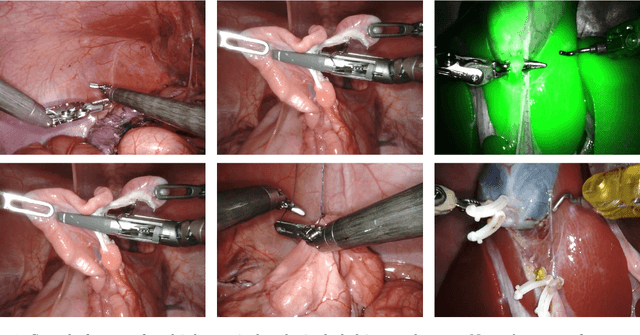
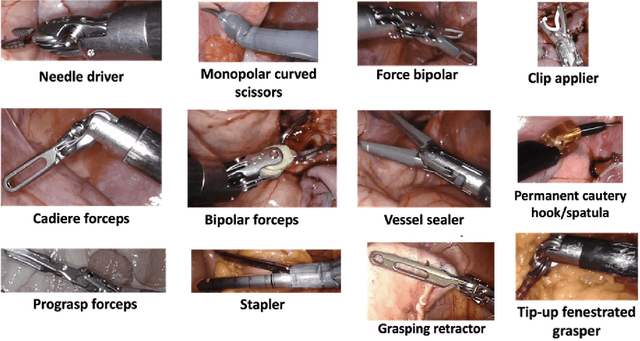


Owing to recent advances in machine learning and the ability to harvest large amounts of data during robotic-assisted surgeries, surgical data science is ripe for foundational work. We present a large dataset of surgical videos and their accompanying labels for this purpose. We describe how the data was collected and some of its unique attributes. Multiple example problems are outlined. Although the dataset was curated for a particular set of scientific challenges (in an accompanying paper), it is general enough to be used for a broad range machine learning questions. Our hope is that this dataset exposes the larger machine learning community to the challenging problems within surgical data science, and becomes a touchstone for future research. The videos are available at https://storage.googleapis.com/isi-surgvu/surgvu24_videos_only.zip, the labels at https://storage.googleapis.com/isi-surgvu/surgvu24_labels_updated_v2.zip, and a validation set for tool detection problem at https://storage.googleapis.com/isi-surgvu/cat1_test_set_public.zip.