 Add to Chrome
 Add to Firefox
 Add to Edge
YOPO-Nav: Visual Navigation using 3DGS Graphs from One-Pass Videos
Dec 10, 2025
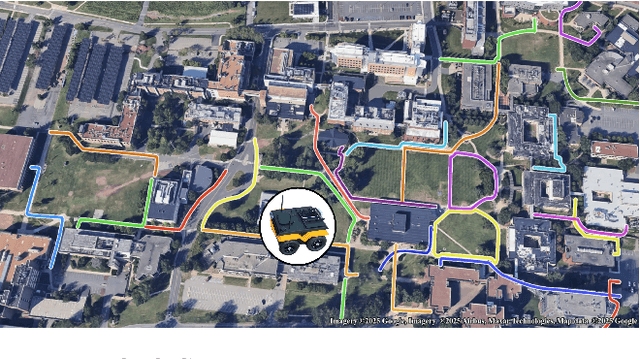
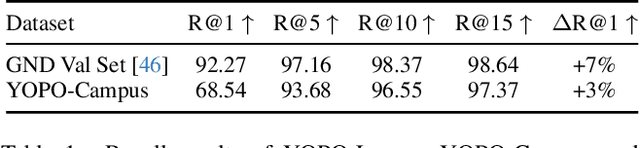
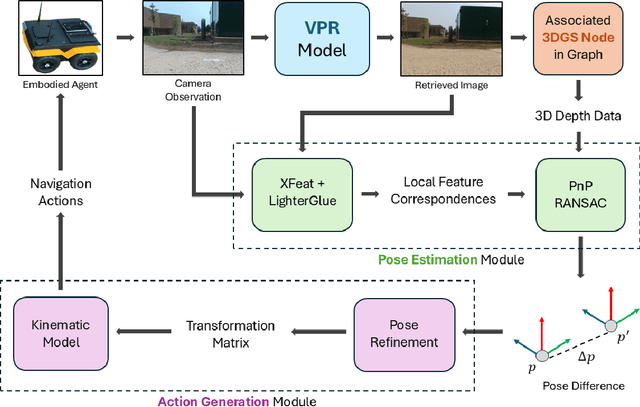
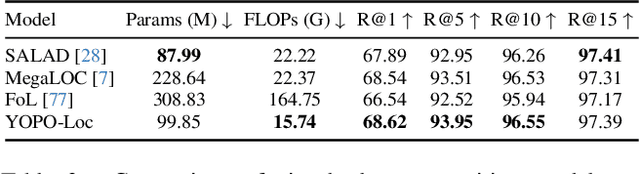
Visual navigation has emerged as a practical alternative to traditional robotic navigation pipelines that rely on detailed mapping and path planning. However, constructing and maintaining 3D maps is often computationally expensive and memory-intensive. We address the problem of visual navigation when exploration videos of a large environment are available. The videos serve as a visual reference, allowing a robot to retrace the explored trajectories without relying on metric maps. Our proposed method, YOPO-Nav (You Only Pass Once), encodes an environment into a compact spatial representation composed of interconnected local 3D Gaussian Splatting (3DGS) models. During navigation, the framework aligns the robot's current visual observation with this representation and predicts actions that guide it back toward the demonstrated trajectory. YOPO-Nav employs a hierarchical design: a visual place recognition (VPR) module provides coarse localization, while the local 3DGS models refine the goal and intermediate poses to generate control actions. To evaluate our approach, we introduce the YOPO-Campus dataset, comprising 4 hours of egocentric video and robot controller inputs from over 6 km of human-teleoperated robot trajectories. We benchmark recent visual navigation methods on trajectories from YOPO-Campus using a Clearpath Jackal robot. Experimental results show YOPO-Nav provides excellent performance in image-goal navigation for real-world scenes on a physical robot. The dataset and code will be made publicly available for visual navigation and scene representation research.

Agtech Framework for Cranberry-Ripening Analysis Using Vision Foundation Models
Dec 12, 2024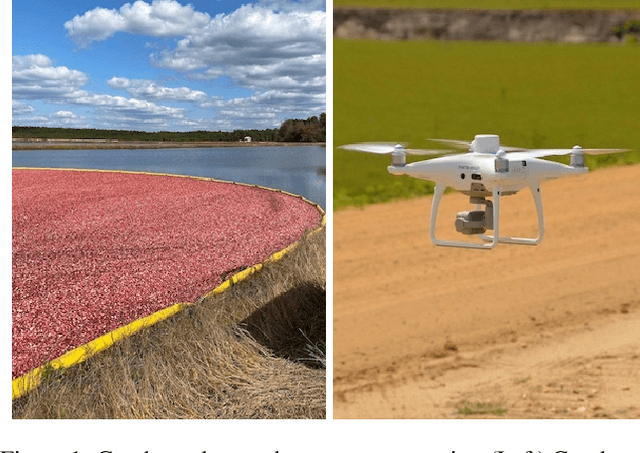
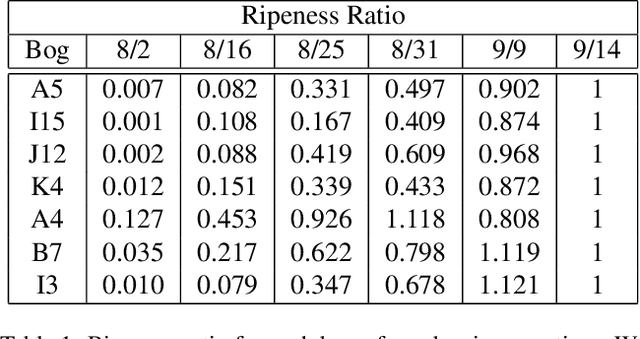
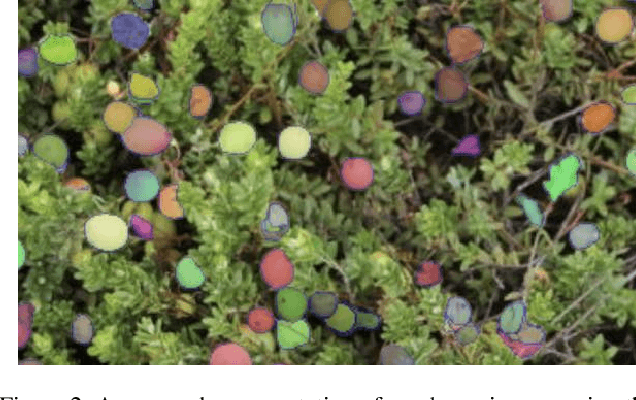
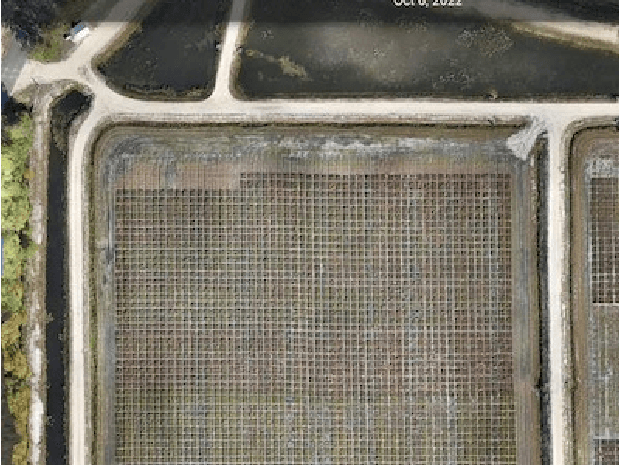
Agricultural domains are being transformed by recent advances in AI and computer vision that support quantitative visual evaluation. Using aerial and ground imaging over a time series, we develop a framework for characterizing the ripening process of cranberry crops, a crucial component for precision agriculture tasks such as comparing crop breeds (high-throughput phenotyping) and detecting disease. Using drone imaging, we capture images from 20 waypoints across multiple bogs, and using ground-based imaging (hand-held camera), we image same bog patch using fixed fiducial markers. Both imaging methods are repeated to gather a multi-week time series spanning the entire growing season. Aerial imaging provides multiple samples to compute a distribution of albedo values. Ground imaging enables tracking of individual berries for a detailed view of berry appearance changes. Using vision transformers (ViT) for feature detection after segmentation, we extract a high dimensional feature descriptor of berry appearance. Interpretability of appearance is critical for plant biologists and cranberry growers to support crop breeding decisions (e.g.\ comparison of berry varieties from breeding programs). For interpretability, we create a 2D manifold of cranberry appearance by using a UMAP dimensionality reduction on ViT features. This projection enables quantification of ripening paths and a useful metric of ripening rate. We demonstrate the comparison of four cranberry varieties based on our ripening assessments. This work is the first of its kind and has future impact for cranberries and for other crops including wine grapes, olives, blueberries, and maize. Aerial and ground datasets are made publicly available.