 Add to Chrome
 Add to Firefox
 Add to Edge
Lucky High Dynamic Range Smartphone Imaging
Apr 21, 2026
While the human eye can perceive an impressive twenty stops of dynamic range, smartphone camera sensors remain limited to about twelve stops despite decades of research. A variety of high dynamic range (HDR) image capture and processing techniques have been proposed, and, in practice, they can extend the dynamic range by 3-5 stops for handheld photography. This paper proposes an approach that robustly captures dynamic range using a handheld smartphone camera and lightweight networks suitable for running on mobile devices. Our method operates indirectly on linear raw pixels in bracketed exposures. Every pixel in the final HDR image is a convex combination of input pixels in the neighborhood, adjusted for exposure, and thus avoids hallucination artifacts typical of recent deep image synthesis networks. We validate our system on both synthetic imagery and unseen real bracketed images -- we confirm zero-shot generalization of the method to smartphone camera captures. Our iterative inference architecture is capable of processing an arbitrary number of bracketed input photos, and we show examples from capture stacks containing 3--9 images. Our training process relies only on synthetic captures yet generalizes to unseen real photos from several cameras. Moreover, we show that this training scheme improves other SOTA methods over their pretrained counterparts.

Edge-preserving Image Denoising via Multi-scale Adaptive Statistical Independence Testing
May 02, 2025Edge detection is crucial in image processing, but existing methods often produce overly detailed edge maps, affecting clarity. Fixed-window statistical testing faces issues like scale mismatch and computational redundancy. To address these, we propose a novel Multi-scale Adaptive Independence Testing-based Edge Detection and Denoising (EDD-MAIT), a Multi-scale Adaptive Statistical Testing-based edge detection and denoising method that integrates a channel attention mechanism with independence testing. A gradient-driven adaptive window strategy adjusts window sizes dynamically, improving detail preservation and noise suppression. EDD-MAIT achieves better robustness, accuracy, and efficiency, outperforming traditional and learning-based methods on BSDS500 and BIPED datasets, with improvements in F-score, MSE, PSNR, and reduced runtime. It also shows robustness against Gaussian noise, generating accurate and clean edge maps in noisy environments.
Neural Spline Fields for Burst Image Fusion and Layer Separation
Dec 21, 2023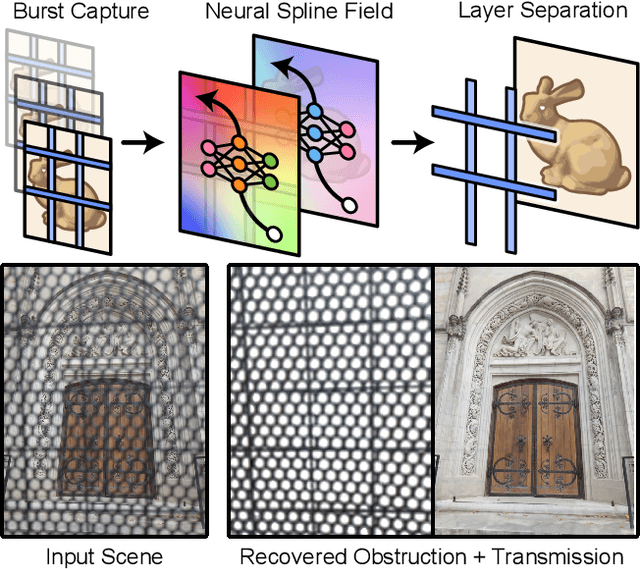


Each photo in an image burst can be considered a sample of a complex 3D scene: the product of parallax, diffuse and specular materials, scene motion, and illuminant variation. While decomposing all of these effects from a stack of misaligned images is a highly ill-conditioned task, the conventional align-and-merge burst pipeline takes the other extreme: blending them into a single image. In this work, we propose a versatile intermediate representation: a two-layer alpha-composited image plus flow model constructed with neural spline fields -- networks trained to map input coordinates to spline control points. Our method is able to, during test-time optimization, jointly fuse a burst image capture into one high-resolution reconstruction and decompose it into transmission and obstruction layers. Then, by discarding the obstruction layer, we can perform a range of tasks including seeing through occlusions, reflection suppression, and shadow removal. Validated on complex synthetic and in-the-wild captures we find that, with no post-processing steps or learned priors, our generalizable model is able to outperform existing dedicated single-image and multi-view obstruction removal approaches.
Ray Conditioning: Trading Photo-consistency for Photo-realism in Multi-view Image Generation
Apr 26, 2023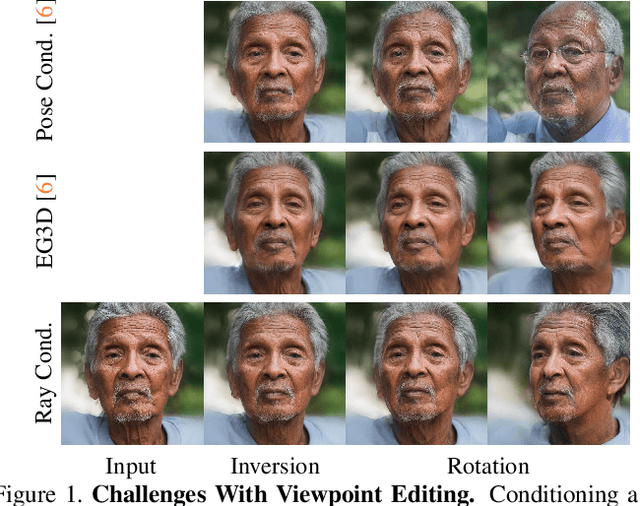
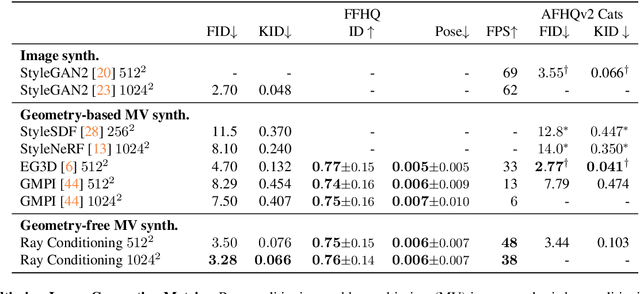
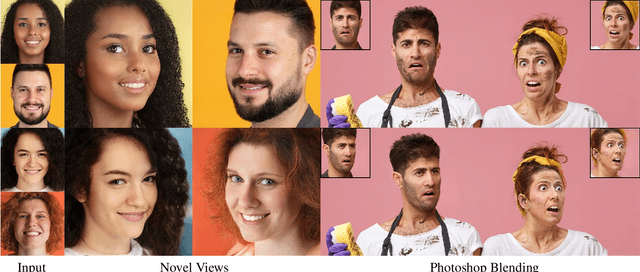
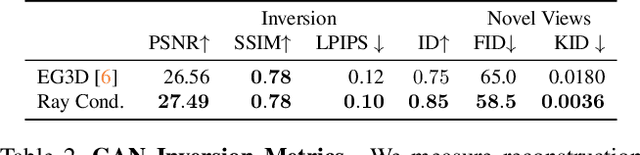
Multi-view image generation attracts particular attention these days due to its promising 3D-related applications, e.g., image viewpoint editing. Most existing methods follow a paradigm where a 3D representation is first synthesized, and then rendered into 2D images to ensure photo-consistency across viewpoints. However, such explicit bias for photo-consistency sacrifices photo-realism, causing geometry artifacts and loss of fine-scale details when these methods are applied to edit real images. To address this issue, we propose ray conditioning, a geometry-free alternative that relaxes the photo-consistency constraint. Our method generates multi-view images by conditioning a 2D GAN on a light field prior. With explicit viewpoint control, state-of-the-art photo-realism and identity consistency, our method is particularly suited for the viewpoint editing task.