 Add to Chrome
 Add to Firefox
 Add to Edge
Seamless Deception: Larger Language Models Are Better Knowledge Concealers
Mar 15, 2026
Language Models (LMs) may acquire harmful knowledge, and yet feign ignorance of these topics when under audit. Inspired by the recent discovery of deception-related behaviour patterns in LMs, we aim to train classifiers that detect when a LM is actively concealing knowledge. Initial findings on smaller models show that classifiers can detect concealment more reliably than human evaluators, with gradient-based concealment proving easier to identify than prompt-based methods. However, contrary to prior work, we find that the classifiers do not reliably generalize to unseen model architectures and topics of hidden knowledge. Most concerningly, the identifiable traces associated with concealment become fainter as the models increase in scale, with the classifiers achieving no better than random performance on any model exceeding 70 billion parameters. Our results expose a key limitation in black-box-only auditing of LMs and highlight the need to develop robust methods to detect models that are actively hiding the knowledge they contain.

JamPatoisNLI: A Jamaican Patois Natural Language Inference Dataset
Dec 07, 2022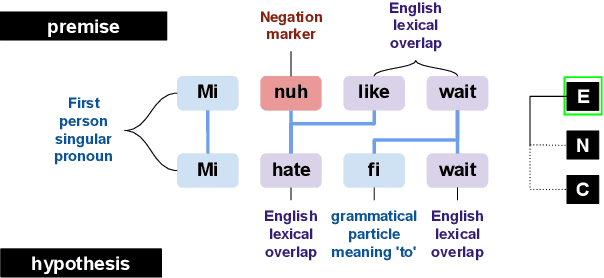
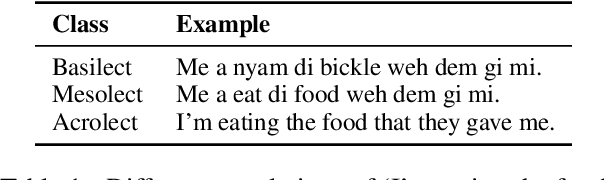
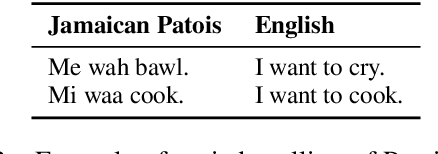
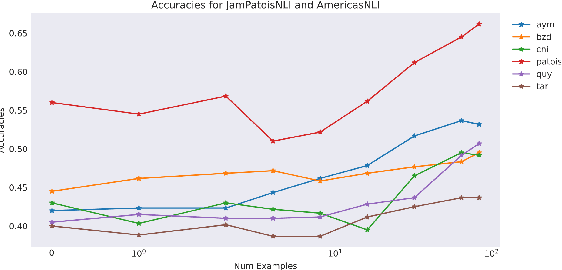
JamPatoisNLI provides the first dataset for natural language inference in a creole language, Jamaican Patois. Many of the most-spoken low-resource languages are creoles. These languages commonly have a lexicon derived from a major world language and a distinctive grammar reflecting the languages of the original speakers and the process of language birth by creolization. This gives them a distinctive place in exploring the effectiveness of transfer from large monolingual or multilingual pretrained models. While our work, along with previous work, shows that transfer from these models to low-resource languages that are unrelated to languages in their training set is not very effective, we would expect stronger results from transfer to creoles. Indeed, our experiments show considerably better results from few-shot learning of JamPatoisNLI than for such unrelated languages, and help us begin to understand how the unique relationship between creoles and their high-resource base languages affect cross-lingual transfer. JamPatoisNLI, which consists of naturally-occurring premises and expert-written hypotheses, is a step towards steering research into a traditionally underserved language and a useful benchmark for understanding cross-lingual NLP.