 Add to Chrome
 Add to Firefox
 Add to Edge
PersonalAI 2.0: Enhancing knowledge graph traversal/retrieval with planning mechanism for Personalized LLM Agents
May 13, 2026
We introduce PersonalAI 2.0 (PAI-2), a novel framework, designed to enhance large language model (LLM) based systems through integration of external knowledge graphs (KG). The proposed approach addresses key limitations of existing Graph Retrieval-Augmented Generation (GraphRAG) methods by incorporating a dynamic, multistage query processing pipeline. The central point of PAI-2 design is its ability to perform adaptive, iterative information search, guided by extracted entities, matched graph vertices and generated clue-queries. Conducted evaluation over six benchmarks (Natural Questions, TriviaQA, HotpotQA, 2WikiMultihopQA, MuSiQue and DiaASQ) demonstrates improvement in factual correctness of generating answers compared to analogues methods (LightRAG, RAPTOR, and HippoRAG 2). PAI-2 achieves 4% average gain by LLM-as-a-Judge across four benchmarks, reflecting its effectiveness in reducing hallucination rates and increasing precision. We show that use of graph traversal algorithms (e.g. BeamSearch, WaterCircles) gain superior results compared to standard flatten retriever on average 6%, while enabled search plan enhancement mechanism gain 18% boost compared to disabled one by LLM-as-a-Judge across six datasets. In addition, ablation study reveals that PAI-2 achieves the SOTA result on MINE-1 benchmark, achieving 89% information-retention score, using LLMs from 7-14B tiers. Collectively, these findings underscore the potential of PAI-2 to serve as a foundational model for next-generation personalized AI applications, requiring scalable, context-aware knowledge representation and reasoning capabilities.

MaxEntropy Pursuit Variational Inference
May 20, 2019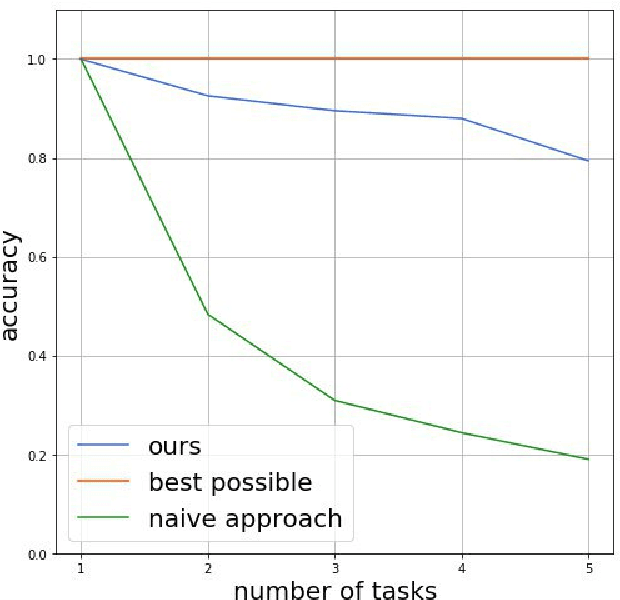
One of the core problems in variational inference is a choice of approximate posterior distribution. It is crucial to trade-off between efficient inference with simple families as mean-field models and accuracy of inference. We propose a variant of a greedy approximation of the posterior distribution with tractable base learners. Using Max-Entropy approach, we obtain a well-defined optimization problem. We demonstrate the ability of the method to capture complex multimodal posterior via continual learning setting for neural networks.
* 10 pages, 1 figure
Deep Neural Networks Predicting Oil Movement in a Development Unit
Jan 08, 2019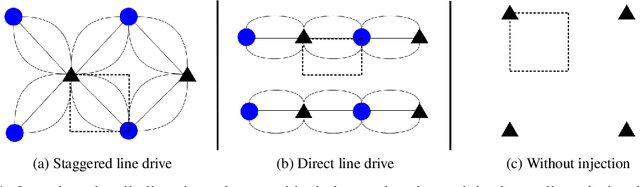
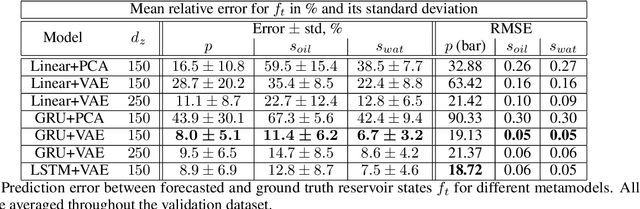
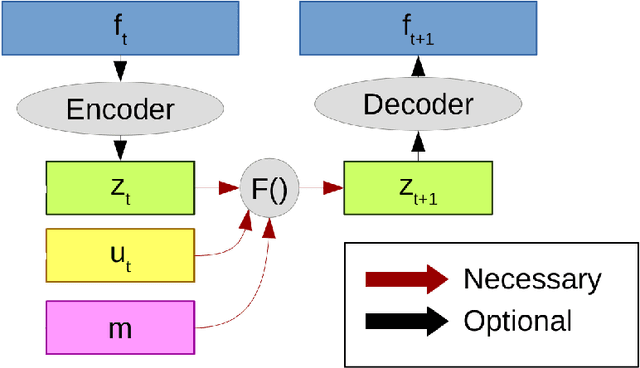
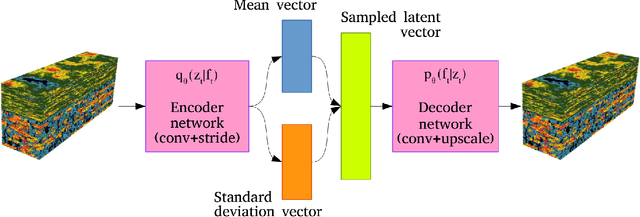
We present a novel technique for assessing the dynamics of multiphase fluid flow in the oil reservoir. We demonstrate an efficient workflow for handling the 3D reservoir simulation data in a way which is orders of magnitude faster than the conventional routine. The workflow (we call it "Metamodel") is based on a projection of the system dynamics into a latent variable space, using Variational Autoencoder model, where Recurrent Neural Network predicts the dynamics. We show that being trained on multiple results of the conventional reservoir modelling, the Metamodel does not compromise the accuracy of the reservoir dynamics reconstruction in a significant way. It allows forecasting not only the flow rates from the wells, but also the dynamics of pressure and fluid saturations within the reservoir. The results open a new perspective in the optimization of oilfield development as the scenario screening could be accelerated sufficiently.