 Add to Chrome
 Add to Firefox
 Add to Edge
Vision-Language Models for Deployable Social Robot Navigation: Bridging Semantic Reasoning and Low-Level Control
Jun 27, 2026
Social robot navigation (SRN) requires more than geometric path planning; it demands understanding human intentions, social norms, and contextual cues to generate socially compliant behaviors. Although classical navigation methods provide reliable metric planning and collision avoidance, they often lack the semantic reasoning capabilities necessary for operation in complex human-centered environments. Recent advances in Vision-Language Models (VLMs) have opened new opportunities for SRN by enabling high-level VLM understanding, commonsense reasoning, and natural language interaction. However, a fundamental challenge remains: how to integrate VLMs into real-time, safety-critical navigation systems and reliably translate their high-level reasoning into grounded navigation actions. In this survey, we present a unified perspective of VLM-based SRN and organize existing approaches into three interconnected components: high-level VLM reasoning, low-level planning and control, and intermediate mechanisms that bridge reasoning and action. Based on this perspective, we propose a structured roadmap for coupling VLMs with navigation systems, covering semantic reasoning, evaluators, spatial grounding, intermediate representations, and control modules. The roadmap highlights both the strengths of VLMs and the necessity of hybrid architectures for practical deployment. We further review representative datasets and evaluation platforms developed for SRN. Finally, we discuss key open challenges. This survey aims to provide a foundation for building reliable, socially compliant, and deployable VLM-enabled navigation systems.

Toward Dignity-Aware AI: Next-Generation Elderly Monitoring from Fall Detection to ADL
Nov 12, 2025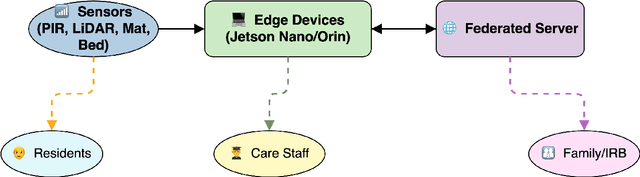
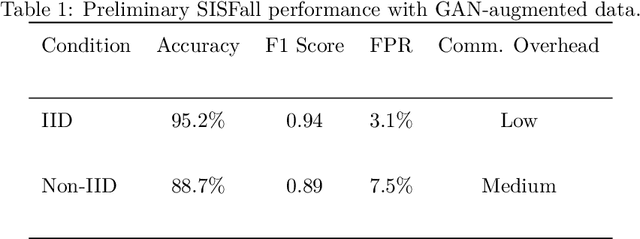


This position paper envisions a next-generation elderly monitoring system that moves beyond fall detection toward the broader goal of Activities of Daily Living (ADL) recognition. Our ultimate aim is to design privacy-preserving, edge-deployed, and federated AI systems that can robustly detect and understand daily routines, supporting independence and dignity in aging societies. At present, ADL-specific datasets are still under collection. As a preliminary step, we demonstrate feasibility through experiments using the SISFall dataset and its GAN-augmented variants, treating fall detection as a proxy task. We report initial results on federated learning with non-IID conditions, and embedded deployment on Jetson Orin Nano devices. We then outline open challenges such as domain shift, data scarcity, and privacy risks, and propose directions toward full ADL monitoring in smart-room environments. This work highlights the transition from single-task detection to comprehensive daily activity recognition, providing both early evidence and a roadmap for sustainable and human-centered elderly care AI.