 Add to Chrome
 Add to Firefox
 Add to Edge
Unlocking Latent Dimensions: Exploring Representations of Large-Scale X-ray Scattering Data using Variational Autoencoders
Jun 12, 2026
Scientific user facilities generate X-ray scattering data faster than traditional workflows can process them. We address this challenge across two settings, offline dataset exploration and live on-the-fly analysis. We train a domain-specific attention-based Convolutional Variational Autoencoder (C-VAE) on 1.5 million X-ray scattering images to learn low-dimensional representations capturing structural variation across diverse experimental conditions. The learned latent space reveals well-organized clusters and smooth trajectories reflecting experimental progression. It further supports controlled synthetic scattering image generation across diverse structural states. When deployed without retraining, the model organizes time-resolved film formation experiments at two synchrotron facilities into interpretable latent structures. Benchmarking against DINOv3 (ViT-7B), a general-purpose vision foundation model, demonstrates that domain-specific training yields more interpretable latent organization for scattering data. Both workflows are integrated within Latent Space Explorer, a component of the MLExchange platform, supporting interactive structural exploration across archived datasets and live experiments.

Structured Extraction of Process Structure Properties Relationships in Materials Science
Apr 04, 2025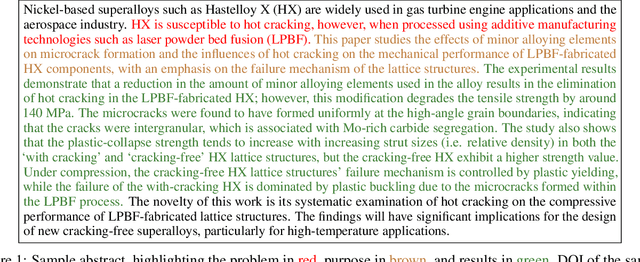
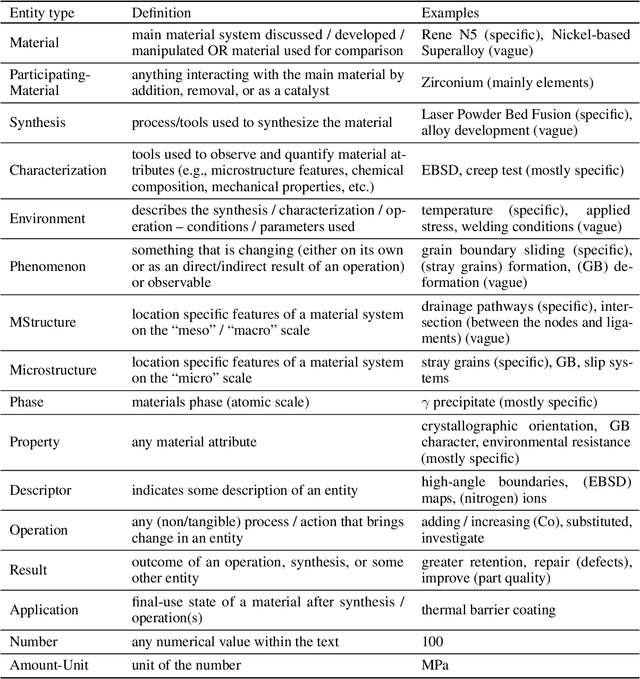
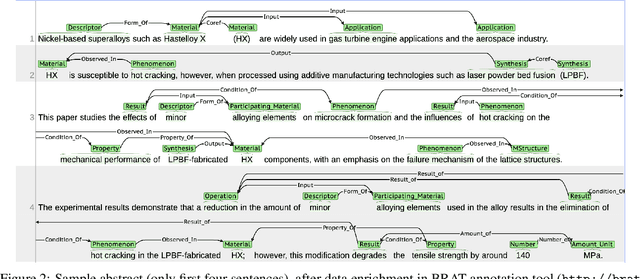
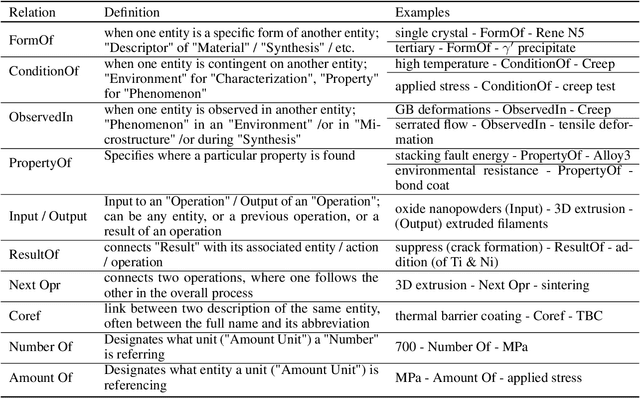
With the advent of large language models (LLMs), the vast unstructured text within millions of academic papers is increasingly accessible for materials discovery, although significant challenges remain. While LLMs offer promising few- and zero-shot learning capabilities, particularly valuable in the materials domain where expert annotations are scarce, general-purpose LLMs often fail to address key materials-specific queries without further adaptation. To bridge this gap, fine-tuning LLMs on human-labeled data is essential for effective structured knowledge extraction. In this study, we introduce a novel annotation schema designed to extract generic process-structure-properties relationships from scientific literature. We demonstrate the utility of this approach using a dataset of 128 abstracts, with annotations drawn from two distinct domains: high-temperature materials (Domain I) and uncertainty quantification in simulating materials microstructure (Domain II). Initially, we developed a conditional random field (CRF) model based on MatBERT, a domain-specific BERT variant, and evaluated its performance on Domain I. Subsequently, we compared this model with a fine-tuned LLM (GPT-4o from OpenAI) under identical conditions. Our results indicate that fine-tuning LLMs can significantly improve entity extraction performance over the BERT-CRF baseline on Domain I. However, when additional examples from Domain II were incorporated, the performance of the BERT-CRF model became comparable to that of the GPT-4o model. These findings underscore the potential of our schema for structured knowledge extraction and highlight the complementary strengths of both modeling approaches.