 Add to Chrome
 Add to Firefox
 Add to Edge
Unlocking Latent Dimensions: Exploring Representations of Large-Scale X-ray Scattering Data using Variational Autoencoders
Jun 12, 2026
Scientific user facilities generate X-ray scattering data faster than traditional workflows can process them. We address this challenge across two settings, offline dataset exploration and live on-the-fly analysis. We train a domain-specific attention-based Convolutional Variational Autoencoder (C-VAE) on 1.5 million X-ray scattering images to learn low-dimensional representations capturing structural variation across diverse experimental conditions. The learned latent space reveals well-organized clusters and smooth trajectories reflecting experimental progression. It further supports controlled synthetic scattering image generation across diverse structural states. When deployed without retraining, the model organizes time-resolved film formation experiments at two synchrotron facilities into interpretable latent structures. Benchmarking against DINOv3 (ViT-7B), a general-purpose vision foundation model, demonstrates that domain-specific training yields more interpretable latent organization for scattering data. Both workflows are integrated within Latent Space Explorer, a component of the MLExchange platform, supporting interactive structural exploration across archived datasets and live experiments.

Probabilistic Conformal Coverage Guarantees in Small-Data Settings
Sep 18, 2025Conformal prediction provides distribution-free prediction sets with guaranteed marginal coverage. However, in split conformal prediction this guarantee is training-conditional only in expectation: across many calibration draws, the average coverage equals the nominal level, but the realized coverage for a single calibration set may vary substantially. This variance undermines effective risk control in practical applications. Here we introduce the Small Sample Beta Correction (SSBC), a plug-and-play adjustment to the conformal significance level that leverages the exact finite-sample distribution of conformal coverage to provide probabilistic guarantees, ensuring that with user-defined probability over the calibration draw, the deployed predictor achieves at least the desired coverage.
Behind the Noise: Conformal Quantile Regression Reveals Emergent Representations
May 13, 2025Scientific imaging often involves long acquisition times to obtain high-quality data, especially when probing complex, heterogeneous systems. However, reducing acquisition time to increase throughput inevitably introduces significant noise into the measurements. We present a machine learning approach that not only denoises low-quality measurements with calibrated uncertainty bounds, but also reveals emergent structure in the latent space. By using ensembles of lightweight, randomly structured neural networks trained via conformal quantile regression, our method performs reliable denoising while uncovering interpretable spatial and chemical features -- without requiring labels or segmentation. Unlike conventional approaches focused solely on image restoration, our framework leverages the denoising process itself to drive the emergence of meaningful representations. We validate the approach on real-world geobiochemical imaging data, showing how it supports confident interpretation and guides experimental design under resource constraints.
DLSIA: Deep Learning for Scientific Image Analysis
Aug 02, 2023


We introduce DLSIA (Deep Learning for Scientific Image Analysis), a Python-based machine learning library that empowers scientists and researchers across diverse scientific domains with a range of customizable convolutional neural network (CNN) architectures for a wide variety of tasks in image analysis to be used in downstream data processing, or for experiment-in-the-loop computing scenarios. DLSIA features easy-to-use architectures such as autoencoders, tunable U-Nets, and parameter-lean mixed-scale dense networks (MSDNets). Additionally, we introduce sparse mixed-scale networks (SMSNets), generated using random graphs and sparse connections. As experimental data continues to grow in scale and complexity, DLSIA provides accessible CNN construction and abstracts CNN complexities, allowing scientists to tailor their machine learning approaches, accelerate discoveries, foster interdisciplinary collaboration, and advance research in scientific image analysis.
MLExchange: A web-based platform enabling exchangeable machine learning workflows
Aug 23, 2022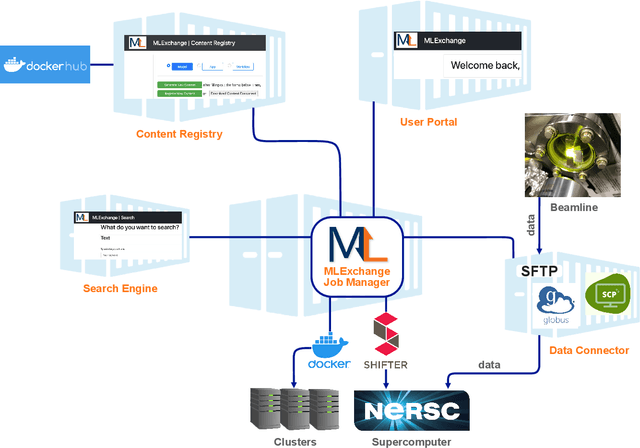
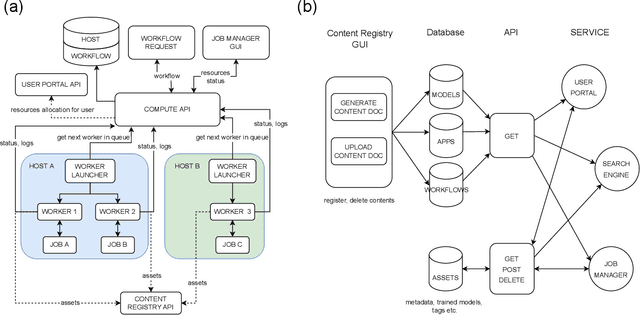
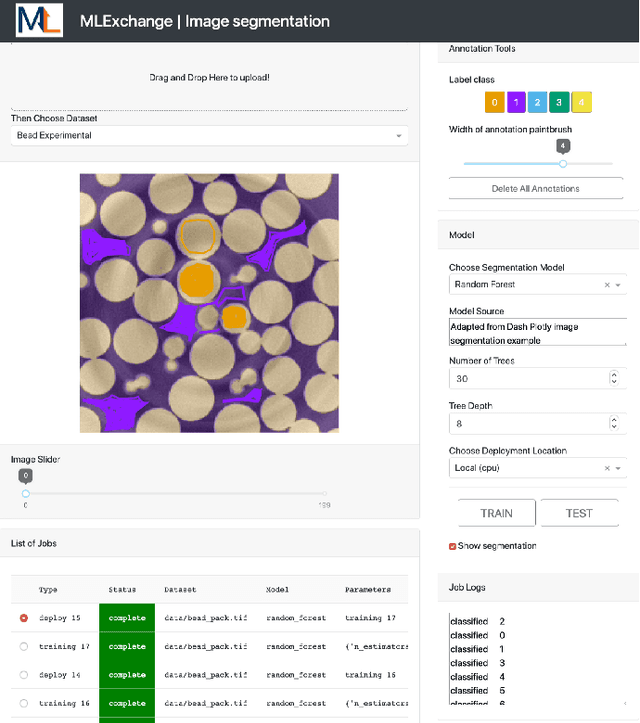
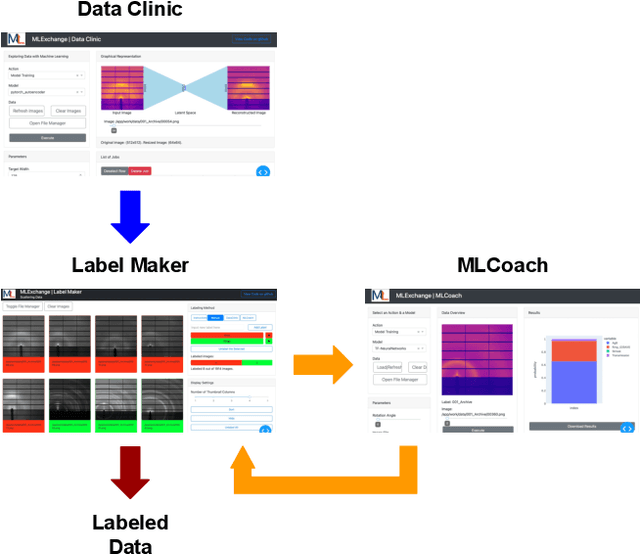
Machine learning (ML) algorithms are showing a growing trend in helping the scientific communities across different disciplines and institutions to address large and diverse data problems. However, many available ML tools are programmatically demanding and computationally costly. The MLExchange project aims to build a collaborative platform equipped with enabling tools that allow scientists and facility users who do not have a profound ML background to use ML and computational resources in scientific discovery. At the high level, we are targeting a full user experience where managing and exchanging ML algorithms, workflows, and data are readily available through web applications. So far, we have built four major components, i.e, the central job manager, the centralized content registry, user portal, and search engine, and successfully deployed these components on a testing server. Since each component is an independent container, the whole platform or its individual service(s) can be easily deployed at servers of different scales, ranging from a laptop (usually a single user) to high performance clusters (HPC) accessed (simultaneously) by many users. Thus, MLExchange renders flexible using scenarios -- users could either access the services and resources from a remote server or run the whole platform or its individual service(s) within their local network.