 Add to Chrome
 Add to Firefox
 Add to Edge
PPSEBM: An Energy-Based Model with Progressive Parameter Selection for Continual Learning
Dec 17, 2025
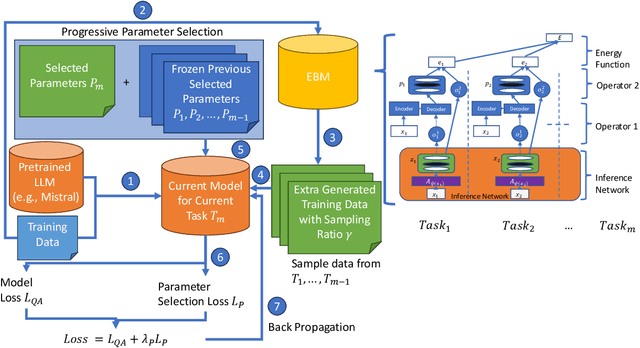
Continual learning remains a fundamental challenge in machine learning, requiring models to learn from a stream of tasks without forgetting previously acquired knowledge. A major obstacle in this setting is catastrophic forgetting, where performance on earlier tasks degrades as new tasks are learned. In this paper, we introduce PPSEBM, a novel framework that integrates an Energy-Based Model (EBM) with Progressive Parameter Selection (PPS) to effectively address catastrophic forgetting in continual learning for natural language processing tasks. In PPSEBM, progressive parameter selection allocates distinct, task-specific parameters for each new task, while the EBM generates representative pseudo-samples from prior tasks. These generated samples actively inform and guide the parameter selection process, enhancing the model's ability to retain past knowledge while adapting to new tasks. Experimental results on diverse NLP benchmarks demonstrate that PPSEBM outperforms state-of-the-art continual learning methods, offering a promising and robust solution to mitigate catastrophic forgetting.

LSEBMCL: A Latent Space Energy-Based Model for Continual Learning
Jan 09, 2025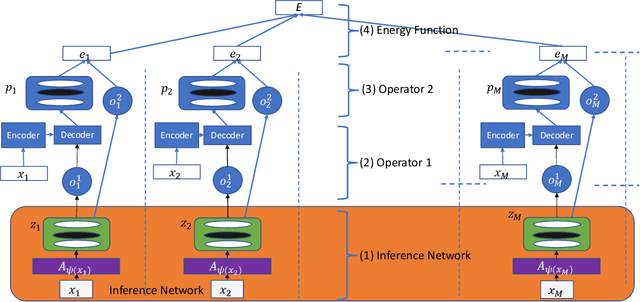
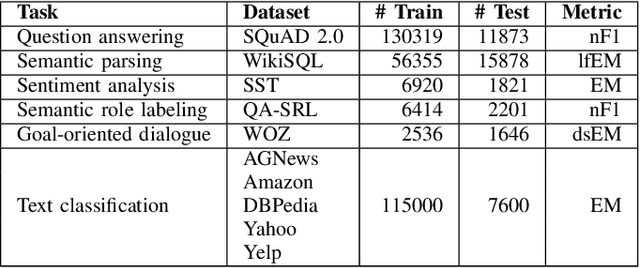
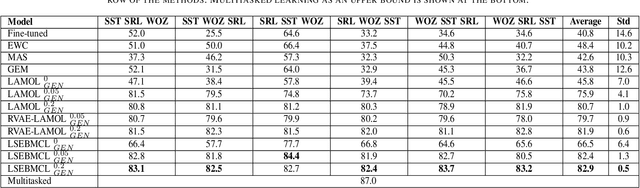

Continual learning has become essential in many practical applications such as online news summaries and product classification. The primary challenge is known as catastrophic forgetting, a phenomenon where a model inadvertently discards previously learned knowledge when it is trained on new tasks. Existing solutions involve storing exemplars from previous classes, regularizing parameters during the fine-tuning process, or assigning different model parameters to each task. The proposed solution LSEBMCL (Latent Space Energy-Based Model for Continual Learning) in this work is to use energy-based models (EBMs) to prevent catastrophic forgetting by sampling data points from previous tasks when training on new ones. The EBM is a machine learning model that associates an energy value with each input data point. The proposed method uses an EBM layer as an outer-generator in the continual learning framework for NLP tasks. The study demonstrates the efficacy of EBM in NLP tasks, achieving state-of-the-art results in all experiments.